At todays VMworld Keynote VMware Integrated OpenStack version 3.0 is going to be announced. If you are like me and haven’t had a chance to learn about the VIO offering as a whole then let me give a basic overview and then what new capabilities and features are coming in the 3.0 release.
What is VMware Integrated OpenStack (VIO) ?
VIO is an “Integrated Product” Approach to OpenStack
Standard OpenStack Distribution (delivered as OVA)
Deploys & Manages Proven Production Architecture on VMware SDDC
Fully Supported by VMware
The features that have been released prior to the this release and the ones in this release are:
VIO 1.0 (Q1 2015)
Icehouse Based
VMware Platform Differentiation
Production Ready
Simplified Deploy
Day 2 Operation Workflows
Automated Patching
Fully Supported
VIO 2.0 (Q3 2015)
Kilo Based
Seamless / Automated Upgrade & Rollback
Backup & Recovery
Customisations
VIO 2.5 (Q2 2016)
Kilo Based
Compact Architecture
VM Template Import
Scale, Perf & Stability Improvements
Simplified Monitoring & Troubleshooting
NFV Features
VIO 3.0 (H2 2016)
Mitaka Based
Compact VIO
Import existing vSphere workloads
VIO 3.0 Mitaka OpenStack Release
Latest OpenStack Release
Tons of improvements
Improved day-to-day experience for cloud admins and administrators.
Simplified configuration for Nova compute service.
Streamlined Keystone identity service is now a one-step process for setting up the identity management features of a cloud network.
Keystone now supports multi-backend allowing local authentication and AD accounts simultaneously.
Heat’s convergence engine optimized to handle larger loads and more complex actions for horizontal scaling for improved performance for stateless mode.
Enhanced OpenStack Client provides a consistent set of calls for creating resources no longer requiring the need to learn the intricacies of each service API.
Support for software development kits (SDKs) in various languages.
New “give me a network,” feature capable of creating a network, attaching a server to it, assigning an IP to that server, and making the network accessible, in a single action
VIO 3.0: Slimmer Full HA Architecture
VIO 3.0: Compact Mode
VIO 3.0: Import vSphere Workloads
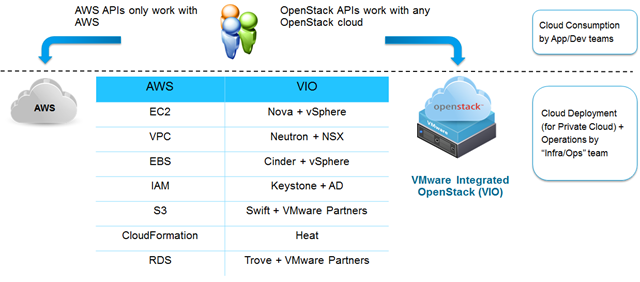
VIO delivers AWS Productivity with Private Cloud Control
If you want to learn more about VIO then make sure you attend the VMware booth in the solutions exchange at VMworld US if you are attending the conference or speak to your TAM/VMware Sales representative for a demo or PoC.
As is customary, VMworld US starts on Sunday with the Partner Exchange events as well as an opportunity for people to register and receive their VMworld badge, bag and initial swag.
This year I am attending as part of the vBrownbag crew and so Sunday is a big day for us as we run Opening Acts with the VMUnderground crew. This year we have also included the vBrisket crew for a nice BBQ (Braai) for lunch. The panels were very well attended and there was really good audience participation. You can watch all of the Opening Acts on the vBrownbag YouTube channel.
vBrisket was amazing with some seriously nice food where I got to chat to a number of people I only know from the twitterverse and talk some VCDX with Rebecca Fitzhugh, Mike Burkhart and Brett Guarino after thier recent VCDX attempts (NDA retaining)
I then attended the VMworld Solutions Exchange for the Welcome party sponsored by Accenture and had an amazing preview of the work VMware can do with Business Critical Apps by Niran Chen. Make sure you go by and see the demo near the VMware booth. We also had a nerdy #beVCDX picture showing 7 VCDX among the 5 of us (seeing as Niran and Augustin are double VCDX’s). I the picture is @NiranEC@sammcgeown@amalanco@iam_andysmith and I.
The VMunderground party was hosted at the nine fine irishmen bar in the NYNY casino and as per usual it was the best best party for Sunday evening (sorry VMUG I am making assumptions here)
I ended the day not too late due to some jetlag and also needing to be spritely for the VMVillage where the vBrownbag Techtalks are being run where we live stream them as well as record them for uploading to the vBrownbag YouTube channel.
Current Employer: Bank Of Tokyo Mitsubishi UFJ LTD
VCDX #: 225
How did you get into using VMware?
I started back in 2009 when my previous employer started a large datacentre consolidation project. I quickly did my VCP to ensure I was the main resource on the project.
What made you decide to do the VCDX?
I really wanted to further my knowledge after doing the VCAPs. What I liked about the VCDX program is it makes you stronger in so many different technology areas.
How long did it take you to complete the whole VCDX journey?
About 13 months once I had passed the VCAP’s.
What advice would you give to people thinking of pursuing the VCDX accreditation?
Try and enjoy the whole experience, especially the defence. When you stand in front of that panel it is an amazing feeling thinking about where you were when you started the journey and where you are now.
We always find excuses not to do things, for instance, my current employer has strict polices preventing us from emailing stuff out of the bank which meant I had to recreate all of the design documentation at home as well as fund the entire process myself, but this was important so I did not let any of that get in the way.
If your excuse is “you’re too busy” consider this… my mentor has three children all under the age of 6 but still woke up at 5am twice a week (due to the time difference) once my defence was accepted to help get me ready. He did all this while working on his own second VCDX certification and working full-time for VMware… If he found the time we all can 🙂
If you could do the whole VCDX journey again what would you do differently?
For someone not from a consulting background I should’ve practiced the design scenarios a little earlier on in the process.
Life after the VCDX? How did your company respond? Was it worth it?
This has been one of the best experiences in my career and I am really grateful to the VCDX program and community. After a short break I am very much looking forward to completing the VCDX-NV track and helping others achieve their numbers.
The company I was employed with in 2007/2008 wanted to implement ESXi. We only had two four node clusters with shared storage. That company sent me to the vSphere 3.5 ICM class. My instructor in that class John Krueger was so passionate about the technology that it rubbed off on me.
What made you decide to do the VCDX?
My current director pushes his staff to stay current with advanced certificates. After I passed my DCA & DCD it seemed like a natural progression. I also enjoy the challenge of something like this.
How long did it take you to complete the whole VCDX journey?
I wrote my first outline for my design in April 2015, so about 15 months total. This includes my three defences, I failed the first two.
What advice would you give to people thinking of pursuing the VCDX accreditation?
Read the blueprint, find a mentor, find a study group and read the blueprint. This journey can be accomplished alone depending on your knowledge and job roles, but with an ever growing community why risk it? Be prepared to sacrifice a fair amount of your personal time. I wrote the bulk of my design during the summer, and was unable to attend many things. Also, make sure your family is prepared to support you. My kids didn’t really understand why I had to disappear into my office for 2 hours at random points during the day for mocks with my study group.
If you could do the whole VCDX journey again what would you do differently?
I probably wouldn’t have submitted for the October 2015 defences. I was very unprepared. Also increasing my T-Skills, I was a bit short on storage and that showed very much in my first defence.
Life after the VCDX? How did your company respond? Was it worth it?
It’s feels amazing to get this weight off my shoulders after 15 months. I honestly did not realize how much it stressed me out until it was over. My company was extremely supportive of the whole process and was excited for my success. I would say yes, it was worth it. I learned more about the entire infrastructure stack than I ever thought. In addition, I’ve made some good friends via study groups.
Yet again I am honoured to have been given a bloggers pass to VMworld US due to my vExpert work but more importantly the vBrownbag TechTalks and opening acts that the vBrownbag crew will be running in the hang space.
VMworld is always an exciting conference to go to and if you haven’t yet booked your place then let me list some of the reasons I think you should attend as they are the reasons I try to attend every year.
On the Sunday of VMworld is Partner Exchange and TAM day where VMware partners can attend exclusive sessions talking about everything from future roadmaps for all of VMware product lines but also new solutions VMware are looking to release. The sessions are always extremely interesting and from my experience are the best chance to speak to the “rockstars” who evangelise and breath the various solutions. If you aren’t a partner or are looking for something less formal than PEX then the vBrownbag crew along with the vBrisket and VMUnderground crew are running opening acts with vBrisket for lunch and VMUnderground party at the end of the day. Opening acts has gained popularity with each year and the level of panels as well as those attending has also kept on increasing. The schedule for the day is:
My second reason for attending is networking. I know it should be sessions or HOL but the ability to network with like-minded people and make relationships with people doing cutting edge work with the latest technologies has proved so beneficial to me in the past. The ability to network can be done in several places and at several parties but the best place IMO has to be the hangspace where you can sit at the bloggers table or speak to the VMware communities team as well as (and most importantly) listen and watch the vBrownbag TechTalks. If you have never heard of the TechTalks then a brief overview is below:
Tech Talks originated at VMworld 2012 where they provided an opportunity for community members, whose presentation submissions were not accepted into the main catalogue, to present the core of a topic. #TechTalks are a ten minute presentation by a community member for the benefit of the community. Since almost everyone working in technology has solved problems and learned something almost everyone could present a #TechTalk. The format can be a slide deck or simply talking, they are usually about how to solve a problem or get the most out of a product. The TechTalk is captured on video and published on the vBrownBag YouTube channel.
If the conference Internet connection allows, the talk is also live streamed from the show.
#TechTalks are for community members to reach other community members, any topic that will help other people is good. The one thing that TechTalks are not is an opportunity to present the corporate slide deck about a great product you would like us to buy. #TechTalks are about up skilling and education, the only marketing should be from the TechTalk sponsors who help make the whole thing happen.
Anyone can watch the TechTalks and there are almost always a crowd of the biggest names in the industry,VCDX, vExperts and top 50 vBloggers either watching the TechTalks, Chatting amongst themselves nearby or writing up blogs and uploading videos to their blogs from the bloggers table. The community is very welcoming so please do come say hi and I promise if i am there I’ll try not be grumpy 🙂
Next are the sessions. The VMworld Schedule Builder opened yesterday and within 3 hours a whole bunch were fully booked just to show the sheer interest of people to listen to some of the biggest names talking about the biggest technologies such as Duncan Epping of Yellow-Bricks.com fame talking about “A day in the life of a VSAN IO”. The sessions are always engaging and cover technical depth from beginners all the way to veterans so there is always something to learn. the sessions are also recorded so if you can’t make it to a sessions due to a conflict then by registering for VMworld you get access to all the recorded sessions after the conference for you to watch in your own time.
Next reason are the hands on labs. the labs cover all technologies and not just from VMware but also partners including the EMC Federation. The labs allow you a brilliant way of working your way through using the latest solutions and technologies so if your boss is wondering what NSX is and if it will fit your companies requirements you can do several labs on it and then can not only help your company understand it’s benefits having gone to sessions around NSX but also know how to do tasks inside NSX due to the labs.
Next is the solutions exchange which is firstly an amazing place to talk to all the top vendors and companies working within the virtualisation arena and secondly to maybe even win yourself a few prizes from the plethora of competitions all the stands are running constantly. I personally love walking around the solutions exchange after grabbing some food so that you can listen to all the vendors explain why their solution is the best fit for you and get in some much-needed sustenance as you will be walking A LOT at the conference.
Lastly are the parties, these are normally amazing and seeing as the conference is in Las Vegas the locations are likely to be unbelievable. The parties vary in craziness so you can attend mellow drinks or full or parties in clubs it is entirely up to you. Apart from the VMUnderground party the Welcome Reception kicks off the conference experience with food, drinks, and networking in the Solutions Exchange. The always energetic Welcome Reception is a great way to reconnect with old friends, network, share ideas, and get to know our inviting community of VMware customers, experts, and partners. The parties have only just started getting announced but you can see which ones have been announced on Hans’ blog here. The VMworld party finishes off the conference on Wednesday night and is hosted at the legendary Las Vegas Motor Speedway and the band has been announced and despite what some old farts say about the band selected I can’t wait to listen to Fall Out Boy!!
Hopefully i will see you at the conference and as I stated do come by the hang space and say hello, I will be wearing a vBrownbag shirt with my name and twitter handle on so I should be easy to locate and identify.
Do you want to attend VMworld® 2016 US in Las Vegas this year, but your company won’t pay for the conference passes? Try your luck and win two full conference passes to VMworld® on VMTurbo®.
Evaluate logical performance considerations for a given vRealize Automation solution.
Performance considerations will be the number of virtual machines the solution has to provide sufficient resources for as well as future growth (20% growth over the next 3 years) . This is very much like vSphere sizing but now with the speed with which solutions can be created, modified and deleted especially if you are doing CDCI you need to also prepare for the number of continuous deployments and workflows at once. For example a DEM worker can only process 15 concurrent workflows at a time so if you are likely to be doing 60 workflows simultaneously due to the lifecycle of your machines then you are going to need at least four DEM workers to be deployed to handle this.
Performance also entails using mechanisms such as Storage DRS to automatically load balance provisioned workloads as they are requested, DRS to load balance the workloads across the hosts in the solution and performance of the vRA management components by isolating them in a management cluster, ensuring they are load balanced so one side isn’t always hit and the other is doing nothing. They don’t mention it in the tools but for this section and the exam as a whole I would recommend reading the latest vCAT documentation as well as the vRA 6.2 Reference Architecture document .
Differentiate infrastructure qualities related to performance.
Just like I have mentioned for the availability and management sections, the infrastructure quality for performance will need to be applied to certain requirements and designs decisions in the exam via drag and drop questions (I have done the exam so I am basing this on experience) . The performance infrastructure quality is defined as:
Indicates the effect of a design choice on the performance of the environment. This does not necessarily reflect the impact on other technologies within the infrastructure.
Key metrics:
Response time
Throughput
Analyze the current performance of an environment and address gaps when building a logical design.
So this is down to you deploying the vRA solution in an existing environment where there are workloads running and you need to analyse the performance of the environment to ascertain if the environment meets the performance requirements or if additional resources/another environment is required for the solution to work.
There are a number of methods to do this:
Get a VMware partner or VMware to run an analysis via VMware Capacity Planner to work out what your current environment is doing.
Use vRealize Operations Manager to give you a current state analysis as well as use historical data to work out trends and if there are month end increases in performance requirements or seasonal increases depending on the company’s business.
vSphere performance charts can also give you a not bad idea of what is happening if the above two aren’t possible as well as 3rd party tools.
Use a conceptual design to create a logical design that meets performance requirements.
In the conceptual design you will have defined and signed off the requirements. In these requirements there should be a number of them that apply to the performance infrastructure quality for example “The solution must be able to support the provisioning of 500 workloads a day” and “the solution must be able to service 5000 workloads with a 20% increase year on year for the next five years”
You will also have requirements where due to BC/DR requirements you will need spare capacity in the event of a failure so for example “The production workloads in Site A which makes up 20% of the 5000 workloads need to run on the secondary site in the event of a planned or emergency failover” .
Determine performance-related functional requirements based on given non-functional requirements and service dependencies.
Non-functional requirements are normally constraints imposed by the customer so for example the customer has defined you have to use existing networking in the datacentres and these are only 1GB switches which will severely impact what is possible from the solution. So if we keep to my example then having a service dependency that needs to talk to a physical SQL server where large amounts of data is transferred between the services to the database a single 1 GB link won’t be sufficient so either the service will have to be scaled down or the SQL database created as part of the service to allow inter virtual switch connectivity thereby allowing higher network throughputs.
Define capacity management practices and create a capacity plan.
Incorporate scalability requirements into the logical design.
This has been covered above already but what they are looking for is for you to design for future growth of the environment as the number of workloads increases and/or the amount of workload requests increases. The vRealize Automation reference architecture document also gives great coverage of scalability
Determine a performance component for service level agreements and service level management processes.
I covered this in the availability section where you have done a business impact analysis and worked out what theirs RPO and RTO values are. Part of availability also ties into performance as if the solution is running so slowly that users can’t use it then the service is essentially down and SLA’s are possibly not being met.
Evaluate which management services can be used with a given vRealize Automation Solution.
Management of vRealize Automation is achieved via various methods and solutions. You have management of the underlying vSphere infrastructure via the vSphere client and web client, management and monitoring of both vSphere and vRA via vRealize Operations with management packs for vRA, logging via vRealize LogInsight, change management via third part CMDB tools as well as VMware tools such as vRealize Configuration Manager and Hyperic.
There is also the standard vRA management via the vRA portal and the VAMI portals for management of the vRealize Appliances. I haven’t done the exam but based on previous exam experience I would make sure you know what tabs and options there are for all the vRA VAMI portals.
Differentiate infrastructure qualities related to management.
I partly covered this in the previous 2.3 posting, what they are likely to do from previous experience ( I have not done the exam nor the beta) is to give you a whole bunch of infrastructure qualities and you have to match them up. Manageability is all about ease of management and having the most optimal amount of manageability without impacting other infrastructure qualities or any of the requirements.
Build interfaces into the logical design for existing operations practices.
My take on what they are looking for here is that the customer you are doing the design for has existing operations practices and solutions and you need to take these into account and then design the solution to meet these. So for example if the customer has a CMDB and every time a machine is requested, built, edited and destroyed CI’s need to be passed to the CMDB to track these changes. Another example is syslogging and setting up syslog’s to go to a customer existing logging solution. Reading through the reference architecture and getting an understanding of what kinds of external solutions and services you might need to plug in to is great prep for this. Also adding the vRA management to AD,NTP,SNMP and DNS is very applicable and is required for all deployments (maybe not SNMP for every one)
Address operational readiness deficiencies.
This is where either the customers IT team who are going to look after the solution when you leave aren’t skilled up enough or they don’t have anyone to manage it at all (I’ve seen both in my experience). To fix this knowledge transfer workshops are required, or to link to the manageability infrastructure quality you simplify management as much as possible and try use their existing management mechanisms if they fit so allow easier management of the solution building on existing knowledge. You can also put it as a constraint the lack of existing knowledge to manage the solution and the risk mitigation is training of the team via formal training or learning from yourself and/or the person deploying the solution. You should also read the recommended Operational Readiness Assessment document from VMware.
Define Event, Incident and Problem Management practices.
These are where the logging of the solution and the management of the solution by tools such as vROps, LogInsight, vSphere alarms and event management via 3rd party tools such as Arcsight. The use of LogInsight and vROps is a great combination as they integrate brilliantly together and with the use of the management packs for vRA and LogInsight give amazing manageability of events, incident and problems with intelligent alarms. These can also be tracked by tools such as Service Now which is a fairly popular option for large enterprises in my experience and VMware have even written blogs about the integration http://blogs.vmware.com/management/2015/01/integrating-vrealize-automation-servicenow.html
Design a log management solution.
As mentioned above log management can be done via VMware solutions or 3rd part solutions. LogInsight is most likely the one they are going to reference in the exam seeing as it is VMware’s solution and you can get a vRA management pack for it to allow it to alert on vRA specific alerts https://solutionexchange.vmware.com/store/products/vra-6-1-log-insight-content-pack .
Determine request fulfilment and release management processes.
Request fulfilment I am taking as the fulfilment of all the required parameters to provision as service from the vRA catalogue. You would do this via the service design that you have done for each service where you have defined what parameters need to be fed in and that incorrect values aren’t inserted to ensure service requests are successful. In regards to ASD this is where you make sure the request form is using optimal selection boxes to make sure letters aren’t used where only number should be inserted and drop down lists are used so that only applicable options can be selected.
Release management would also be done in the service design document although it might be the same across all the service offerings or might differ per service offering based on the lifecycles. This would be the definition of when new blueprints are published, where they are published, who they are published to and version control.
Define change management processes based on business requirements.
Change management can be done via logging to ensure if any changes are made they are tracked, this can also be done via the Service Now method I mentioned earlier as well as change management via vRealize Configuration Manager. During design workshops you should ascertain what change management processes they need to follow and then make sure those are met via usage of API’s to the CMDB solution or logging to LogInsight or Arcsight for example.
Based on customer requirements, identify required reporting assets and processes.
Very much like above the customer will define what kind of reporting they are looking for or what you think they should be getting and then producing these reports via tools such as vROps or LogInsight. For the exam I think they are going to have certain reporting requirements given to you such as the Infrastructure manager wants to get a daily report around any alerts that were found in vRA for the past day or sent an email if an alarm is triggered in vRA.
Evaluate dependencies for infrastructure and application services that will be included in a vRealize Automation design.
One of vRealize Automations biggest selling points is its ability to provision various services and applications be they single tier services or multi-tier services including load balancers and network isolation via NSX. When you are creating a vRealize Automation design for your customers they will have a number of services and applications in mind that they want to make available for consumption via vRA. You job and the point of this section is that you need to discovery and evaluate all of the required infrastructure and application services required.
This can either be existing infrastructure needed by the applications or due to company policies so for example if you are provisioning multiple machines to test code and then commit it back depending on the success or failure then that existing infrastructure might be something like GIT. Or it might need to be tracked via a CMDB so an existing CMDB needs to be available and able to be communicated with via the infrastructure so that it can be logged and tracked. The infrastructure may also be something that needs to be created as part of the service so something like an NSX edge to isolate a service from existing services every time they are deployed would then need to be created as part of the service.
There are various ways to do this and from my experience doing a few normally allows you to cover it pretty well. These are:
· Interviews with existing service owners to understand how it is done at present (if it is being done at present that is)
· Existing documentation around service design if available.
· Design workshops with the current users of a service offering as well as the companies IT team and project sponsors to understand what they want the vRA offering to offer.
· Via usage of VMware vCenter™ Application Discovery Manager which monitors the existing environments, applications and infrastructure and gives you an overview of what the existing services are actually connected to and using for the service. This is a brilliant tool if you have it at your disposal and can also be used in conjunction with vRealize Infrastructure Navigator.
Create Entity Relationship Diagrams that map service relationships and dependencies.
These diagrams are normally created as part of the service design document you should be creating for each service offering you are planning to make available within vRA and so that it is easier to understand what all the interdependencies are between the various components that make up the service.
For the exam they are most likely going to want you to do some drag and drop or even visio style questions for these diagrams so I would make sure you practice creating these kinds of diagrams in visio or paint for applications within your own environment
Analyze interfaces to be used with new and existing business processes.
This is vRealize Infrastructure Navigator work where VIN scans the environment and gives you a mapping of all interfaces that current services are using. There’s a BRILLIANT YouTube video by VMware that covers not just this heading but also the first heading https://www.youtube.com/watch?v=Uu0bGB7bc4A
Determine service dependencies for logical components.
For service dependencies you can use VIN again as the tool to determine this. The video mentioned above gives a great example of exchange dependencies.
Include service dependencies in a vRealize Automation logical design.
Personally I like to create separate design document for each service design rather than stick it into the vRA logical design but these can be portrayed either via the relationship diagrams or via flow charts showing the dependencies along with definitions of all the required components that make up the service offering.
Analyze services to identify upstream and downstream dependencies.
Again this can be done via VIN and Application Discovery Manager where you can ascertain what is required in what order so for example you will need a SQL database instance up and running before you can deploy a web services web servers and application servers.
Navigate logical components and their interdependencies and make decisions based upon all service relationships.
I take it they are looking for you to see a whole bunch of logical components and are told of their interdependencies and for you to then put them in the correct order to ensure it is built correctly.
Evaluate which logical availability services can be used with a given vRealize Automation solution.
For logical availability services this comes down to making sure there are multiple instances of a component if possible and that it is load balanced either via a physical load balancer like F5 or a virtual one like NSX and it is protect via HA and DRS rules are configured for anti-affinity for hosts placement and storage placement. I did a blog posting about designing an enterprise level distributed VRA . As you can see from the diagram I have split out the vRA appliances, IaaS Managers, IaaS Web servers, DEM workers and vSphere Agents and load balanced all the management components via NSX load balancers. The exam is supposedly based on vRA 6.2 so the postgres database is now clusterable between the vRA appliances so it being on an external vRA appliance instance isn’t required anymore.
Differentiate infrastructure qualities related to availability.
This is being able to tell what things apply to what infrastructure quality. If you dn;t know what the infrastructure qualities are then they are Availability, Manageability, Performance, Recoverability and Security. A great definition and break down of what availability is has been done in a blog posting by Rene van den Bedem. This will most likely be drag and drop where you take certain pieces and place them under the different qualities.
Analyze a vRealize Automation design and determine possible single points of failure.
I think this is really self-explanatory as you need to understand how a highly available design is achieved and then pick up on any SPOF. For example if the vRA databases are on a SQL installation that isn’t clustered or protected by HA then this is a SPOF.
Determine potential availability solutions for a logical design based on customer requirements.
Availability can be achieved either via separation of components to allow resiliency in the event of one of the components failing, load balancing components to ensure services aren’t lost if one portion goes down and protection via HA or BC/DR to allow a quick MTD. Look at the vRA reference architecture for a good overview of how to design for resiliency and high availability. Also my blog posting I mentioned earlier covers it nicely if I do say so myself. There is also the two VMware articles around Configuring VMware- vRealize Automation High Availability Using an F5 Load Balancer and Configuring VMware- vCenter SSO High Availability for VMware vRealize Automation
Create an availability plan, including maintenance processes.
Here is where in an ideal world you have done a Business Impact Analysis and determined what their RTO and RPO values are and then started to work out how various design methods and solutions can ensure these SLA’s are maintained as well as maintenance windows where these SLA’s don’t apply. Rene’s posting I mentioned earlier gives a brilliant amount of ideas of what to think about to ensure availability of a solution.
Balance availability requirements with other infrastructure qualities.
This is a part of an design where you need to holistically look at the design and ensure if one decision is made it doesn’t cause impacts to requirements or other decisions and if so if it is worth keeping that method or changing the other one. For example if you are requested to provide 99.999% of availability then this is going to cost the customer a serious amount but also some high level solutions are going to be required to ensure this is met which can impact manageability if the current team don’t have the skill set to manage it once you walk out the door.






 TheSaffaGeek