TheSaffaGeek

My ramblings about all things technical


Leave a comment

VCAP6-CMA Design Objective 1.4 – Identify Existing Business Practices and Organizational Structure

Due to my decision to aim for my VCDX6-CMA this year and thereby to get it in in time for the only VCDX-CMA defence of the year (so far) I have signed up for the VCAP6-CMA Design beta exam. I’ve been working on a very large-scale vRA 6.2 project for the past 14 months and so I hope this experience of designing and building it as well as my preparations via these objectives breakdown (plus my study resources) and using some of my VCDX5-DCV knowledge will help me. So I thought I would slowly post up each objective for my own benefit but also hopefully help other people looking to pass the VCAP6-CMA Design exam (beta or GA).I will be consolidating all the objectives on my blog page here.

Knowledge

Evaluate the customer-s current capacity requirements.

Categorize existing workloads.

  • Again this can be done via vROps and via the usage of dashboards or just via the built in categories provided by vROps. Apart from this I personally can’t see any other ways to cover this piece so if you think of anything then please do let me know.

Recognize organizational structure and governance requirements.

  • Governance for companies is a major design challenge but is also one of the biggest requirements you have to meet during a project. There are a wide range of governance policies out there from PCI to security hardening to HIPAA. For this piece I am taking it that during a design scenario the customer will mention some kind of governance they need to keep to and this decision will obviously impact how the solution is designed.
  • Organisational structure is understanding different departments and their possible requirments for separation and seeing as vRealize Business is mentioned in the study tools in the exam blueprint then the ability of vRB to do show-back and chargeback on different departments/Business Groups within vRA.

Analyze application architecture.

  • This is a lot like a previous sections requirements where you need to understand how an application is architected to meet the requirements of the application. As I mentioned this can be done via your design workshops with the application owners and via vRealize Infrastructure Navigator. Once you have an understanding this can then be mapped out in Application services or via the usage of multi-machine blueprints to name but two options. What they are going to test you on here is most likely diagrams of applications and then understanding how they are configured. Or possibly even a Visio style diagram where you have to take their text information and design the applications architecture in “AS”. Practicing doing this kind of design in Visio is a great way of practicing this skill.

VMware Recommended Tools

The VMware recommended study tools for this objective are:

If you disagree with anything I’ve said above then please let me know and if I agree (I’m always open to learning) then I will update the posting. Now onto objective 2.1.

Gregg

Leave a comment

VCAP6-CMA Design Objective 1.3 – Differentiate Requirements, Risks, Constraints and Assumptions

Due to my decision to aim for my VCDX6-CMA this year and thereby to get it in in time for the only VCDX-CMA defence of the year (so far) I have signed up for the VCAP6-CMA Design beta exam. I’ve been working on a very large-scale vRA 6.2 project for the past 14 months and so I hope this experience of designing and building it as well as my preparations via these objectives breakdown (plus my study resources) and using some of my VCDX5-DCV knowledge will help me. So I thought I would slowly post up each objective for my own benefit but also hopefully help other people looking to pass the VCAP6-CMA Design exam (beta or GA).I will be consolidating all the objectives on my blog page here

Knowledge

Differentiate between the concepts of risks, requirements, constraints, and assumptions.

  • Firstly I’ll take it you know the definitions of Risks, Constraints, Assumptions and Requirements. If not I would recommend looking them up and there is great overview in the VMware recommended study resource around CAD’s.
  • We covered what requirements are, how you would collect them and how they needed to be concise and be mapped to the infrastructure qualities of AMPRS in objective 1.2. During the workshops and interviews you have done with the customer you will also have picked up that a number of their requirements will have been around using certain technologies or certain methods for the project.
  • A constraint is where the customer has asked you to use a certain vendors storage for example or that you have to use their existing network infrastructure. These are almost always non-functional requirements and your biggest challenge around this is understanding how the technology they have asked for you to use will impact the solution in a holistic manner. There are always constraints in a project and it is your job as the architect to record these and understand them and then determine if these are not going to meet what the customer requires from the solution (using a 1GbE network can be a severe one on a vRA design) , is a risk to the project (the existing storage you have to use for the project is end of life in 18 months’ time and the migration to new storage is currently undefined from the vendor for example) or it actually meets the requirements of the solution and is just a constraint.
  • Risks as I mentioned above are a fair portion from the constraints but also external risks such as the project is being done the arab emirates and there are seasonal sandstorms that affect the communications to the data centre or it can be down to personnel where the people from the customer due to maintain the project once you leave have never touched VMware technology before. I like to have a risk register where I record all of these, rate them on their severity (Low,Medium,High and Critical) and also the risk mitigation or if there is no mitigation then that the project sponsor or someone high up has accepted this risk. So to use my example of customers IT team having no VMware knowledge or experience they could mitigate the risk by sending people on the required training and that there is dedicated time allocated to them outside BAU work to work with the consultants building the solution to gain knowledge and experience as well as knowledge transfer workshops at the end of the project.
  • Assumptions are where you can’t get a definitive answer on something that the project relies on and so you have to assume that it will be in place for the success of the project. Assumptions in real life designs should be as minimal as possible as it is your job as the architect to try get clarification on any assumptions but sometimes you have to have assumptions for example that the storage solution purchased from vendor XYZ will be built and configured in a resilient manner to a production level standard seeing as you aren’t the one doing this portion of the design.

Analyze impact of VMware best practices to identified risks, constraints, and assumptions.

  • “Best practices” are a double edged sword but for the exam these are the gospel and knowing the VMware way of designing it is a must (which is what it was like in the VCAP4-DCD and VCAP5-DCD I sat) . This is fairly straight forward if you understand my points in the section above. VMware best practices are covered largely in the vRealize Automation Reference Architecture document and the vCloud Architecture Toolkit (vCAT) documents.

Given a statement, determine whether it is a risk, requirement, constraint, or an assumption.

  • Very much the same as above in that if you understand what assumptions, risks and constraints are then you can amp them no problem. I think they only let you choose one quality per statement so my personal rule of thumb was that if it was between a risk and a constraints I chose it as a risk. Referring back to what I said earlier where not all constraints are risks is where you can have this difference in the exam.

VMware Recommended Tools

The VMware recommended study tools for this objective are:

If you disagree with anything I’ve said above then please let me know and if I agree (I’m always open to learning) then I will update the posting. Now onto objective 1.4.

Gregg


1 Comment

VCAP6-CMA Design Objective 1.2 – Gather and Analyze Application Requirements.

Due to my decision to aim for my VCDX6-CMA this year and thereby to get it in in time for the only VCDX-CMA defence of the year (so far) I have signed up for the VCAP6-CMA Design beta exam. I’ve been working on a very large-scale vRA 6.2 project for the past 14 months and so I hope this experience of designing and building it as well as my preparations via these objectives breakdown (plus my study resources) and using some of my VCDX5-DCV knowledge will help me. So I thought I would slowly post up each objective for my own benefit but also hopefully help other people looking to pass the VCAP6-CMA Design exam (beta or GA).I will be consolidating all the objectives on my blog page here

Knowledge

Gather and analyze application requirements for a given scenario.

  • What I believe is being looked for here is for you to having spoken to the stakeholders and more importantly the application owners and worked out what exactly they require for their applications and the interdependencies the applications have. Applications can be standalone and require no outside communication or could be multi-tiered and require access to the internet or a public git repository for example. Asking the right questions and fully understanding what the applications do and require will then allow you to provide what is required or if it isn’t available start making plans to make it available.

Determine the requirements for a set of applications that will be included in the design.

  • This is exactly the same as above in my opinion but now instead of just one application you need to get a holistic idea of all the applications in a multi-machine blueprint for example and all the requirements these have to work whilst also not impacting other workloads.

Collect information needed in order to identify application dependencies.

  • This is done by speaking to the application owners and then validating yourself as even though the application owners say they need certain things you need to validate this and ensure that they are correct and that putting it into the vRA solution doesn’t require another method of doing something. For example maybe the physical F5 load balancers can’t be used for load balancing applications deployed within the vRA solution so you either need to open firewalls to allow this or deploy maybe NSX load balancers within the environment to allow this capability. In the blueprint they recommend the Foundations and Concepts document which is good but personally I think you need to know much much more than the foundations to understand application dependencies and how they would fit within vRA.
  • They recommend the vRealize Infrastructure Navigator User-s Guide as a study tool and this is certainly a great method of looking at existing applications and understanding heir interdependencies and what the applications are talking to. This also makes sure that the application isn’t talking to some old database server in the background that Joe Blogs setup before he got retrenched and no one has known about since. VIN is a great tool and there’s loads of free videos and resources you can use to learn about the product like this VMware YouTube video.

Given one or more application requirements, determine the impact of the requirements on the design.

  • Again this is understanding holistically what the applications are talking to and require and then ensuring it is available within the environment or communicable from the environment (services like AD, DNS,IP Management etc). I’m not really sure how you can learn more about this without experience of differing products but understanding how multi-tiered applications work and require resilient back-end resources to function is very important (think of a web applications with multiple web servers, application server and a DB)

VMware Recommended Tools

The VMware recommended study tools for this objective are:

If you disagree with anything I’ve said above then please let me know and if I agree (I’m always open to learning) then I will update the posting. Now onto objective 1.3.

Gregg


Leave a comment

VCAP6-CMA Design Objective 1.1 – Gather and Analyze Business Requirements.

Due to my decision to aim for my VCDX6-CMA this year and thereby to get it submitted in time for the only VCDX-CMA defence of the year (so far) I have had to sign up for the VCAP6-CMA Design beta exam. I’ve been working on a very large-scale vRA 6.2 project for the past 14 months and so I hope this experience of designing and building it as well as my preparations via these objectives breakdown(plus my study resources) and using some of my VCDX5-DCV knowledge will help me. So I thought I would slowly post up each objective for my own benefit but also hopefully help other people looking to pass the VCAP6-CMA Design exam (beta or GA).I will be consolidating all the objectives on my blog page here.

Knowledge

Associate a stakeholder with the information that needs to be collected.

  • This is down to the questions you need to ask and also who you need to ask these questions. These questions are ones you are going to ask during the design workshop for the design/project. For the workshop you need to make sure you have the applicable project participants/stakeholders who can join the workshops (depends if you want one big one where people come and go at certain points or multiple ones where you speak to each business unit/ team). For the stakeholder meetings/design workshops I personally like to try bring in the following people, this does vary depending on the project and what has been chosen but 9/10 times these are the people you want to speak to:
      • Virtualisation administrators (if applicable. If not already present then future administrators of the solution)
      • Server Hardware Administrators
      • Backup Administrators
      • Storage Administrators
      • Desktop/OS Administrators
      • Network Administrators
      • Application Administrators (these are very important as their applications may have very specific requirements)
      • Security Officer
      • Project Sponsors
      • End users/ Developers/ Help desk personnel (this I find is helpful to find out what are the current support desk tickets/problems the company are facing and if these will impact the project in any way. Also these discussions are easy to have in the hallway/over a coffee but have alerted me to unknown risks that would have severely impacted the design and delivery)

Utilize customer inventory and assessment data from the current environment to define a baseline state.

  • This is a really strange one for a vRA design as this normally applies for a vSphere design where you are possibly migrating workloads into a new environment but I’ll take this as possibly an assessment of the current vSphere estate and if it is a fit for the customers’ requirements from vRA. This is still conceptual so basic things like sites connectivity possibilities if they want off site DR or stretched clusters.
  • This could also mean the workloads being created on the vRA portal as catalogue items are currently workloads running somewhere and an analysis of these to determine possibly sizing metrics to have for example 1000 of a certain developer workstation in the vRA environment is a possibility. Also if the workstations all require isolation from each other for something like CD/CI then you will know you will need Level 4-8 capabilities to provide this isolation from NSX or Palo Alto for example.

Analyze information from customer interviews to explicitly define customer objectives for a conceptual design.

  • · I think this is fairly straight forward as from the design workshops and interviews you have collected what their objectives are and also ensured from all the workshops there are no obvious conflicts of people’s plans for the solution they want you to design. A “normal” customer objectives piece would be:
    • Customer XYZ has embarked on a strategy to increase extensively the level of automation and the rate of virtualization of data centre services. The intention is to enable application and system owners to consume on demand services as a catalogue-based service through a web portal. By initiating this project, XYZ aims to create a platform for IT service delivery that:
      • Is cost-effective through improved resource utilization with the use of cloud management software.
      • Can host 1000 developer workloads.
      • Increases agility through the use of automation and virtualization provided by cloud management software.
      • Is accessible through the use of their custom XYZ-Cloud portal for the consumption of IT Services.
    • Customer XYZ has chosen VMware vRealize™ Automation™ to provide their Infrastructure as a Service (IaaS) and Platform as a Service (PaaS).

Given results of a requirements gathering survey, develop requirements for a conceptual design.

  • Again this should be relatively straight forward for anyone as you’ve now spoken to all the applicable people and have taken down all their requirements and ensured there are no requirements conflicts. Requirements have to be very precise so that there is no misinterpretation that could cause scope creep and it forces you to ensure you know exactly what the customer requires and that they validate this as correct before you start the logical design. For example a requirement of “Customer wants high availability” is far too vague as everyone might have a different understanding of what high availability means. Your requirement should be “Customer wants 99.99% availability for the front end portal and 99.9% availability for consumer workloads outside of scheduled maintenance windows”. You would also include RPO and RTO values for these in my opinion in subsequent requirements so that SLA mapping is clear.

Categorize business requirements by infrastructure quality to prepare for a logical design.

  • I’m glad this is mentioned here as for the VCDX they are very big advocates for mapping your requirements to the infrastructure qualities. If you don’t know what the infrastructure qualities are they are:
    • Availability
    • Manageability
    • Performance
    • Recoverability
    • Security
  • So for example my previous concise requirement would fall under Availability, application of PCI/SOX/Hardening guidelines would fall under security, and ability to run the 1000 developer workloads would be performance.
  • This is also very helpful if you are doing requirements mapping from the conceptual requirements to the logical design decisions to the physical design decisions.

VMware Recommended Tools

The VMware recommended study tools for this objective are:

If you disagree with anything I’ve said above then please let me know and if I agree (I’m always open to learning) then i will update the posting. Now onto objective 1.2.

Gregg


Leave a comment

vExpert 2016 Truly Honoured

https://thesaffageek.co.uk/wp-content/uploads/2011/07/vexpert_logo_q109.jpg

The 2016 vExpert announcements have been made and for the sixth year in a row I have been honoured with the designation. If you don’t know what the vExpert is here is the definition from the vExpert site:

The VMware vExpert Award is given to individuals who have significantly contributed to the community of VMware users over the past year. vExperts are book authors, bloggers, VMUG leaders, tool builders, and other IT professionals who share their knowledge and passion with others. These vExperts have gone above and beyond their day jobs to share their technical expertise and communicate the value of VMware and virtualization to their colleagues and community.

A massive thanks to Corey and the rest of his team for selecting me, it is an amazing honour Open-mouthed smile. Also a massive congratulations to all the other people selected especially all the ones from the London VMUG and my vBrownbag brothers and sisters. You can see the list of the other vExpert 20162 awardees on the list here

Gregg


7 Comments

VCAP6 Design Beta Exams Released

A very quick posting around the release of the VCAP6 design beta exams. I know the internal VMware round was happening this week and now they have opened the design beta exams for the DTM,CMA and DCV https://blogs.vmware.com/education/2016/02/new-vcap6-beta-exams-now-available.html . make sure you register for the one you want most first as the validation can take a bit of time and you can only do one authorisation at a time it seems. Here’s hoping the VCAP6 beta exams go better that the VCP6 beta exams did.


Gregg


Leave a comment

VCDX Advice

The Love Guru - VCDX is achieveableSince my obtaining of my VCDX I’ve been humbled that some people have asked me for advice around aiming for the VCDX. So I thought I would ask as many VCDX as I could (and who would be willing to respond) to send me some VCDX advice one liners. If you are a VCDX and wish to add to the list then please let me know as I’d love to have a one liner (or a few like some people have done) from every single VCDX added to this posting. So below are all the one liners sent to me so far:
John Arrasjid VCDX #1 : “Those pursuing the VCDX program benefit from dedicated time each day to strengthen their weak areas, fully understand their design, and anticipate questions. By doing this & mock defenses, they set themselves up for success.”

John Arrasjid VCDX #1 : “Although challenging to achieve, the benefits of the VCDX certification is recognized in the industry. Your design, tech, operational, troubleshooting, & presentation skills are all important to VCDX and design success.”

Jason Boche VCDX #34 : “VCDX certification is a multi-step journey. The defense ties all together. Preparation and confidence yields success. Exhibit confidence, but not to a fault. Successful design has a key listening component.”

Andrea Mauro VCDX #35 : “You can pass or fail your VCDX defense. But the most important aspect is the journey itself. And you can improve yourself”

Chris Colotti VCDX #37  : “Do Your Best….and Forget the Rest” — Tony Horton 🙂

Magnus Andersson VCDX #56  : “A great learning experience no matter the end result.”

Michael Webster VCDX #66 : “Know what you don’t know”

Hugo Phan VCDX #75 : “Fail to plan? Then plan to fail, preparation is key.”

James Charter VCDX #106 : “Be honest with yourself on your strengths and weaknesses; use this opportunity to push yourself and focus on improving your weaknesses, it will make you a better architect”

Mike Tellinghuisen VCDX #111 : “Aim to be finished with everything 1 month before submission and try to get peer reviews of your design – you’ll be surprised at what a fresh set of eyes will pick up and it will ensure you have time to make any necessary changes.”

Jon Kohler VCDX #116 : “VCDX is just as much about the journey as it is about the outcome. You’ll likely find that learning the design methodologies as well as the defense preparation/presentation strategies will be extremely valuable whether you achieve the certification or not”

Rene van den Bedem VCDX 2xVCDX#133/NPX#8 : “Start with the Conceptual Model, then the Logical Design, Physical Design and Risks, finishing off with the Supporting documentation.”

Rene van den Bedem VCDX 2xVCDX#133/NPX#8 : “Consume technology to extract business value.”

Harsha Hosur VCDX #135 : “ Ever tried. Ever failed. No matter. Try again. Fail again. Fail better. Pursue excellence; success will find its way to you. “

Safouh Kharrat VCDX #136 :  “Give yourself enough preparation time before submitting your VCDX application and if you couldn’t make it, don’t give up! Use the feedback to improve your design and go for it again.”

Joe Clarke VCDX #138 : “Read. The. Blueprint. Again. 🙂 “

Niran Even-Chen VCDX #142  : “Manage your time right during this journey, taking a breath between sprints is important. I’m saying that because I’ve seen folks with excellent designs get to the finish line burnt and exhausted and they don’t pass”

Joseph Griffiths VCDX #143 : “Pace yourself delaying three months will not kill you. Detail everything on your design.”

Jason Shiplett VCDX #183  : “Do your homework. If you come into the design process without having prepared well, you put yourself at a severe disadvantage.”

Jason Shiplett VCDX #183 : “ Stick with it. There will be times in the process when you want to give up – I know I did. Tenacity is the key.”

Jayson Block VCDX #186 : “Know your limits, it’s okay to have them. When reaching for the clouds, don’t get trapped in the fog. Demonstrate you have a methodology and are confident in your approach.”

Thomas Brown VCDX #187 : “Do mock defences before you submit so you find the holes in your design while you still have the ability to fix them. “

Yves Sandfort VCDX #203 :  “Go top down or fail. The Conceptual is your sketch of your dream house, the logical is your architects raw drawing, physical is what you build the house from.”

Gregg Robertson VCDX #205 : “ If I can do it anyone can do it with enough work and sacrifice. Always ask yourself “Do I want it more than X” and you’ll be amazed how much time you find to get it done “

Jason Grierson VCDX #206 : “Motivation is key, you are running a marathon not a 100m dash. Pace yourself and believe you will make it to the finish line.”

Andy Smith VCDX #208 : “Focus on the blueprint and how your design maps to that blueprint and your customer’s requirements.”

Konrad Clapa VCDX #211 : “Understand every single decision you made! If you put it in the design know why.”

Niels Hagoort VCDX  #212 :”Do take all the VCDX clichés into account, but make sure you follow your own path in getting to the level of comfort in yourself and your design to successfully apply and defend”

Gregg


Leave a comment

VCDX Spotlight – Konrad Clapa

Name: Konrad Clapa

Twitter Handle: @clapa_konrad

Current Employer: AtoS

VCDX #: 211

How did you get into using VMware?

I first learned about VMware at University doing an internship in Spain as a Systems Technician. I was very much into networking and I got amazed what possibilities virtualization could bring and I made me to make a change in my future career. I decided to do my thesis on Servers Virtualization. No one was really interested in it at that timeJ.

What made you decide to do the VCDX?

I haven’t really planned to do VCDX. I always found VMware exams very challenging comparing to other Vendors. Having VCP certificate few years ago was an achievement. When I did my first VCAP I understood I can actually do more, but still did not think about VCDX as an achievable goal. There were less than 200 people in the world with that accreditation! When I got my second VCAP I thought, “OK, let’s do it”.

How long did it take you to complete the whole VCDX journey?

Well there are 2 things actually. One is the time I needed to get proper experience and second is the time to prepare and pass all exams. I believe you really need to have Enterprise experience to pass VCDX as it is not only about technology. Thankfully, I always worked with big customers in Atos so it was a natural process for me. I believe it took me minimum 2 year to pass all the exams. But I would not be able to make it if I did not get the hands-on experience in the first place.

What advice would you give to people thinking of pursuing the VCDX accreditation?

There are few things. First, stop thinking that there is any limit to what you can achieve. Second, take small steps. Third, understand that VCDX is not only about technology. Fourth, know EVERYTHING about you designs. Fifth, do mock exams with people that can really challenge you.

Last but not the least, find a Mentor.

If you could do the whole VCDX journey again what would you do differently?

I will not lie. VCDX journey took part of my private life away and you really need to take it into account. I did and I actually took some weeks of holidays just to concentrate only on VCDX. However, I would not really do anything differently. I took every opportunity to prepare and learn about the program. We had lot of on-line mock exams with my peer Krzysztof – invaluable. I also prepared myself mentally for the exam and possible result. I wanted to pass it in first attempt but I thought if I don’t then I am not there yet. It allowed me to accept both scenarios and get confidence.

Life after the VCDX?  How did your company respond?  Was it worth it?

Getting my application accepted was already a big achievement for me so I really felt like on a cloud nine! When I got a phone call from my peer in the morning saying ‘results are out, I passed!’. I set in front of my laptop, browsed my mails and found out that I was VCDX #211! That was a day I had champagne for breakfast! (Btw. I was on my annual leave at that timeJ).

I still think that VCDX is not as recognizable as it should be. We did get a lot of recognition from colleagues that understand what VCDX is but I guess it will take some more time for people to understand the real value. So was it worth? – yes definitely! The thing that I was most happy about was that I did stand in from of the panellist and I did defend my own design! I would definitely do it again just for this experience!

Btw. I would like to thank Krzysztof Hermanowski for all the time spent late evenings doing mock exams. Artur Krzywdzinski and Magnus Andersson for all the useful tips I got. AtoS colleagues for all the support. Also all guys from the Study group.


Leave a comment

Finally I made it to a #UKVMUG

Yesterday I finally made it to my first #UKVMUG. They have been running for five years but each time they have happened I’ve been unable to attend either due to having attended VMworld so also attending UKVMUG would be pushing my luck or I couldn’t motivate a day not billing time to a customer. This year I didn’t attend any VMworld’s so made sure I booked out the day to attend and I’m really glad I did.

My day started a bit later than most attendees as I had to drop off my daughter at nursery as it opened and then drive the 93 miles to the Birmingham motorcycle museum where the UKVMUG was being held. I unfortunately missed the keynote by EMEA CTO Joe Bagueley as well as my mention alongside colleague Sam McGeown for our achieving of our VCDX’s and the award of shirts until our vouchers for the official VCDX shirts come through.  Thanks to Alaric and the rest of the UKVMUG crew for printing this for me =0)

image1 image2

I then spoke to quite a few fellow London VMUG attendees as well as peers from twitter and was very very appreciative of all the VCDX congratulations from so many of them.

I then attended a discussion by Zerto all around their offering and what has been released in their new version. A really great product and very interesting alternative to VMware SRM and vSphere Replication.

I then attended a session by two current and one ex Xtravirt employees around finding the silver lining in vCAC/vRA projects and the sharing of their war stories. Certainly some really great advice from the guys and the most important bit of advice around integrating tests and error reporting into your vCO/vRO workflows from the beginning.

image3

It was then lunch time where again I spoke to a number of current and ex colleagues as well as fellow London VMUG regulars as well as fellow vBrownbag host (albeit he is on a sabbatical from it at present) Josh Atwell. Mike Laverick then did his swag bag raffle that he does every year in aid of charity which this year had raised £470 and the winner was Sean Killen.

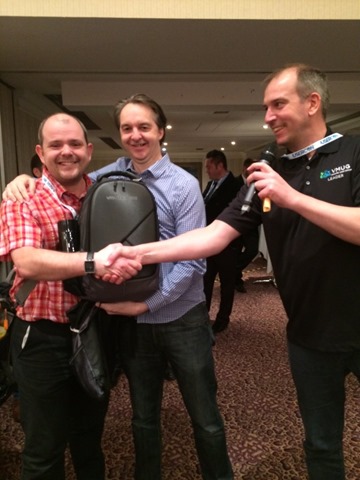
CULIUtUVEAAghtA

After some talking shop with some vendors I made my way to the “VMware’s Virtual SAN: A technical Deep Dive and Product Roadmap buy Christos Karamanolis and Lee Dilworth. the session was very interesting and Christos certainly gave in-depth explanations around VSAN, I just wish they had spent more time on the roadmap and new features in the releases due in Q1 next year.

image4

Next was a session by Frank Buechsel who is one of my fellow EMEA vBrownbag co-hosts who presented all around vRealize Automation-Lessons Learned. To say Frank didn’t sound like a big fan of vRA and the sheer complexity of getting a production setup working (tell me about it I’ve spent the last year of my life doing this) would be an understatement and I actually asked him at the end if he had anything nice to say about vRA which he did say it is a brilliant product but the errors are far too vague and the start-up and shutdown orders of a distributed installation are a nightmare.

Doing the closing keynote was then the illustrious John Troyer. It was a brilliant keynote all around how to try architect your IT career and how you need to keep learning new skills as the skills you have now will most likely be replaced/redundant in less than ten years. Poor John did seem to be suffering from a cold and jet lag but gave great advice. It was also great to hear a mention of the vBrownbag in his discussion. Thanks for that John 🙂

image5

Then it was the aptly named “The Red Wedding” ( G.o.T SPOLIER ALERT!! ) section of the day where Jane Rimmer, Alaric and Stuart all announced they would be stepping down as leaders of the London VMUG and UKVMUG after 25 years of service between them to allocate more time to their jobs and hobbies. These three have been amazing in building the community and dedicating so much of their time to the user group. Simon Gallagher hasn’t stepped down so that’s one consolation from it.If you think you could dedicate the time and are interested in becoming a leader then there is a survey available to complete as part of the process. this closes next Thursday so get your interest in ASAP.

Last but not least Pietro Piutti was generous enough to bring me over a few bottles of beer from the only certified trappist brewery in Rome. Not sure about the eucalyptus they add but man it was good. Not a Westvleteren 8 but it still got 4.75 out of 5 on untappd 😀

image6

It was a brilliant day and I certainly will be aiming to attend again next year even though I plan to attend the US VMworld next year also.


Gregg


2 Comments

VCDX Spotlight: Jason Grierson

Name: Jason Grierson

Twitter Handle: @JasonTweet7889

Blog URL: www.virtualtiers.net

Current Employer: Cisco Systems

VCDX #: 206

How did you get into using VMware?

I started just prior vMotion being introduced. I was working for a loaning company at the time which was an early adopter of VMware. At the time I was lucky to be part of the project to upgrade to the latest version and saw vMotion for the first time. I knew right then this would change the way Datacenters would work.

What made you decide to do the VCDX?

I had been working with VMware for a number of years now and had held my VCP since 3.5 upgrading it along the way. I figured it was just time to strive for my VCDX. Why couldn’t I reach the VCDX and what harm would come in trying. Little did I know where the journey would really take me.

How long did it take you to complete the whole VCDX journey?

Between the VCAP-DCA, VCAP-DCD and VCDX the journey took me a year and half pretty well.

What advice would you give to people thinking of pursuing the VCDX accreditation?

My advice would be to go for it! It’s not an unachievable exam that sits on a pedestal. It’s a lot of hard work and time commitment but in the end the lessons you will learn while striving for your VCDX is priceless. You will become a much better architect and meet many others striving for the same thing which will only expand your network of professionals. The lessons learned along this journey will only better your career no matter where you end up going.

If you could do the whole VCDX journey again what would you do differently?

Umm I don’t really know lol. I would probably focus more on my defence probably knowing what I know now. Also there would probably be sections of my design I could improve on.

Life after the VCDX?  How did your company respond?  Was it worth it?

Life after my VCDX has gone back to normal for the most part now that the dust has settled. My company was very excited that I passed and send out a Canadian wide email so now there a lot more VMware questions being fielded my way lol. Was it worth it, yes absolutely! I couldn’t imagine the growth in my career or where an exam track would take me and am extremely appreciative of all of those who helped me along the way. I’m also beyond over joyed to have my VCDX # and am looking forward to seeing my Partner achieve his soon as well.