TheSaffaGeek

My ramblings about all things technical


Leave a comment

VCDX Spotlight: Kenny Garreau

Name: Kenny Garreau

Twitter Handle: @kennega

Blog URL: http://dudewheresmycloud.com

Current Employer : Lumenate

VCDX #: 115

How did you get into using VMware?

My first exposure to VMware came when I was starting as a System Admin for a financial services company. I invested a lot of personal time learning the technology, and was eventually given the task of re-architecting our virtual infrastructure. This was a formative time for learning and putting into practice VMware, networking and storage design skills before I dove into the consulting arena.

What made you decide to do the VCDX?

I spent a couple of years consulting before I felt I had enough customer presentation and design experience to suitably defend a design. The design I submitted for my VCDX application was my first design at my second consulting job, and I remember thinking “Wow, this would be a great candidate for a VCDX defense.” It turns out that VMware and the panellists agreed.

How long did it take you to complete the whole VCDX journey?

I began by completing my VCAP-DCD and VCAP-DCA at the end of October 2012. I submitted my initial design in early December of 2012 to defend at PEX. I didn’t pass, so I took a couple of months off to recharge. I went back at it for VMworld 2013, and passed. So about 10 months.

What advice would you give to people thinking of pursuing the VCDX accreditation?

Understand it’s not about the size or the complexity of the design you’re submitting to defend. It’s about your skills in designing around customer requirements and constraints, and mitigating risk to the customer and the project. Know your design, and recognize that if you include something in your design, justify it and know it. Finally, make sure your significant other knows and understands the journey you’re about to undertake. You’ll need their support, but it’s equally important to make time for them as well.

If you could do the whole VCDX journey again what would you do differently?

I would engage my fellow applicants earlier – they will be much more critical of your design going through the process than someone outside of the VCDX program. I’d try to complete my design a couple of weeks ahead of the deadline and run through a mock defense. It will help you identify weak points in your presentation, both technically and grammatically. You can then improve your design for its final submission and review by the panel.

Life after the VCDX?  How did your company respond?  Was it worth it?

Spend some time decompressing; you are going to need it! I had an overwhelming response from my co-workers, but the community response was what inspired me. Those who have been through the program realize the time and effort that goes into the entire process. To be counted among many of the very best names in datacenter and virtualization design is a humbling honour.


Leave a comment

VCDX Spotlight: Travis Wood

Name: Travis Wood

Twitter Handle: vTravWood

Current Employer: VMware

VCDX #: 97


How did you get into using VMware?
I’d seen a demo of VMware and like many people I was blown away by the concept of VMotion. The company I was working for won a deal to build a VMware environment and P2V about 100 servers into it, so I positioned myself to get selected for the project. It was intense working with such a new technology, stuff broke and we had to work through a lot of problems. P2V’s were far more complex then as Converter didn’t exist yet so we spent many late nights swapping NICs and disk controllers around trying to get the right combinations of hardware that’d work with P2V Assistant or using Ghost. But the experience was invaluable, at the time P2V skills were rare so this opened up many opportunities for me.


What made you decide to do the VCDX?

I remember where I was when I first heard of VCDX. It was described as the pinnacle of VMware certification and extremely difficult to obtain. The concept of defending before a panel sounded intimating but challenging at the same time, I knew immediately this was something I’d have to do! At the time I was working in a projects team, building VMware environments with little design experience so I knew I’d have to start working my way towards a design role.


How long did it take you to complete the whole VCDX journey?
It depends when you measure it from. When I received my VCDX certification in 2012 I’d been working in IT for about 10 years, and each step along the whole process eventually got me here. I first heard about the certification in 2008 and decided I would go for it but the journey really started when I joined VMware in 2009, so it took about 3 years.


What advice would you give to people thinking of pursuing the VCDX accreditation?

Start with your end goal, VCDX and then figure out where on the scale you are now. Then create a plan to get there through a series of small, iterative but measurable steps. Figure out what you need to do and how you will do it. Secondly when it comes to submitting your design, read the blueprint. It is quite specific one what you need to cover.


If you could do the whole VCDX journey again what would you do differently?

I was quite happy with my journey, really the only thing I would’ve changed is tried to get more of the documentation done during the actual project that I used in my submission. When I decided to submit I reviewed my design against the blueprint and noticed there were areas I needed to cover but weren’t a part of this design, so that meant a bit of extra work ensuring I’d covered off everything.

Life after the VCDX?  How did your company respond?  Was it worth it

Before VCDX I was in the VMware Professional Services team for Australia & New Zealand which gave me the necessary experience to get the certification. My VCDX certification got me noticed by the right people in the company to get tapped on the shoulder to join the Global Professional Services Engineering team as a Solution Architect. Now I am responsible for creating the services that VMware Professional Services offer as well as being an escalation point for the field and interacting with our product teams. I am also now a VCDX panellist which I find very interesting seeing how people approach design problems.


Leave a comment

VMworld US Day 1

Now that the dust has started to settle on day 1 of VMworld US 2013 let’s have a look at what was announced, what seems to have been missed from the keynote that I felt are a few major improvements/fixes in vSphere/vCloud 5.5 and all the other important releases coming from the conference. *disclaimer* I am not at VMworld US so this is my take from across the Atlantic.

The day started with the keynote form VMware CEO Pat Gelsinger. I’m not going to detail a minute by minute commentary on it as I think the blog postings I will be mentioning below cover everything you need to know and you can watch the keynote for yourself clip_image001 Also Scott Lowe has done a brilliant live blogging of the keynote here.

I was fortunate enough to again be invited to an early access blogger program by VMware almost two months ago around all the announcements that were due to come out at VMworld. It has been really hard as a consultant to not mention it to customers especially the changes/rebuild of SSO. I did have a few blog postings in the works on the announcements but felt I could not do them justice so left it for better people and I was right in doing this I think as Chris Wahl has done an amazing nine part series on all the announcements which I think are a great overview of all the new features and changes and would have destroyed mine:

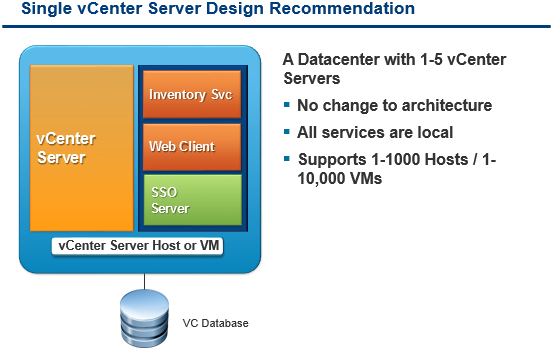
As I mentioned one of the big changes in vSphere 5.5 that I felt should have been mentioned in the keynote and would have probably got a loud cheer from the crowd was the massive changes to SSO. The SSO service has been almost totally rebuilt and when I was on the early access blogger webinars everyone breathed a sigh of relief as the SSO in vSphere 5.1 was not a simple thing to install especially seeing as it was recommended to break up all the individual components. This has now changed and it is recommended that they are all kept on one machine. Below is the recommended layout now for the vCenter Server design.

image

Kendrick Coleman also gave a great overview of it from 30k feet here . For me the real improvement is the simple steps to setup SSO now which are:

1. Accept License agreement (EULA)

2. Prerequisite check summary

3. Edit default port number 7444 (if necessary)

4. Select Deployment placement

5. Provide Administrator@vSphere.local password

6. Provide a site name or select a previous site name

7. Edit destination directory (if necessary)

8. Summary

9. Installation Complete

I’m one of the hosts of the EMEA vBrownbag and all of the US Brownbag and a few of the APAC vBrownbag team are out at VMworld US doing the very popular Tech Talks. The Tech Talks are 10 to 15 minute presentations by members of the VMware community on topics of their choice, almost like a mini #vBrownBag. They are being streamed live by the vBrownbag guys and are being recorded for people like me to watch them when you can. The schedule for the Tech Talks can be found here. Make sure you watch the stream live and give the guys the support they deserve as all of these presentations are from the community.

Talking about the vBrownbag crew one of the main culprits Nick Marshall has released alongside Scott Lowe, Forbes Guthrie, Matt Liebowitz and Josh Atwell (another vBrownbag host) the next instalment of the Mastering VMware vSphere book for vSphere 5.5. A massive congratulations to Nick on this project and for being asked and doing such an awesome job whilst still helping out on the vBrownbag. Nick has detailed the announcement on here blog here.

One of the biggest announcements from the keynote was the release of VMware NSX, as Forbes Guthrie said I’m waiting for NSXi clip_image003 but until that day the below are some of the highlights of the new feature and I would highly encourage you to read Chris Wahl’s detailing of the feature from above.

NSX Highlights:

  • VMware NSX is a next-generation network virtualization solution
  • Provide the key functions of network virtualization: decouple, reproduce, and automate
  • NSX will support any hypervisor, any CMP, any network hardware
    • vSphere, KVM, and Xen are currently supported
    • CMPs currently supported are OpenStack, CloudStack, and vCAC/VCD
  • NSX optimized for vSphere leverages the platform’s enhanced functionality

High-level View of VMware NSX Architecture:
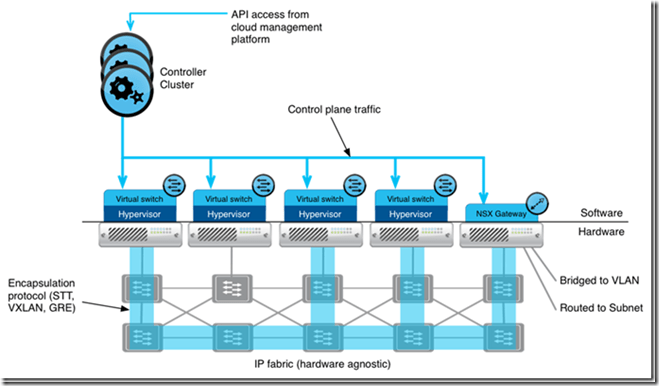
clip_image004

VMware NSX Controllers:

  • Designed with a distributed, scale-out architecture.
    • Minimum of 3 controllers for an NSX controller cluster.
    • NSX optimized for vSphere scales to 5 controllers.
  • NSX controllers run a common code base in different form factors.
    • Controllers run as infrastructure/service VMs in NSX optimized for vSphere.
    • Controllers run as physical appliances in multi-hypervisor environments.
  • Controller functions optimized in each delivery option.

VMware NSX Virtual Switches:

  • NSX uses programmable virtual switches on the hypervisors
  • In NSX optimized for vSphere, NSX leverages:
    • the vSphere Distributed Switch (VDS)
    • the UW (Userworld) Agent for communications with NSX controllers
  • In multi-hypervisor environments, NSX uses:
    • Open vSwitch for KVM and Xen
    • NSX vSwitch (an in-kernel virtual switch) for ESXi

VMware NSX Gateways:

  • The gateways are the “on ramp/off ramp” into or out of logical networks
  • Both L2 (bridging) and L3 (routing) gateway functionality available
  • Basic functionality the same regardless of delivery option
    • NSX optimized for vSphere leverages NSX Edge (derived from vCNS Edge)
    • In multi-hypervisor environments, gateways are physical appliances leveraging a scale-out architecture

VMware have also posted the What’s New pdf for vSphere 5.5 which gives you a very good overview of all the new features and services here

VMware have released a new VMware certification called the VMware Certified Associate for those people looking to get into the IT industry. Unlike the VCP there is no required training but there are free eLearning courses available for people to skill up for the exam. These do look like a good starter for people thinking of learning the basics of virtualization and in my opinion would be great for high school students thinking of going into IT and virtualization after high school.

Well that is what caught my attention from day 1 of VMworld US. I’m looking forward to more information coming out and to getting my hands on all the new vSphere 5.5 tools.

Gregg


6 Comments

VMware vSphere 5.5 Latency-Sensitivity Feature

Today at VMworld US vSphere 5.5 was announced in the keynote and one of the new features released with vSphere 5.5 is the Latency-Sensitivity Feature. The latency-sensitivity feature is applied per VM, and thus a vSphere host can run a mix of normal VMs and VMs with this feature enabled. To enable the latency sensitivity for a given VM from the UI, access the Advanced settings from the VM Options tab in the VM’s Edit Settings pop-up window and select high for the Latency Sensitivity option as shown below:


clip_image003

What Latency-Sensitivity Feature Does

With the latency-sensitivity feature enabled, the CPU scheduler determines whether exclusive access to PCPUs can be given or not considering various factors including whether PCPUs are over-subscribed or not. Reserving 100% of VCPU time increases the chances of getting exclusive PCPU access for the VM. With exclusive PCPU access given, each VCPU entirely owns a specific PCPU and no other VCPUs are allowed to run on it. This achieves nearly zero ready time, improving response time and jitter under CPU contention. Although just reserving 100% of CPU time (without the latency-sensitivity enabled) can yield a similar effect in a relatively large time scale, the VM may still has to wait in a short time span, possibly adding jitter. Note that the LLC is still shared with other VMs residing on the same socket even with given exclusive PCPU access.


The latency-sensitivity feature requires the user to reserve the VM’s memory to ensure that the memory size requested by the VM is always available. Without memory reservation, vSphere may reclaim memory from the VM, when the host free memory gets scarce. Some memory reclamation techniques such as ballooning and hypervisor swapping may significantly downgrade VM performance, when the VM accesses the memory region that has been swapped out to the disk.  Memory reservation prevents such performance degradation from happening. 


Bypassing Virtualization Layers:

Once exclusive access to PCPUs is obtained, the feature allows the VCPUs to bypass the VMkernel’s CPU scheduling layer and directly halt in the VMM, since there are no other contexts that need to be scheduled. That way, the cost of running the CPU scheduler code and the cost of switching between the VMkernel and VMM are avoided, leading to much faster VCPU halt/wake-up operations. VCPUs still experience switches between the direct guest code execution and the VMM but this operation is relatively cheap with the hardware-assisted visualization technologies provided by recent CPU architectures.


Tuning Virtualization Layers:

When the VMXNET3 para-virtualized device is used for VNICs in the VM, VNIC Interrupt coalescing and LRO support for the VNICs are automatically disabled to reduce response time and its jitter. Although such tunings can help improve performance, they may have a negative side effect in certain scenarios. If hardware supports SR-IOV and the VM doesn’t need a certain virtualization features such as vMotion, NetIOC, and FaultTolerance, we recommend the use of a pass-through mechanism, Single-root I/O virtualization (SR-IOV), for the latency sensitive feature.


Leave a comment

VMware vCloud Hybrid Service Beta Impressions

Almost two months ago I was selected as one of the very fortunate few VMware vExperts to participate in the VMware vCloud Hybrid Service beta. If you’ve not heard of vCloud Hybrid Service (vCHS) or not entirely sure what it is, then I’d recommend watching these videos before reading on:

“An Introduction to VMware vCloud Hybrid Service”

“A Look Inside vCloud Hybrid Service”

We were all provided a portion (or slice?) of a virtual datacenter in a multi-tenant cloud. As a bonus I got to share mine with two VCDX’s Chris McCain and Matt Vandenbeld. clip_image001 It’s always super exciting for a nerd like me to be able to do some of the cutting edge stuff with some of the top names in the industry.

Impressions:

The custom portal for vCHS looks extremely sleek and very intuitive for anyone using it for the first time or who may not have even used the vCloud GUI extensively. The front page presents you with a good overview of all your resources bundled into a Resource Snapshot section. You can easily review how much of your total resource is utilized and if you have more than one virtual datacenter you’ll observe the same utilization report per instance.

clip_image002

The virtual datacenter that I shared among three other people was number 25-202. If you click on the virtual datacenter in the Virtual Datacenters section above then it will take you through to your virtual datacenter page where you can check on your Usage & Allocation, Virtual Machines, Gateways, Networks and the Users who have access to this Virtual Datacenter.

Usage & Allocation

clip_image003

Virtual Machines

clip_image004

Gateways

clip_image005

Networks

clip_image006

I created a number of virtual machines for a test I am planning to blog about around using vCenter Configuration Manager in vCHS. One of these virtual machines is an MS SQL server which you can see below. You can access your virtual machines from either the virtual machines tab at the top of the page or via the Virtual Datacenter tab shown previously. If you are a user with permissions to access the vCHS vCloud Director portal (VPC Administrator) you’re able to manage VMs that you have permissions to using vCloud Director by simply clicking Manage VM in vCloud Director (shown below).

clip_image007

Personally I prefer working in the vCloud Director portal as this is something I’m very familiar with but the vCHS portal is more than adequate to undertake administration, it’s not too dissimilar to the standard vCloud one with an organization administrator view.

clip_image008

The flagship feature of the vCHS hybrid cloud connectivity is the ability to migrate workloads using VMware’s vCloud Connector using the new Data Center Extension in vCC 2.5 between your private vCloud instance and vCHS. I’m still testing this functionality but what I’ve seen so far the stretch deploy feature is looking like an amazing use case for people looking to migrate high workload resources to vCHS Chris Colotti covered a real world case and how he utilised stretch deploy here and here.

My initial impression of this service is really good and I’m looking forward to getting even more stuck in with real world customers and requirements. I’ll hopefully have my VCM blog posting out very soon although with all the goodness coming out of VMworld US it’s going to be hard. clip_image009

Gregg


Leave a comment

VCAP-CID Objective 1.2 – Identify and Categorize Business Requirements

Knowledge

 Identify discovery questions for a conceptual design (number of users, number of VMs, capacity, etc.)

  • These questions are ones you are going to ask during the design workshop for the design/project. For the workshop you need to make sure you have the applicable project participants/stakeholders who can join the workshops (depends if you want one big one where people come and go at certain points or multiple ones where you speak to each business unit/ team). For the stakeholder meetings/design workshops I personally like to try bring in the following people, this does vary depending on the project and what has been chosen but 9/10 times these are the people you want to speak to:
      • Virtualisation administrators (if applicable. If not already present then future administrators of the solution)
      • Server Hardware Administrators
      • Backup Administrators
      • Storage Administrators
      • Desktop/OS Administrators
      • Network Administrators
      • Application Administrators (these are very important as their applications may have very specific requirements)
      • Security Officer
      • Project Sponsors
      • End users/ Help desk personnel (this I find is helpful to find out what are the current support desk tickets/problems the company are facing and if these will impact the project in any way. Also these discussions are easy to have in the hallway/over a coffee but have alerted me to unknown risks that would have severely impacted the design and delivery)

vcap

Identify the effect of product architecture, capabilities, and constraints on a conceptual design.

  • I may be looking at this the wrong way but I think this is actually around how specific products architecture, capabilities and constraints isn’t applicable in a conceptual design as for a conceptual design you are only creating a “napkin” design diagram of how the whole environment is going to be delivered.

Skills and Abilities

Relate business and technical requirements to a conceptual design.

  • From one of the VMware service delivery kits available to VMware partners they give a great breakdown of what requirements are and what business and technical requirements are:
    • Requirement – Documented statement that depicts the requisite attributes, characteristics, or qualities of the system
    • Business requirements – Describes what must be achieved for the system to provide value
      • System must provide self-service capability
      • System must provide x% availability
      • System must provide optimal scalability and elasticity
    • Technical requirements – Describes the properties of a system which allow it to fulfill the business requirements
      • System requires a Web portal where users can log in securely and deploy virtual machines based on defined policies
      • System must have fully redundant components throughout entire stack (host, network, storage)
      • System leverages virtualization technology and associated features
  • As mentioned these requirements will be gleamed from the Design Workshops/Stakeholder meetings and then put into the conceptual design. This is where you would work out if the customer requires a private, hybrid, public or even community cloud deployment. For example if the customer requires certain data to remain in a country for regulatory reasons then in the conceptual design you know compute resources, networking and connectivity between that country and the primary site need to be available. The speeds, number of hosts, make of hosts and amount of memory and vCPU are not in the conceptual design as this is the “napkin” design just covering the concept of how it will all work out and may actually change once you get to the logical and physical designs.
Number Requirement
R001 Virtualise the existing 6000 UK servers as virtual machines, with no degradation in performance when compared to current physical workloads
R002 To provide an infrastructure that can provide 99.7% availability or better
R003 The overall anticipated cost of ownership should be reduced after deployment
R004 Users to experience as close to zero performance impact when migrating from the physical infrastructure to the virtual infrastructure
R005 Design must maintain simplicity where possible to allow existing operations teams to manage the new environments
R006 Granular access control rights must be implemented throughout the infrastructure to ensure the highest levels of security
R007 Design should be resilient and provide the highest levels of availability where possible whilst keeping costs to a minimum
R008 The design must incorporate DR and BC practices to ensure no loss of data is achieved
R009 Management components must secured with the highest level of security
R010 Design must take into account VMware best practices for all components in the design as well as vendor best practices where applicable
  • For Technical Requirements a great way of doing it is to break them down into sections like:
    • Virtual Datacentre Requirements – eg: Allocation model Virtual Datacenters reserves 75% of CPU and memory
    • Availability Requirements – eg: VMware vCloud Director (clustering, load balancing)
    • Network Requirements – eg: Organizations have the ability to provision vApp networks
    • Storage Requirements – eg: Different tiers of storage resources must be available to the customer (Tier 1 = Gold, Tier 2 = Silver, Tier 3 = Bronze)
    • Catalogue Requirements – eg: Catalog items are stored on a dedicated virtual datacenter and dedicated storage
    • SLA Requirements – eg: SLA Requirement #1 – Networking 100%
    • Security Requirements – eg: Organizations are isolated from each other
    • Management Requirements – eg: Only technical staff uses remote console access
    • Metering Requirements – eg: Metering solution must monitor vApp power states for PAYG
    • Compliance Requirements– eg: Solution must comply with PCI standards
    • Tenant Requirements – eg: Customer requires the ability to fence off vApp deployments
  • To make sure you are doing the design in a VCDX-like manner which should push you to do it at a very high level, don’t forget to refine the customer-specific technical requirements and validate that they are specific, measurable, accurate, realistic, and testable (SMART).

Gather customer inventory data.

  • This is what is going to be on the new vCloud system whether it is existing workloads or new workloads. A good way of getting this if the customer allows it is to run a VMware Capacity Planner collection on the existing workloads that are going to be migrated in so you know sizes, I/O and current state analysis values. The Capacity Planner can only be run by VMware partners so if this isn’t possible for you then manual collection and recording is going to be required. Another method is via the VMware vCloud Planner which is another tool only available to VMware Partners so maybe getting a VMware partner in to do this for you prior to the project running would be a good idea
  • Also knowing what the customer already has can help you understand possible future constraints for example that all their current servers are IBM and so this is likely to be the server platform for this design.
  • There may also be a requirement to use existing legacy physical kit already present in the datacentre which needs to be recorded and fully understood so that the risks and constraints of using this infrastructure are fully understood. For example if you are using legacy network switches which can’t do stretched VLANs this will impact your design substantially if you have two sites and a requirement for the Management cluster to be failed over/migrated in the event of a disaster.

Determine customer business goals.

  • This is plainly what is the customer looking to gain from the deployment of this solution? At the end of the project what do they hope to achieve? These are sometimes not as clear as you may hope as people have different ideas of what they want the solution to achieve so as the architect you will need to take all these business requirements, set expectations if they are unrealistic due to varying reasons like cost or pre-selected hardware and then define them and get sign off from the customer that they agree to these before any additional work is done. This is very important as if these aren’t defined and agreed to by the customer then scope creep can happen which could cause the project to fail.

Identify requirements, constraints, risks, and assumptions.

  • I’m not going to go into great depth here as I think the definitions of each will give you a good idea of what each is. During the design workshops/stakeholder meetings these are worked out, recorded and agreed to by the customer. Always remember that for any design you need to collect all of these and then look at it in a holistic manner and understand the impacts of each decision.
    • Requirements – Documented statement that depicts the requisite attributes, characteristics, or qualities of the system. See above portions around Business and Technical requirements plus the examples.
    • Constraints – Requirements that restrict the amount of freedom in developing the design
      • Hardware which already exists and must be used (for example,host or storage array)
      • Physical limitations (distance between sites, datacenter space)
      • Cost $$$
    • Risks – Potential issues that may negatively impact the reliability of the design
      • Lack of redundancy for specific hardware component
      • Support staff has not had any training
    • Assumptions – Suppositions made during the design process regarding the expected usage and implementation of a system
      • Provides a sounding board for design decisions which must be validated
      • Hardware required is installed before vCloud implementation
      • Network bandwidth is not a limiting factor for external end users
      • Appropriate training is provided to existing technical staff
    • For assumptions and risks I like to get these highlighted to the customer right away as you normally don’t want any assumptions if possible and for the assumptions you record in your design you want these to be realistically clarified already so that the assumptions are only there to ensure that if what they promised would be there isn’t you can refer them to the assumptions they signed off.

Given customer requirements and product capabilities, determine the impact to a conceptual design.

  • This I think is covered above in places but is also something you can only really learn from actually doing a design and understanding how requirements shape a design and what impacts each of them have. On a conceptual design it isn’t as much of an impact as in a logical and physical design but limitations like keeping workloads in specific geographies and the capability of vCloud stretched clusters between the two locations for example are something that will impact the conceptual design. I would also read the Service definitions listed below in the recommended tools from the blueprint and the implementation examples from the vCAT.

Tools

If you feel I have missed something or am wrong on something then please do comment as I don’t proclaim to be the best and am always learning and welcome constructive criticism and feedback

Gregg


Leave a comment

VCAP-CID Objective 1.1 – Create a Conceptual Design Based on Business Requirements

Due to an imminent customer engagement I am due to be working on I have been refining my vCloud skills and dusty away the cobwebs. One of these tasks was to book the VCP5-IaaS and sit it so that it forced me to learn the basics again and be sure I had a solid base knowledge with no gaps. My experience of the exam and the resources I used for it are mentioned in my VCP5-IaaS Exam Experience blog posting. I have now been using the VCAP-CID blueprint as a structure for perfecting my vCloud design skills and so I thought I would slowly post up each objective for my own benefit but also hopefully help other people looking to take the VCAP-CID. I will be consolidating all the objectives on my blog page here

Skills and Abilities

  • Distinguish between virtualization, automation and cloud computing.

    • This could be defined in a number of ways (I’m more than happy to be corrected here) but the way I piece it all together is:
      • Virtualization is what VMware has been doing for years with vSphere and its complementing technologies. This is nothing new to anyone preparing for this exam and if it is then I hate to tell you this but this exam isn’t for you.
      • Automation ties perfectly into the NIST definition of on-demand self-service which is :  Unilaterally provision computing, as needed, automatically without requiring human interaction
        • This can be done through multiple technologies and mechanisms like VMware’s vCenter Orchestrator, vCAC,vFabric Application Director and third party tools like Puppet, Razor and IBM’s Virtualization Automation solution. Without true automation you can’t have a Cloud.
      • Cloud computing is perfectly defined by the industry recognised NIST cloud requirements which are:
        • On-demand self-service: Unilaterally provision computing, as needed, automatically without requiring human interaction
        • Broad network access: Capabilities are available over the network and accessed through standard mechanisms
        • Resource pooling: The provider’s computing resources are pooled with virtual resources dynamically assigned and re-assigned according to consumer demand.
        • Rapid elasticity: Capabilities can be rapidly and elastically provisioned, in some cases automatically, to quickly scale out and be rapidly released to quickly scale in.
        • Measured service: Cloud systems automatically control and optimize resource use by leveraging a metering capability. Resource usage can be monitored, controlled, and reported providing transparency of the utilized service.
      • For VMware’s IaaS definition from which they define the VMware vCloud blueprint is:
        • A cloud must be built on a pooled, virtual infrastructure. Pools include not only CPU and memory resources but also storage, networking, and associated services.
        • The cloud should provide application mobility between clouds, allowing the consumer to enter and leave the cloud easily with existing workloads. The ability to use existing consumer tools to migrate workloads to or from the cloud is highly desirable. Mobility of workloads between clouds requires cross-cloud resource management.
        • The cloud should be open and interoperable, allowing the consumption of cloud resources over open, Internet-standard protocols. Access to cloud resources does not require any other specific network protocols or clients.
        • Cloud consumers should pay only for resources they consume or commit to consuming.
        • The cloud should be a secure, trusted location for running cloud consumer workloads.
        • Cloud consumers should have the option and the ability to protect their cloud-based workloads from data loss.
        • Cloud consumers are not responsible for the maintenance of any part of the shared infrastructure and do not need to interact with the cloud provider to maintain the infrastructure. They are not responsible for storage and network maintenance, ongoing cloud infrastructure patches, or business continuity activities. The cloud should be available to run high-availability workloads, and any faults occurring in the cloud infrastructure should be transparent to cloud consumers as a result of built-in availability, scalability, security, and performance guarantees.
  • Distinguish between private, public, hybrid and community cloud computing.

    • These are defined perfectly in the vCAT 3.1 introduction document as:
      • Private cloud: A private vCloud (also known as an internal vCloud.) operates on private networks, where resources are accessible behind the firewall by a single company. In many cases, all the tenants share one legal entity. For example, a university might offer IaaS to its medical and business schools, or a company might do the same for various groups or business units. The private vCloud can be managed by the enterprise and hosted on premise or operated on a dedicated infrastructure provided by a vCloud service provider or systems integrator. In any case, a private vCloud must conform to the organizational security constraints.
      • Public cloud: A public vCloud offers IT resources as a service through external service providers and is shared across multiple organizations or the Internet. This can be viewed as a vCloud infrastructure that is operated by one organization for use by multiple, legally separated organizations. A public vCloud is provisioned for open access and might be owned, managed, and operated by one or more entities. A public vCloud provider might also support a private, community, or hybrid vCloud.
      • Hybrid cloud: A hybrid vCloud combines the benefits of the private and the public vCloud, with flexibility and choice of deployment methods. A hybrid vCloud consists of multiple, linked vCloud infrastructures. These distinct vCloud infrastructures can be private, community, or public, they but must meet a set of requirements defined by the providers and agreed to by the consumers. Connecting these vCloud instances requires data and application mobility as well as management. When load-balancing between vCloud instances (cloud bursting), use a consistent monitoring and management approach when migrating an application or data workload.
      • Community cloud: A Community vCloud is a specific public vCloud use case where the cloud is shared, and typically owned, by a group of organizations with a common set of requirements. In many cases, the organizations also include some level of legal separation. Community vCloud resources are shared, with some parts under central control and other parts with defined autonomy. A vCloud built for government, education, or healthcare might be an example of a community vCloud. A community vCloud can be offered by a traditional service provider, by a member of the community, or by a third-party vendor and hosted on one or more sites. It can be placed on-premise at one or more of the organizations’ sites, off-premise at a vCloud provider site, or both on- and off-premise.


  • Analyze a customer use case to determine how cloud computing can satisfy customer requirements.

    • For this I would recommend you read the Service Definitions document from the vCAT as this covers all the definitions and how they map to customer requirements and fulfil these requirements. Also the VMware vCloud Implementation Examples document also from the vCAT shows you how varying implementations can benefit businesses in differing ways


  • Given a customer use case, determine the appropriate cloud computing model.

    • This is one I feel you can only do once you have a firm understanding of the capabilities of all the different Cloud offerings and how each of them meet varying requirements and also have differing constraints/disadvantages.


7 Comments

VCP5-IaaS Exam Experience

This morning I sat the VCP5-IaaS exam and am very pleased to say I passed it and with a pretty good score too! I decided to do the exam as I have been busy with a number of vCloud engagements and had a spare few days to prepare and get it done whilst the ability to gain the VCP5-Cloud if you have the VCP5-DCV was still available.


Resources

My preparations for the exam were fairly short as I only had two weeks of solid study before sitting the exam, that’s not to say I didn’t have a solid understanding of vCloud prior and I have been working with vCloud since the 1.0 days and have done a number of vCloud design and deployment engagements. The resources I used for the exam are as follows:

– The Trainsignal VMware vCloud Director Essentials videos by David Davis. I used these videos quite a while ago when they first came out which helped me gain a very good base knowledge and used a few of the videos again as the VCP5-IaaS exam is based on vCloud 1.5 and I have been using vCloud 5.1 most recently so needed to try remember/block out a few things.

– I also used the Trainsignal VMware vCloud Director Organizations set of training videos done by Jake Robinson. These are also based on vCloud 1.5 but give a great view of how an organisation administrator would do tasks.

– I used a third set of Trainsignal videos for my preparations were the VMware vCloud Director 5.1 Essentials set of videos by VCDX #104 Chris Wahl. These are for vCloud 5.1 whereas the test is vCloud 1.5 but the videos were brilliant and Chris explains vCloud networking amazingly which is the hardest part to get your head around in vCloud.

– For the above three sets of videos I followed along whilst doing it all in my lab and would HIGHLY recommend doing it this way as I don’t think you can understand vCloud without actually doing it yourself.

– Paul McSharry created three practice test for the VCP5-Iaas which can be done here VCP5-IAAS Practice Test 1, Test 2 and Test 3. These were great as a last minute practice test late yesterday to make sure I wasn’t missing anything.

– VMware vCenter Chargeback Manager is a big portion of the exam and I used the VMware vCenter Chargeback Fundamentals course to get my knowledge up to speed on the product. This course is really good and massively important as if you haven’t used Chargeback before you will be lacking in the exam.

– We did a few of the VCP5-IaaS objectives on the EMEA vBrownbag and I watched these as the way the guys cover the components are extremely helpful. They can be downloaded from iTunes here

– Lastly I used the vCloud Architecture Toolkit (vCAT) pdf’s which I read through and made sure I understood it all. This was probably a bit of overkill as the VCP5-IaaS exam is the entry level exam whereas the vCAT is geared more towards the CIA and CID but it gave me a great holistic view of how everything worked so if you have the time I would recommend reading them or at some of them.


The Exam

Due to my last two exams being the VCAP5-DCA and VCAP5-DCD I was used to having to burn through the exam/questions so having to go through the 85 questions was quite refreshing and the exhibits and questions were also fairly straight forward. I finished quicker than I thought I would which I put down to being used to the VCAP exams pace and felt the questions were easier than the ones for example were in the VCP5 (DCV).


Conclusion

Good luck to anyone looking to do the exam. I felt it was really fair although I may still be in a VCAP mind-set and is much shorter than the VCP5-Cloud so if you have your VCP5 already then I would say go for this whilst the “upgrade” path is still available. For me I think I am done for quite a while now and will be focusing on slowly building my VCDX design for a future submission.


Gregg


Leave a comment

London VMUG 4th July

The next London VMware User Group is only two weeks away and is looking to be jam packed with big names, first time presenters and sponsored labs.

The event is growing from strength to strength and I’m always amazed how many people put their hand up when it is asked who is a first time attendee. If you have not been before I would highly recommend it and the sessions are deeply informative and you get to chat to fellow Virtualisation IT workers who are doing the same kinds of work as you or maybe something you are about to do and can give you some helpful tips. It will be held at the usual local of the London’s Chamber of Commerce and Industry, 33 Queen Street, London, EC43 1AP.

Fellow Xtravirt colleagues of mine Seb Hakiel and Grant Friend will be doing an interactive session on the approach and pitfalls of a 4000 seat VDI deployment throughout EMEA which is a must attend in my opinion and I believe the first of many sessions these guys have in them.

The agenda for the day is:

clip_image001

Which is followed by vBeers which is held at the pavilion end pub

clip_image002

Map:

clip_image003

So far I am planning to attend so should be a great day as always and please come say hi if you spot me at the VMUG or even vBeers.


Gregg


Leave a comment

Presenters wanted for the EMEA #vBrownbag

The EMEA vBrownbag team are currently looking for presenters to present on the EMEA #vBrownbag which is run live every Tuesday at 7PM GMT/BST. Currently we are covering several tracks which include:

-VCP5-DT exam blueprint objectives

-VCP5-IaaS exam blueprint objectives

– VCAP5–CID exam blueprint objectives

-VCAP5-CIA exam blueprint objectives

– Anything related to VMware or would interest VMware focused IT people. These can be VMUG presentations or even prep for a conference

If you are interested in presenting then please fill in the form here: http://professionalvmware.com/brownbags/vbrownbag-presenter-sign-up/

Also please spread the word about the podcast and that we are always looking for presenters.

Gregg