I first started by purchasing an IBM xSeries 1U rack mount server off eBay to try out this new product from VMware. I fired up the server in my home office, installed ESX 2.53, and started to learn about virtualization. After the first 20 minutes, I could see that VMware and server virtualization was the future.
What made you decide to do the VCDX?
As soon as I learned of the VCDX certification, I made it a goal to achieve the VCDX certification and a number under 100.
How long did it take you to complete the whole VCDX journey?
I had already had my VCP from 2007, I first took my VMware Design Exam in March of 2010, with the Administration shortly after that. I then defended my design in August of 2010. I then paced around VMworld awaiting my results, which finally came 2 weeks after the show ended.
What advice would you give to people thinking of pursuing the VCDX accreditation?
If you want it, go for it! I learned more about technology, enterprise architecture, and process than I ever thought I would have. During your defence know when to say ‘I do not know’, it is a hard skill to master but a critical one. Know the smallest details of your design and know them through and through.
If you could do the whole VCDX journey again what would you do differently?
When I first attempted the VCDX certification, I was newly married to a wonderful woman that allowed me to focus 100% on the process. Now we have a 1-year-old child, I am not able to devote the time needed. I would take more time to thoroughly understand and complete my design.
Life after the VCDX? How did your company respond? Was it worth it?
My previous company did not know what to make of the certification or what it really meant. It wasn’t soon after I got the VCDX certification that I made the choice to leave that company and move to VMware. From there, my career has blossomed and continues to do so.
In 1998 I started with the first early versions of VMware workstation on Linux while I was working at a large ISP. This allowed me some great options for supporting customers on multiple OS’s without having multiple machines. I started using ESX in 2002, and even with the very early versions could see the potential.
What made you decide to do the VCDX?
I wanted to achieve VCDX as a competitive differentiator from other consultants and consulting businesses and I wanted to prove to myself that I could be one of the best in the world at what I do. I also wanted to prove to VMware that I was a serious partner.
How long did it take you to complete the whole VCDX journey?
At least 10 years, if you include the work experience that leads up to it. I think the previous work experience I had was one of the factors that helped me be successful the first time through. If you’re just interested in the certificate path it took about 12 months in total from the time I passed VCP4, VCAP4-DCD, VCAP4-DCA and VCDX defence. Most of the time was spent waiting for the exams to become available.
What advice would you give to people thinking of pursuing the VCDX accreditation?
Read the blueprints and application documents very carefully and do exactly what they say. Re-read them multiple times and make sure you cover everything. Make sure you know your design inside and out like the back of your hand. Be prepared to answer any questions on any aspect of it. Make sure you know where you made mistakes and can point them out and make sure you know where you deviated from best practices and why. Read all of the blog posts from the other VCDX’s about their journey and the tips that they give. Everything you need to know to be successful in VCDX is already publically available if you’re ready. Be prepared to invest hundreds of hours and a significant amount of money (yours or your companies). Do a mock defence with people that can ask pointed questions as a customer would so you have to explain and justify everything. Make sure you are comfortable presenting and can think and design and troubleshoot on your feet.
If you could do the whole VCDX journey again what would you do differently?
I don’t think I’d change anything.
Life after the VCDX? How did your company respond? Was it worth it?
Regardless of how my company and customers responded the process was definitely worth it. I loved the process and I learned a lot from it. Even if I wasn’t successful at the defence it would still have been worth it, just for the learning experience alone.
It has opened a lot more doors since I achieved VCDX and I have had the opportunity to work on a few more exciting projects that I may not have had otherwise. Some customers are specifying a requirement for VCDX in their RFP’s. So being one of such a small group really is worth it.
I get the opportunity to contact and work with quite a few other VCDX’s and this is very valuable, as everyone has different experience and there is always opportunities to learn more.
One thing that I constantly have running through my mind is “With great power comes great responsibility.” I think with having achieved VCDX people pay a lot more attention to what I say and do and I have to be a good role model. The number of followers and connections I have has certainly increased a lot. So there can be a lot greater consequences for what I say in public and I try to be mindful of that. But it’s not going to stop me speaking my mind. But I do consider the impact a lot more before I take a position on something.
But everybody is human, even VCDX’s. We can’t know everything, but we do try and know what we don’t know, and if we don’t know something say so. Integrity is of the utmost importance.
This is actually a long story, but I will try to keep it brief. Back in late 2003, I began playing with ESX 1.5 in a home lab for my own personal education. At the time I was a business analyst working for the office of the Executive Vice President at PC Connection in NH, helping create a new custom application for the sales team. However, I really wanted to work in the IT department. I started to learn as much about VMware and virtualization as I could as part of the project. Once the project needed to move into implementation I saw my opening to pitch the use of VMware. I also knew that nobody in IT at the time even heard or it, so I ended up being the VMware expert and was moved into IT to run the implementation of the systems. I deployed PC Connection’s first groups of clusters on IBM hardware and storage with good success. At the time we were one of very few companies using VMware 2.x in Production at the time and we were a great story for IBM and VMware.
What made you decide to do the VCDX?
I’d like to say it was for career advancement, or recognition, but really the main reason was personal growth. As a VMware PSO employee at the time it was harder to find the time and the support from some managers back then to take the tests, let alone the defence. Like many things I do in my life, I do them just to see if I can and to help myself grow to a new personal level. It’s a challenge to myself to learn new things and VCDX was one I wanted to see if I could get. I simply wanted to be one of the first people in VMware PSO to achieve the certification and my mission was accomplished.
How long did it take you to complete the whole VCDX journey?
This for me took almost 2 years. I started the process by taking the original tests once they were released. Getting support from managers as a PSO person on delivery engagements was always a challenge, but there was also delays in the early stages of the tests and defences. Once I passed the tests, there were not many defences available to get into at first. I think I recall there only being ones at PEX and VMworld at that time. If memory serves there was not any outside of corporate events like the big two. I also think the limited spots were being given to VMware employees at fist in order to get the word out on the program for non VMware people. Travel budgets and other restrictions got lifted and finally made it possible at Partner Exchange in Las Vegas.
What advice would you give to people thinking of pursuing the VCDX accreditation?
I think the best advice I can give is like any challenge, do it for you. Not for you’re company, your boss, the hope of a raise, or jumping ship with a shiny new certification to get you a new job. If you go into it with goals that are not for personal growth, it’s not going to be fun or rewarding. You should WANT to get your VCDX, you should not feel like you HAVE to get it. The other things may or may not come, but nothing is ever guaranteed except personal satisfaction. Prepare for the defence properly. It’s a conversation between you and the panel. It’s not a grilling session of you by them, or a 90 minute PowerPoint by you. Have fun with it and I say these days, enjoy the journey. I think the best part for me was the defence itself, and that is where most people freak out. I actually had fun talking about the solution and admitting where things were not really great in the design. Those areas gave me talking points for the panel. No design is perfect, you should admit where you made mistakes, and why they may have been bad decisions. Lastly, too many people worry about the names of the panellists and who they will get. Don’t worry about it, frankly it does not matter who you get on your panel.
If you could do the whole VCDX journey again what would you do differently?
I’m not sure really. I passed the defence on the first attempt, so I really have nothing to look back on and change. Personally the written exams are tough for me. If I could change anything it would be to study for those more. Even today I have trouble with the exams to maintain my upgrade status. I cannot even say I’d want a different group of panel members as a joke. I liked having both Frank and Duncan in the room for my defence. We have all three been friends really ever since and found mutually newfound respect for one another. My journey led to many projects with both of them. I can’t say I’d personally change anything, I’d do it the same a second time around.
Life after the VCDX? How did your company respond? Was it worth it?
Trick question since I work for VMware. At the time it was so new and not well known so there was not much response to be honest. I think now as people pass it there is more visibility to it, so there may be more recognition internally. For me being #37 and the fact it was so new made it hard for people to understand what it meant. Life is the same as it was before for the most part. I’d say it was worth it for my personal growth like anything else I do, but for me it has not change anything in what I do or how I do it. Back then I wish it had more recognition, but as they say, it is what it is.
During a recent customer engagement for a Virtual Infrastructure build out I was tasked with deploying an Isolated/Air Gap Update Manager Download Service architecture. If you do not know what an isolated Update Manager Download Service is then read this article first before carrying on. I came across a few hurdles during this deployment and so i waned to create a quick reference of what I followed for my future reference and to hopefully help anyone who gets the problems I was getting during the setup
For this setup, I got a service account created that would be used for the installation of VUM and the UMDS.
For my setup I setup VUM and UMDs on their own dedicated servers as you obviously have to do as the UMDS has to be in the DMZ.
Note: The first hurdle I hit in this installation was that the SQL Client for SQL 2012 doesn’t work for the ODBC connections so I had to install the SQL 2008 Client from here for it to show the ODBC configuration when I went through each of the installations.
Next was the exporting of the downloaded patches to the UMDS folder under the IIS website (for mine I did a virtual directory to a folder on my data drive so that the c drive was not filled up with patches.)
Note: For the exporting, I kept getting an error as detailed in this VMware Communities discussion I created. As detailed in the discussion the problem was I had to set the folder location as my default export store by running vmware-umds -S –default-export-store <your path to the UMDS folder>.
Then you can export the patches to the folder location by running: vmware-umds –E <your path to the UMDS folder>.
Now you can go into your vCenter and setup the UMDS as your shared repository location by pointing to the IIS website you created for the UMDS folder
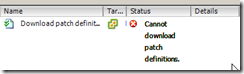
Note: For the downloading of the patches I kept getting a failure where the downloading patches task would get stuck at 50% for a few minutes and then fail stating “Cannot download patch definitions” as shown below.
2. The problem here was that the service account running the VUM service on the VUM server did not have full permissions to the folder. After reapplying the patches the downloading of the patches worked
After going through all of the above steps, my air gap Update Manager Download Service was now setup
I hope that this saves someone the headaches I had along the way
I started using workstation in 2001, but the real work began in 2006 with GSX (now called VMware Server) and ESX. We had a lab full of software development and testing servers, out of Power, Space, & Cooling. We needed consolidation and test automation that included full OS re-installs multiple times daily, virtualization was the only solution. At the time I worked for a Microsoft gold partner we were pressured to use their solutions, but they were weak. VMware’s platform was/is robust and solid, we made the obvious decision. A year later we added Lab Manager to assist with the automation, now we use vCloud Director for the same functionality.
What made you decide to do the VCDX?
I have spent a lot of time creating and implementing vSphere designs the past 7 years, this certification seemed like a worthy challenge. I began blogging about my IT experiences in 2008. I created a couple of popular posts, one of them about VMware Lab Manager best practices that gained a lot of traction in the community. I hoped VCDX certification would add to my credibility.
How long did it take you to complete the whole VCDX journey?
I have had a current VCP since 2008. I really started considering VCDX and passed my VCAP4 exams in Sept & October of 2011. I then passed on my first paper/defence attempt in May of 2012 gaining VCDX4 certification. After passing the VCAP5-DCD exam I now have VCDX5 certification as well.
What advice would you give to people thinking of pursuing the VCDX accreditation?
It’s a very positive life changing experience, it will vault you into an impressive peer group that I doubt I will ever feel worthy of. Be sure to allocate plenty of time for preparation, know your design and be ready to explain why you made every decision you did and why you didn’t make the other choices.
If you could do the whole VCDX journey again what would you do differently?
One thing I never read anywhere else is not only that you should do practice defence of your paper, but also do some mock design problems. I posted some thoughts about the defence before I got my results http://bsmith9999.blogspot.com/2012/05/vcdx-thoughts.html
Life after the VCDX? How did your company respond? Was it worth it?
I have already been given more opportunities to work on bigger and more visible projects. I now enter any situation with more confidence and my ideas are worth a lot more than just another suggestion in the room. Meeting other VCDX candidates was a great experience; I have a few new friends and a lot of new career networking options. It was definitely worth it. The only change I would make is to have pursued it earlier.
Current Employer: Enterprise Networking Solutions Inc.
VCDX #: 53
How did you get into using VMware?
I first started using VMware Workstation and ESX in 2005 while working at JTS Communities as a Network Administrator. As I worked with ESX and saw the isolation/encapsulation capabilities I could see just how disruptive virtualization would be for the technology industry and that it would enable and usher in so many new capabilities that were either very difficult and/or costly to implement and manage. I also liked the fact that in order to do virtualization well it would require me to be well rounded in Server Operating Systems, Networking, and Storage as well as virtualization itself. I liked that challenge and saw this as the career path I wanted to target. So I then looked for employers where I could design and implement virtualization solutions or where I could manage and administer large and complex virtual environments.
How long did it take you to complete the whole VCDX journey?
I started in November of 2009 taking the VMware Administrator and VMware Design exams (now the VCAP-DCA and VCAP-DCD exams). VMware was still working out kinks in the communication process for how you were enrolled for those exams, and then getting back to you on when you could schedule the next step. I then took the first VCDX Boot Camp at Partner Exchange in Vegas in 2010. I sat in the back of the room and started to soak in the information. I ended up sitting next to Frank Denneman (VCDX#29) and he was giving his VCDX defense the very next day. He was SO gracious and helpful pointing me in the right direction giving me a heads up that I would need to spend a good deal of time and attention on the application and design documentation. I then ended up filling out the application and augmenting and providing the necessary required documentation from my real world design in May and submitted all of that information right before the deadline (Like I think I maybe had an hour to spare). That was really the most gut wrenching part of the entire process, and in my opinion the most difficult. I got the thumbs up that my application and documents had been accepted and that I would be defending my design the Thursday before VMworld. I then spent the remaining time till then reviewing my design and based on the advice from the VCDX boot camp, going over not only why I had made certain design decisions, but also why I chose not to make different design decisions. Was it because of a constraint, a customer requirement, or perhaps even preference towards a certain hardware vendor on the customers end. For me, the defense, while nerve wracking, was not actually the most difficult portion of the entire process. I am pretty good at thinking on my feet, I have excellent communication and soft skills, and I’ve had plenty of experience delivering designs and doing presales sessions in front of customers. Doing the defense was really no different. I just had a VERY well educated and technical astute customer. It was nice to be done with the defense and enjoy VMworld, but it wasn’t till almost a month later that I got the e-mail with the good news.
What advice would you give to people thinking of pursuing the VCDX accreditation?
First off, the VCDX isn’t for everyone. It really is for those that are currently VMware design architects or that aspire to that kind of position. This certification is really geared for folks that understand how to take a customer’s business requirements and can turn that into a technical solution given all the potential risks, requirements, and constraints for that particular customer.
If you do feel this is the right path for you then I first of all recommend that you use a real customer design. Even though a fictitious customer is acceptable, it will drive you crazy having to create from scratch a whole customer scenario (this would be analogous to the work of J.R.R. Tolkien coming up with the entire history of Middle Earth, legends, the Elvish language, etc. – you don’t want to really do that unless you’re a glutton for punishment).
Another item of advice is to make sure you’ve given yourself enough time to put together the application and documents. Don’t put it off or procrastinate. You’ll be sorry if you do.
Also, keep your design simple. Your design doesn’t have to be a 500 page multi-site international design complete with VDI, every hardware vendor under the sun, etc. The cleaner and simpler you can make your design, the better off you’ll be. Don’t hand in a five page design doc – that would also be hurtful to your chances of passing. But remember, you’re gonna need to know this design like the back of your hand when you give your defense, so do yourself (and the VCDX application review board) a favour and keep it short, but also complete (DO NOT leave out anything that they ask you in the application to have included in your documentation).
And finally get peer support. Get advice from folks on twitter or the community forums. Have people review your design and folks you respect watch your mock defense sessions.
If you could do the whole VCDX journey again what would you do differently?
Have given myself more time on the application and design documentation.
Life after the VCDX? How did your company respond? Was it worth it?
Life is good. I feel truly honoured (and still quite shocked) to be in the company of some truly amazing people. I actually ended up changing jobs weeks before I found out if I had gotten the VCDX. But that was really just a chance for me to move back home from Kansas to Northern California. That in itself has been a true joy. I’m working at a small integrator out of Sacramento, CA and I have the privilege to work alongside some truly fantastic peers. I know I could have my pick of several great opportunities out there, but for now, the ability to stay close to home with almost no travel allows me to spend quality and quantity time with my son and daughter.
How did you get into using VMware? As a software developer in the late 90’s, I encountered VMware Workstation as a solution to the "aww, man, that bug goofed up my configuration" problem. I had used the product as a sandbox for testing software or developing installation and configuration documentation: step-by-step processes with screenshots. Fast forward to 2002, we had a test lab built for our Netware/NDS to Windows 2000/AD migration project. The hardware consumed 2 full 42U datacenter racks and made quite a bit of noise. We installed VMware GSX on one machine and reduced the hardware footprint of our test lab to something closer to 15U of gear, including the tape drive used to back the environment up. The lab room became so much quieter (and cooler!) that you could barely tell the gear was powered up. Based on that success, we looked at ESX 2.0 as an even more efficient way to consolidate, and started looking at moving some low-impact workloads from old hardware into VMs on newer hardware. With the advent of VMotion (capital ‘V’ back then) then HA and DRS in VI3, we were able to accommodate production workloads by addressing the ‘all of your eggs in one basket’ problem. Adoption of the platform simply took off from there.
What made you decide to do the VCDX? I had moved from a customer to a VMware partner at this point. I actually credit my interest in consulting to my involvement with VMware. Based on some interactions on the VMware forums that turned into in-person Q&A sessions, I realized that I enjoyed that part a lot more than operational maintenance and carrying a pager. At the time, in late 2007 or early 2008, there was no VMware certification beyond the VCP. I was talking with a coworker, Mark Gabryjelski — he’s got a crazy-low VCP number (#46) — about the value of some kind of advanced VMware certification that would help further differentiate the people who really focused on this technology and its application. A quick visit to the certification section of VMware’s website revealed that VMware was creating a new Design certification called VCDX. Right there, we challenged one another to become part of the program as a way to validate our skills, help differentiate the company, and ultimately help shape the certification itself. We saw it as becoming even more involved with the growing VMware community.
How long did it take you to complete the whole VCDX journey? I filled out a ‘skills assessment’ on the website in Q1 of 2008, and received an invitation to take the "VMware Enterprise Administration Exam." After passing that exam, I was invited to take the "VMware Design Exam" in Q1 of 2009. At the end of July 2009, I was notified that I had passed the second exam and that there were going to be VCDX Defense opportunities at VMworld 2009. In order to get in to that group, I had to have my application completed by August 14, so, I had roughly 2 weeks to complete my application, design and design documentation. Fortunately, I was able to work things out and was able to complete my documentation AND reserve a slot for the defense. I was notified that I had passed on September 1, 2009, so the whole process took a little shy of two years for me.
What advice would you give to people thinking of pursuing the VCDX accreditation? If you’re even considering it, get started now. Do some research and find out if it is something you really want to do. There is a lot of information about VCDX out there — blueprints, blog posts, workshops, even sessions at Partner Exchange and VMworld that walk you through the process. I’ve even presented a session at VMUG about it. I don’t think any of the VCDX certified individuals, or the people who run the VCDX program, are secretive about how the process works and what it takes to pass. As long as you don’t ask us something that would violate our NDA, most of us are pretty open to talking about it. To get started down the path, get the blueprints for the VCAP exams, get them scheduled, and take a look at what is required for a VCDX-level design. If you’re not building your designs that way today, start using the guidelines to make your current work that much better. As an added benefit, this gives you plenty of practice towards building the documentation for your application and defense. Don’t rush the process, but don’t be afraid of it, either. Once you have your defense scheduled, make sure that you know your design. Not just the, "here’s how we built it," but the "why did you choose to build it that way" aspects. Understand how your customer’s requirements and constraints shaped the design — be able to explain the WHY. Once you get to the defense, relax and have fun with it!
If you could do the whole VCDX journey again what would you do differently? I don’t think I would have done much different. I was fortunate to be working with a great customer at the time my defense was scheduled. They agreed to answer all kinds of crazy questions, and provided me with excellent feedback that helped me solidify the design and get everything straight in my head. Having that kind of support from my customer was amazing. I strongly recommend using a real design for your defense and reviewing it with the actual customer or coworkers/peers who can ask you tough questions about it.
Life after the VCDX? How did your company respond? Was it worth it I received accolades from the local VMware team as well as recognition from my company, both internally and at events we sponsored. In the early days, nobody knew what a VCDX meant, so I had to explain what it was at just about every event — my apologies to those who had to hear me say the same thing multiple times! Today, the situation is better, and more people understand what VCDX means, although we do have a ways to go before it achieves the widespread recognition of, say, CCIE.
I have started my IT Career with IBM partners specializing in System X(IBM x86 Servers) & Storage. As Virtualization was a part of most other platforms in IBM (Main frames, iSeries, pSeries), I felt it was finally the chance to join the Virtualization boat when VMware came with Virtualization that run on System X. It was like bringing equality to the System X team (Wohoo we finally got VIrtualization too!) . I have started working on VMware since ESX 2.5 building POCs for customers. When ESX 3.5 came out resources were scarce, so more Virtualization projects start being put on my plate by day. The magical features of VMware Virtual Infrastructure at that time, & the response of customers made me feel as its the technology of the future and was glad I joined the boat of Virtualization back then.
What made you decide to do the VCDX?
I always was a certification junky, but after a while I got tired of attempting multiple choices certifications where the value of them were quickly diluted. When the VMware Administration & Design exams came out, I thought that should be a challenge that can be worth a while in a field that is invading the technology world at that time. Then when VCDX came out, it seemed like a very unique certificate in the market where you really have to proof your knowledge/skills in the front of the experts before obtaining your magical number, & here the journey started. Glad I was up to the challenge at the end of the Journey.
How long did it take you to complete the whole VCDX journey?
Almost 3 years, as I started on VI3 where I got to the stage of my design being accepted for the last VI3 defense, but was not able to attend due to travel constraints(Getting Visa on time as well cost). Afterward, I have upgraded my design & certification to vSphere 4 and waited to get a VCDX defense in a close proximity where my employer was ready to sponsor the cost. Its important to note though things are much easier from logistics perspective with VCDX4/5 as you can do the VCAP exams at any local Prometric Testing Center, where it was only available at particular times and in few centers around the world for the VCDX3 with none being near me at that time.
What advice would you give to people thinking of pursuing the VCDX accreditation?
If you are passionate about Virtualization & VMware in particular, then VCDX is the journey you are looking for. There is currently no other Virtualization certification in the market that get even close to VCDX. VCDX is not the easiest certificate to obtain, but its well worth the challenge so get your act in place and enjoy the ride. The knowledge gain of the journey itself is as valuable as the certificate itself. My biggest advice would be to plan well ahead. Make sure you have enough time for the full journey where you have enough time for each part of the journey with the least amount of time pressure possible. Time shortage pressure trying to achieve your VCDX before the last defense will never be on your side and can raise your frustration & stress. Save yourself from being burned out during the VCDX trip and plan a head. By the way there is no better time to start your VCDX 5 journey than now, as there is still plenty of time and many defense opportunities left out. At last make sure you get advantage of other VCDXs in the community and blog sphere who share their VCDX trip experience and great tips all over the web. Wish everyone good luck on their VCDX event! Never give up!
If you could do the whole VCDX journey again what would you do differently?
I would probably delayed the start of my journey to the VCDX4, as I did not plan enough time to be able to manage all the logistics to attend the VCDX3 defense on time. I believe many others have fallen for the same trap as well.
Life after the VCDX? How did your company respond? Was it worth it
Was it worth it? 100%. The joy of obtaining my magical number after a long challenge was well worth it. The knowledge I have obtained during my VCDX trip is influencing my design decisions on daily basis, as well ensure I look into more details than I ever did before.
As far how my company responded, obtaining VCDX was greatly greeted by VMware as the first response go, as I got nice congrating e-mails from the management as well my colleagues. Further, VCDX seems to get much more attention lately in VMware & seems more events and awareness will be surrounding the VCDX certification and it feel great just being a part of it. I hope I will be on the second part of the fence one day as a VCDX panelist. I had the VCDX as one of my career goals for the year, so I am hoping for a nice pay rise too!
I had been a Post/Pre Sales engineer for a number of years, specialising in Storage / Servers / Wintel type technologies, the company I was working for at the time put me on the VMware Virtual Infrastructure – Install and Configure Course and wanted me to get VCP as soon as possible as a requirement of the VMware partner program. The course really inspired me, and I quickly focused my attention and career path on virtualisation and shared storage. I gained my first VCP (VCP3) in mid 2007.
What made you decide to do the VCDX?
A good friend of mine (and former Colleague) James Wirth, better known as VCDX#83 and I decided to challenge ourselves and each other. It started out as a bit of a challenge or contest, but quickly turned into an excellent learning experience. In the back of my mind I also wanted see how my skills compared to the elite virtualisation architects (the VCDXs).
How long did it take you to complete the whole VCDX journey?
As always, I tend to put myself under pressure, which I did in this case. James and I agreed we would like to defend in Germany and take a run down the autobahns in a Porsche 911 Turbo, but we quickly realised time was not on our side as applications were due in December, so we agreed on Toronto.
I sat the VCP4 in November 2011 (after already sitting VCP5 thinking that would qualify me for the VCAP4 exams, big mistake!), then VCAP4-DCD in early December, VCAP4-DCA in mid December, then prepared my application in January & Feb (while also Sitting VCAP5-DCD Beta exam).
I completed the VCDX4 Defence in Toronto May 2012.
So all up, including study it was only October 2011 to May 2012, a total of 8 months.
I would however not recommend anyone try to go through the VCDX “Journey” in 8 months as I studied day and night, and had minimal personal life during this time. I was lucky to have had a solid 6 years working with VMware products, so the experience was essential, without the experience, I wouldn’t have had a chance.
What advice would you give to people thinking of pursuing the VCDX accreditation?
The VCDX journey should be looked at as a huge learning experience, rather than just aiming for a certification.
Assuming you have several years (I’d suggest 5+) of solid VMware experience with significant and varied design experience, I’d give yourself 6 months per VCAP exam, and 6 months to prepare your VCDX application. So 18 months, total.
I would suggest
1. Do whiteboard design scenario sessions with other skilled VMware architects and consider the pro’s and con’s of every architectural decision, and when you use one setting over another, and vice versa. This is very handy, not just for VCDX defence where you will be asked these type of questions, but for a VMware architects day to day job.
2. Read, read, and read some more. Books like Duncan and Frank’s vSphere 4.1 HA/DRS & vSphere 5 Clustering books are excellent. Blogs, VMware Best practice documents etc are great resources.
3. Setup a home lab (if you don’t have a lab at the office). Test things, try as many different scenarios as possible and run through all the tasks in the VCAP4-DCA blueprint several times, as the DCA exam requires you complete alot of tasks in a short period of time, so you don’t want to have to refer to the manuals at all if possible.
4. Know the VCAP and VCDX blueprints back to front!
5. Repeat items 1 through 4
6. Refer to item 5
If you could do the whole VCDX journey again what would you do differently?
Take more time, a lot more! I still feel there is a lot I can learn, and I feel I would have enjoyed the journey more, as I wouldn’t have been under such tight time pressures. I would also have done more design scenario sessions with friends and colleagues, as these are great ways to learn as well as help prepare for the VCDX panel.
Life after the VCDX? How did your company respond? Was it worth it
Was it worth it?? 100% Yes. It was definitely worth it. I learned a huge amount, and improved as a VMware architect. I now think my architectural decisions through much more and consider a wider range of options.
Life after VCDX for me is much like the VCDX journey, keep learning as much as possible, including improving my skills in complimentary technologies, such as Storage & networking.
I am planning on knocking off the desktop certifications VCA4-DT, VCP4-DT and VCP5-DT in the next couple of months, and when released, the VCPVCD511 (VCP-IaaS).
Hope I can get a healthy pay rise too! (Hope the boss reads this, wink wink, nudge nudge)
About two years ago I came up with the idea of the vExpert Spotlight to help people looking to get into IT,virtualisation and possibly gain the same kinds of roles a number of the vExperts are in. I’m pleased to say the idea gained loads of interest and is now being published three times a week on the VMTN blog. At present I’m looking to start my journey on becoming a VCDX5 and came up with the idea of using the same kind of format as the vExpert Spotlights but getting the current VCDX’s to answer a few questions so that VCDXWannabe’s like myself can find out more about each of them and why they decided to start the journey in becoming a VCDX. I asked a few of the VCDX’s I know who follow me on twitter if they would be willing to answer the questions and as is the case in the VMware community, everyone was more than happy to do it and liked the idea. So I would like to introduce the first in hopefully almost 100(the current number of VCDX’s worldwide) VCDX Spotlights and one from a good friend of mine who obtained his VCDX only a few months ago:
VCDX #: 85 – that’s “ochocinco” for the US folks 😉
How did you get into using VMware?
I worked for a small Citrix and Microsoft reseller in the late 1990s (Hensmann Technology in Castle Rock, CO for anyone who remembers them) that was focused on delivering solutions to small healthcare providers. The owner was a forward-thinker and saw VMware as a game changer. We started using ESX 1.5 internally and went to the 5-day certification class so that we could attain VCP certification and become an authorized reseller for VMware. I was hooked…
What made you decide to do the VCDX?
I love a challenge! VCDX was a motivation for me, a goal that would help me take my virtualization and datacenter skills deeper. I also saw it as career insurance – a way to differentiate myself in the job market.
How long did it take you to complete the whole VCDX journey?
I think it was some time in mid-2010 that I started exploring the idea of pursuing VCDX. In late 2010 I made up my mind and I started studying in earnest for the DCA exam and took that in early 2011. That’s probably the most difficult exam I’ve ever taken (although VCP2 was no walk in the park either). DCD came later that summer. I stalled a bit at that point because I knew that there was a lot of work that needed to go in to my design and there was uncertainty from VMware whether or not they would hold another VCDX 4 defense. I also had taken a lot of time off from pursuing my Master’s degree and needed to take some classes toward that. When VMware announced that Toronto would be the final shot at VCDX 4, I got busy! So I guess around 18 months, but I certainly didn’t hurry.
What advice would you give to people thinking of pursuing the VCDX accreditation?
Do it! I learned a tremendous amount through the process and took myself beyond limits that I thought that I had. Don’t look at the VCDX as a purely technical certification – it’s not. VCDX requires both technical and business skills, so seek peer review of both your submission and your presentation skills. Plan to do several mock defenses with both technical gurus and business leaders – the business leaders may ask more difficult questions and ones that you wouldn’t otherwise prepare for! Study the blueprint, VMware publishes it for a reason. And get support from your family and friends – find a cheerleader to keep you motivated when it’s late at night and you want to give up. VCDX is a long journey and I could not have achieved this without the support of my wife!
If you could do the whole VCDX journey again what would you do differently?
I would definitely work more on my soft skills and mentally preparing myself. I’m in a position right now that doesn’t require me to be in front of people very often, so my presentation skills had dried up a bit from my consulting days. Above all I would learn to control my nerves better and calm down – I was a nervous wreck during my defense!
Life after the VCDX? How did your company respond? Was it worth it?
Well it’s only been a couple of weeks since the results went out…not a lot of time for change, but it has certainly opened up some exciting doors for me. Several folks at my company congratulated me and my boss took me to dinner but I don’t think that many understand the significance of the certification. My reps and contacts at EMC and VMware were all excited and happy for me. Was it worth it? Absolutely!



![clip_image004[1]](https://thesaffageek.co.uk/wp-content/uploads/2012/08/clip_image0041.png "clip_image004[1]")
 It was nice to be done with the defense and enjoy VMworld, but it wasn’t till almost a month later that I got the e-mail with the good news.
 TheSaffaGeek