TheSaffaGeek

My ramblings about all things technical


Leave a comment

VCAP6-CMA Design Study Resources

A very quick posting around the creation of my new VCAP6-CMA Design study resources page now that the beta exam has been released. As I have done in the past for the VCP5 and VCAP5-DCV exams, I have started building a list of resources I will be using for the beta and if I don’t make the mark then the GA exam for the VCAP6-CMA design. If you feel I’ve missed any resources please do let me know as these pages seem to be very popular and so everyone can benefit with top class resources.

For those signed up for the beta, good luck!

Gregg


Leave a comment

VCDX Advice

The Love Guru - VCDX is achieveableSince my obtaining of my VCDX I’ve been humbled that some people have asked me for advice around aiming for the VCDX. So I thought I would ask as many VCDX as I could (and who would be willing to respond) to send me some VCDX advice one liners. If you are a VCDX and wish to add to the list then please let me know as I’d love to have a one liner (or a few like some people have done) from every single VCDX added to this posting. So below are all the one liners sent to me so far:

John Arrasjid VCDX #1 : “Those pursuing the VCDX program benefit from dedicated time each day to strengthen their weak areas, fully understand their design, and anticipate questions. By doing this & mock defenses, they set themselves up for success.”

John Arrasjid VCDX #1 : “Although challenging to achieve, the benefits of the VCDX certification is recognized in the industry. Your design, tech, operational, troubleshooting, & presentation skills are all important to VCDX and design success.”

Jason Boche VCDX #34 : “VCDX certification is a multi-step journey. The defense ties all together. Preparation and confidence yields success. Exhibit confidence, but not to a fault. Successful design has a key listening component.”

Andrea Mauro VCDX #35 : “You can pass or fail your VCDX defense. But the most important aspect is the journey itself. And you can improve yourself”

Chris Colotti VCDX #37  : “Do Your Best….and Forget the Rest” — Tony Horton 🙂

Magnus Andersson VCDX #56  : “A great learning experience no matter the end result.”

Michael Webster VCDX #66 : “Know what you don’t know”

Hugo Phan VCDX #75 : “Fail to plan? Then plan to fail, preparation is key.”

James Charter VCDX #106 : “Be honest with yourself on your strengths and weaknesses; use this opportunity to push yourself and focus on improving your weaknesses, it will make you a better architect”

Mike Tellinghuisen VCDX #111 : “Aim to be finished with everything 1 month before submission and try to get peer reviews of your design – you’ll be surprised at what a fresh set of eyes will pick up and it will ensure you have time to make any necessary changes.”

Jon Kohler VCDX #116 : “VCDX is just as much about the journey as it is about the outcome. You’ll likely find that learning the design methodologies as well as the defense preparation/presentation strategies will be extremely valuable whether you achieve the certification or not”

Rene van den Bedem VCDX 2xVCDX#133/NPX#8 : “Start with the Conceptual Model, then the Logical Design, Physical Design and Risks, finishing off with the Supporting documentation.”

Rene van den Bedem VCDX 2xVCDX#133/NPX#8 : “Consume technology to extract business value.”

Harsha Hosur VCDX #135 : “ Ever tried. Ever failed. No matter. Try again. Fail again. Fail better. Pursue excellence; success will find its way to you. “

Safouh Kharrat VCDX #136 :  “Give yourself enough preparation time before submitting your VCDX application and if you couldn’t make it, don’t give up! Use the feedback to improve your design and go for it again.”

Joe Clarke VCDX #138 : “Read. The. Blueprint. Again. 🙂 “

Niran Even-Chen VCDX #142  : “Manage your time right during this journey, taking a breath between sprints is important. I’m saying that because I’ve seen folks with excellent designs get to the finish line burnt and exhausted and they don’t pass”

Joseph Griffiths VCDX #143 : “Pace yourself delaying three months will not kill you. Detail everything on your design.”

Jason Shiplett VCDX #183  : “Do your homework. If you come into the design process without having prepared well, you put yourself at a severe disadvantage.”

Jason Shiplett VCDX #183 : “ Stick with it. There will be times in the process when you want to give up – I know I did. Tenacity is the key.”

Jayson Block VCDX #186 : “Know your limits, it’s okay to have them. When reaching for the clouds, don’t get trapped in the fog. Demonstrate you have a methodology and are confident in your approach.”

Thomas Brown VCDX #187 : “Do mock defences before you submit so you find the holes in your design while you still have the ability to fix them. “

Yves Sandfort VCDX #203 :  “Go top down or fail. The Conceptual is your sketch of your dream house, the logical is your architects raw drawing, physical is what you build the house from.”

Gregg Robertson VCDX #205 : “ If I can do it anyone can do it with enough work and sacrifice. Always ask yourself “Do I want it more than X” and you’ll be amazed how much time you find to get it done “

Jason Grierson VCDX #206 : “Motivation is key, you are running a marathon not a 100m dash. Pace yourself and believe you will make it to the finish line.”

Andy Smith VCDX #208 : “Focus on the blueprint and how your design maps to that blueprint and your customer’s requirements.”

Konrad Clapa VCDX #211 : “Understand every single decision you made! If you put it in the design know why.”

Niels Hagoort VCDX  #212 :”Do take all the VCDX clichés into account, but make sure you follow your own path in getting to the level of comfort in yourself and your design to successfully apply and defend”

Gregg


Leave a comment

VCDX Spotlight – Konrad Clapa

Name: Konrad Clapa

Twitter Handle: @clapa_konrad

Current Employer: AtoS

VCDX #: 211

How did you get into using VMware?

I first learned about VMware at University doing an internship in Spain as a Systems Technician. I was very much into networking and I got amazed what possibilities virtualization could bring and I made me to make a change in my future career. I decided to do my thesis on Servers Virtualization. No one was really interested in it at that timeJ.

What made you decide to do the VCDX?

I haven’t really planned to do VCDX. I always found VMware exams very challenging comparing to other Vendors. Having VCP certificate few years ago was an achievement. When I did my first VCAP I understood I can actually do more, but still did not think about VCDX as an achievable goal. There were less than 200 people in the world with that accreditation! When I got my second VCAP I thought, “OK, let’s do it”.

How long did it take you to complete the whole VCDX journey?

Well there are 2 things actually. One is the time I needed to get proper experience and second is the time to prepare and pass all exams. I believe you really need to have Enterprise experience to pass VCDX as it is not only about technology. Thankfully, I always worked with big customers in Atos so it was a natural process for me. I believe it took me minimum 2 year to pass all the exams. But I would not be able to make it if I did not get the hands-on experience in the first place.

What advice would you give to people thinking of pursuing the VCDX accreditation?

There are few things. First, stop thinking that there is any limit to what you can achieve. Second, take small steps. Third, understand that VCDX is not only about technology. Fourth, know EVERYTHING about you designs. Fifth, do mock exams with people that can really challenge you.

Last but not the least, find a Mentor.

If you could do the whole VCDX journey again what would you do differently?

I will not lie. VCDX journey took part of my private life away and you really need to take it into account. I did and I actually took some weeks of holidays just to concentrate only on VCDX. However, I would not really do anything differently. I took every opportunity to prepare and learn about the program. We had lot of on-line mock exams with my peer Krzysztof – invaluable. I also prepared myself mentally for the exam and possible result. I wanted to pass it in first attempt but I thought if I don’t then I am not there yet. It allowed me to accept both scenarios and get confidence.

Life after the VCDX?  How did your company respond?  Was it worth it?

Getting my application accepted was already a big achievement for me so I really felt like on a cloud nine! When I got a phone call from my peer in the morning saying ‘results are out, I passed!’. I set in front of my laptop, browsed my mails and found out that I was VCDX #211! That was a day I had champagne for breakfast! (Btw. I was on my annual leave at that timeJ).

I still think that VCDX is not as recognizable as it should be. We did get a lot of recognition from colleagues that understand what VCDX is but I guess it will take some more time for people to understand the real value. So was it worth? – yes definitely! The thing that I was most happy about was that I did stand in from of the panellist and I did defend my own design! I would definitely do it again just for this experience!

Btw. I would like to thank Krzysztof Hermanowski for all the time spent late evenings doing mock exams. Artur Krzywdzinski and Magnus Andersson for all the useful tips I got. AtoS colleagues for all the support. Also all guys from the Study group.


2 Comments

VCDX Spotlight: Jason Grierson

Name: Jason Grierson

Twitter Handle: @JasonTweet7889

Blog URL: www.virtualtiers.net

Current Employer: Cisco Systems

VCDX #: 206

How did you get into using VMware?

I started just prior vMotion being introduced. I was working for a loaning company at the time which was an early adopter of VMware. At the time I was lucky to be part of the project to upgrade to the latest version and saw vMotion for the first time. I knew right then this would change the way Datacenters would work.

What made you decide to do the VCDX?

I had been working with VMware for a number of years now and had held my VCP since 3.5 upgrading it along the way. I figured it was just time to strive for my VCDX. Why couldn’t I reach the VCDX and what harm would come in trying. Little did I know where the journey would really take me.

How long did it take you to complete the whole VCDX journey?

Between the VCAP-DCA, VCAP-DCD and VCDX the journey took me a year and half pretty well.

What advice would you give to people thinking of pursuing the VCDX accreditation?

My advice would be to go for it! It’s not an unachievable exam that sits on a pedestal. It’s a lot of hard work and time commitment but in the end the lessons you will learn while striving for your VCDX is priceless. You will become a much better architect and meet many others striving for the same thing which will only expand your network of professionals. The lessons learned along this journey will only better your career no matter where you end up going.

If you could do the whole VCDX journey again what would you do differently?

Umm I don’t really know lol. I would probably focus more on my defence probably knowing what I know now. Also there would probably be sections of my design I could improve on.

Life after the VCDX?  How did your company respond?  Was it worth it?

Life after my VCDX has gone back to normal for the most part now that the dust has settled. My company was very excited that I passed and send out a Canadian wide email so now there a lot more VMware questions being fielded my way lol. Was it worth it, yes absolutely! I couldn’t imagine the growth in my career or where an exam track would take me and am extremely appreciative of all of those who helped me along the way. I’m also beyond over joyed to have my VCDX # and am looking forward to seeing my Partner achieve his soon as well.


Leave a comment

VCDX Resources

I made it fairly public when I failed my first VCDX attempt that I was going to go all in for my second attempt and set myself a serious list of resources I was going to go through for it. I’ve received a lot of messages from people asking did I use all those resources and is all of that really necessary to obtain a VCDX number? There’s a few answers to this so I thought I’d write up this blog posting to cover it:

  1. Did you use all those resources!!?? Honestly yes and no, yes I used each of them during my preparations but I didn’t read and watch every single one from start to finish due to time constraints and also deciding at a point that focused preparations was a better method. Now this focused method was still fairly wide and I even used resources that were not even on the list, one of the biggest was the soon to be released “The Art of IT Infrastructure Design” by John Arrasjid @vcdx001 Mark Gabryjelski @MarkGabbs & Chris McCain @hcmccain.
  2. Which of those resources helped you the most?? Hard to say as each of them filled gaps in my knowledge. What I will say though is that for some of them they went into details I knew I would never remember but for ones like the 5 different HA states I made sure I learn them by adding them to my quizlet to test myself so they would be burnt in my memory ( Running,Partitioned,Isolated,Failed and FDM Agent Down in case you were wondering). I knew I had gaps in my knowledge and after speaking to colleagues and peers and asking them about their area of expertise I would then be able to see how far I had to go to learn. A few of these came from mock sessions where people would ask me about for example “How would your design have changed if the customer asked for FCoE?” or ” What mechanisms did you use to span the VLANs between the two sites?” , these showed me I needed to learn about not just the storage mechanism in my design but how it would have looked if they asked for something else and that I needed to T Skill on networking and truly understand why certain things were done.
  3. How did you find the time to go through these!!?? A few methods helped me do this:
    1. I would watch Pluralsight videos at 1.5x speed. I’ve been doing this for ages not just for CBT videos but also podcasts and you get used to it really quickly.
    2. Pluralsight lets you download a certain amount of videos to view offline on your tablet or even phone. I would watch the videos whilst at the gym on the bike, on the plane back and forth from my current project in Rotterdam as well as the train and metro back and forth to Rotterdam.
    3. As mentioned above I would watch CBT videos, read books, read blogs and listen to podcasts whilst commuting back and forth each week. I also would read and watch them in the hotel most evenings before going out for dinner or even get room service and just spend the evening doing that.
    4. I’m still trying to perfect this but after reading so much I seem to be getting closer and closer to being able to speed read whilst still retaining what I read. If I went to school now they would possibly diagnose me as ADHD so it certainly took me a fair amount of time to focus my mind and block out external noise (my wife isn’t too keen on this new skill 🙂 ) For this to work I’ve found a certain font and size via my kindle works best and I would ask myself after each page if I could explain what I had just read to someone and if I couldn’t I would reread it until I felt I could.
  4. What about new versions for example vSphere 6.0? True none of the resources I listed were even 5.5 per se nevermind vSphere 6. My design was a 5.0 design so I needed to ensure I remembered what was possible then but I did relatively keep up to date on the latest versions and what was possible. As rob Nolen mentioned in a vBrownbag we did around the VCDX, a good architect should know about the latest versions and what decisions you may have made in your 5.0 design that you would have changed now knowing where the newer versions have gone to ensure ease of upgrading (I paraphrase here).  It was hard to try not get mixed up between new features and what was possible in 5.0 so one bit of advice I would give is try submit a design for VCDX as soon after designing it as possible or upgrade your design to the latest version of vSphere 5 or even vSphere 6.

For the resources like most of the things for the VCDX it’s all about making time for it and realistically looking at how you spend your time and how you can use it more efficiently. I was catching the 6:50 flight to Amsterdam every Monday morning after waking up at 3:30 am to make it to the airport and through Heathrow in time to board and 99% of the time I looked around the cabin everyone but me had their eyes closed and was trying to get another hour of sleep. It’s not easy at time but you have to ask yourself how badly do you want it.

Gregg


2 Comments

What Changed Between My Two VCDX Design Submissions

I’ve been asked quite a few times what did I do differently in my architecture design between my first submission and my second so I thought why not put out a posting around some of those changes whilst not breaking NDA and also still making people work at it so they learn like I had to which has benefited me greatly.

  1. The first change was that after my defence I did what Lior has  recommended in his VCDX Attempt, Strike One – Part 3 posting and wrote down all the places I thought I was lacking and needed to strengthen for my next attempt. I also ensured that the feedback I got from the panel around my weaknesses (these are fairly generic for eg. “ Recoverability was lacking in the logical design” ) were addressed in my design so that I wouldn’t have those problems next time.
  2. I got good design review feedback from peers and my mentor that were also generic in that they told me to look at an area and think about all the decisions there without telling me what was wrong. This may seem harsh but I think it’s the best way and keeps to the mentors “code of conduct” as it makes you learn how you can do better without someone telling you what to change as then 1. You aren’t learning and 2. It’s your design not theirs.
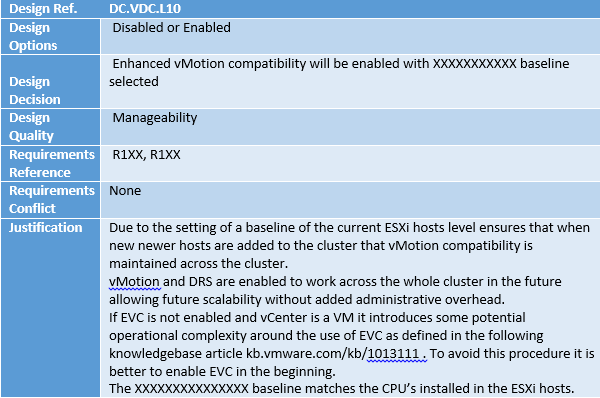
  3. The next change was one that took quite a while due to me having to retrofit it into my design but I implemented and applied the requirements matrix mapping Rene mentions in his posting to ensure I had clear mapping between my conceptual,logical and physical design sections. A large portion of this was implementing all of the design decision tables into my design for all my design decisions. This method was/is brilliant and really makes you think about every possible option and why not only did you choose one of them but why you didn’t choose the others. This also helps you remember in the defence why you made these decisions and why the others weren’t the most optimal. An example of one of the logical design tables that I had for VDC is below:Design Decision – DRS Enhanced vMotion Compatibilityimage
  4. I  read through my whole design whilst doing the requirements matrix mapping and with now more experience as an architect behind me made improvements to my design and simplified wherever possible so that the solution not only met the customers requirements but was also operationally easier to manage once I walked out the door. This also applied to my operations guide where I made improvements.
  5. I ensured all my physical design decisions mapped to validation/tests within my validation guide thereby proving I had validated them and the test we ran to prove this. As stated before my design was a real world design so these tests were actual ones I had done before and actually had in my original submission but the mapping of these ensured there was a clear link from conceptual all the way to validation.
  6. I standardised and simplified all my diagrams. For my diagrams I had a few that I had used varying colours for when I first built the design to make it look flash but all it made them look like were that they came from different sources. For my design I tried to standardise all the colouring and not make the colours neon colours and also simplified them where applicable so they made more sense.

If you want to read about my utter joy about passing the VCDX then have a look at my VCDX #205 posting and also my VCDX Spotlight.

Gregg


Leave a comment

VCDX Troubleshooting Skills

55020378So this posting isn’t about my opinion of if the dropping of the scenario is good or bad as in all honesty more time in the design scenario sounds great to me. This posting is actually about the resources I used to prepare for my VCDX troubleshooting scenario that I think an architect should know and thereby any good VCDX should also.

  • The first resources I used were actually the ones I used in my preparations for the VCAP5-DCA as this really makes you learn where all the logs are, what methods there are of troubleshooting issues and what you might be looking for. My study resources list for the VCAP5-DCA is a great start and if you are at the point of defending for VCDX you should have used some of these in your preparations but what I went over again were the troubleshooting videos by David Davis. Even though they are old the methods in them still apply especially ESXTOP etc.
  • The next resources were a mix between my two mentors for my recent VCDX attempt aka Larus Hjartarson and Rene van den Bedem. Both of them did brilliant breakdowns of how to prepare and think during the scenario and the methodology you need to keep to. These methods give you a great plan of attack even if it is a real world customer you are trying to help. Larus’ methodology is mention in his VCDX: Troubleshooting Scenario posting and Rene’s VCDX – Troubleshooting Scenario Strategy posting.
  • One resource that I felt was the best real world applicable resource I used that didn’t map perfectly to the VCDX scenario methodology but was brilliant was one that was recommended to me by Frank Buechsel who used to work for VMware GSS until recently was a book called Debugging—The Nine Indispensable Rules for Finding Even the Most Elusive Software and Hardware Problems. It’s more based at software development but each of the steps applies perfectly to troubleshooting any issues in a technology environment and now that the scenario has been stopped I can put out the loose outline from the book and kinds of questions I wrote up for each of the headings plus what I wanted to say to explain why i was asking in red that I wanted to ask in the scenario and how I thought it might fit:
    • UNDERSTAND THE SYSTEM
      • When did the problem start exactly?
      • What is meant to happen? – Why I am asking is because……………and what I’m hoping to achieve…………
      • When did you see the problem start happening? Is it recurring after a certain task or event or has it only happened once? – Why I am asking is because……………and what I’m hoping to achieve…………
      • Have any changes been made recently and are they tracked in a change management system? – Why I am asking is because……………and what I’m hoping to achieve…………
      • Have we collected logs or alerts from the systems and are we using something like vCOps where we can drill down and see alarms or alerts? ? – Why I am asking is because these mechanisms can give us ideas of the failures and possibly where it is happening if not just one location and what I’m hoping to achieve is to find the specific places the errors are showing, what the errors have been in the past if possible but also prepare for the next step of making it fail again so we can possibly see the error again or collect it for the first time.
    • MAKE IT FAIL
      • If it happens around a certain event can we try replicate the error and make it happen as often as possible? – Why I am asking is because I want to confirm the error is in fact happening at the point you mention and I’m hoping to achieve the exact step where it is happening and confirm if indeed our assumptions of when it is happening are true or not so we don’t waste time troubleshooting an assumption.
      • When are we doing the replication of the error can we document each step? – Why I am asking is because I want to confirm it is not just the step where it fails but the steps leading up to it in case a step in the sequence is then causing the eventual failure and I’m hoping to achieve the possible conflict or incorrect setting/step being followed.
    • QUIT THINKING AND LOOK
      • Are there any alarms or alerts on the source or destination system/s ? – Why I am asking is because I want to confirm not just the outcome of the failure that you mention but hopefully what is causing the failure and what I’m hoping to achieve is the point/component where we should do the troubleshooting so that we don’t make any unnecessary changes.
      • For the errors can we search the VMware/Vendor KB/Forums and see if any matches come up for some/all of the errors? – Why I am asking is because some of the errors might be known or even just give us an idea for where to look and what I’m hoping to achieve is to isolate the problem even more and not waste time looking at other components when a kb article might give us a good lead and save us precious time getting the issue fixed
    • DIVIDE AND CONQUER
      • For the machines that are failing are they the same configuration/going to the same location/coming from the same location/going over the same path? – Why I am asking is because I want to isolate the good parts/side and the bad parts/side and what I’m hoping to achieve is to focus my attention on the side that is showing the error so we don’t waste time and have less things to cover in the hope we can isolate the problem.
      • Can we try reverse the step in the opposite direction? – Why I am asking is because……………and what I’m hoping to achieve…………
    • CHANGE ONE THING AT A TIME
      • Try a migration/alteration/fix and if it doesn’t work then change it back and try something new. “Please can we migrate the failing machines to another host? “it still fails” Ok please move it back “– Why I am asking is because I don’t want to receive additional/red herring errors due to the change we made and what I’m hoping to achieve is to keep the environment unchanged as much as possible so we don’t cause additional errors/lose methods to troubleshoot.
    • KEEP AN AUDIT TRAIL (these were more writing out my thoughts and what I felt I needed to remember)
      • Write down what you did and the outcome and also WRITE DOWN THEIR RESPONSES as these may have clues!! “there are no errors in vSphere” might mean the error is not reaching vSphere for it to log the error so go “upstream” to find the source.
      • The error doesn’t sound like it is in vSphere so can we please look at the HBA on the host and ensure it is connected correctly and receiving data via ESXTOP.
    • CHECK THE PLUG
      • You state that the network connections are correct but please can we get it checked again? – Why I am asking is because I want to confirm that what we state is correct is in fact correct right now and what I’m hoping to achieve is to clear up any assumptions and have clear and confirmed facts about necessary “upstream” components.
      • Are the steps you are following worked in the past? Are we following the exact steps that worked before? – Why I am asking is because I want to confirm if it has ever worked/if we are following different processes and what I’m hoping to achieve is to confirm if it has ever worked and if a new step if causing the error to happen so we can troubleshoot what the different steps is bringing up.
    • GET A FRESH VIEW
      • Not really applicable to VCDX troubleshooting but asking for someone who is an SME in the customer might shed some new light/clear up what the exact problem is.
    • IF YOU DIDN’T FIX IT, IT AIN’T FIXED
      • Not really applicable to VCDX troubleshooting.

If you want to read about my utter joy about passing the VCDX then have a look at my VCDX #205 posting and also my VCDX Spotlight.

Next I’m hoping to dive deeper into each of the points from my VCDX #205 posting starting with VCDX Resources – Did you use them all??

Gregg


Leave a comment

VCDX Spotlight: Eric Shanks

Name: Eric Shanks

Twitter Handle: @eric_shanks

Blog URL: theITHollow.com

Current Employer: Ahead

VCDX #: 195

How did you get into using VMware?

I was at a Chicago Microsoft Users Group and a company called Altiris was speaking about virtualizing applications with their solution. The whole idea was pretty eye opening to me so when my boss suggested some enhancements to our infrastructure the virtualization concept was brought up again. After some testing we decided that VMware was the clear leader in the space so we virtualized our infrastructure on 4.0.

What made you decide to do the VCDX?

The VCDX certification was a challenge I wasn’t convinced that I could achieve, but I had to know for sure. A few other co-workers already had the credentials and I decided it was the time to find out what I was capable of doing.

How long did it take you to complete the whole VCDX journey?

The whole process took me about six months to complete. I already had my VCAP-DCA and VCAP-DCD before I decided to try the VCDX so that helped, but I left myself plenty of time to work out my design before submitting it.

What advice would you give to people thinking of pursuing the VCDX accreditation?

Talk with your family first about the endeavour. The VCDX is challenging, but more than that time consuming. Expect to spend nights and weekends working on it. The VCDX journey is personal achievement but can’t be done without some support from family, friends and co-workers.

Aside from talking with your family first, the second piece of advice I’d give is don’t be afraid to fail. This isn’t an easy challenge and many really qualified people have stumbled on it. It doesn’t mean you’re not awesome, it just means you need to tweak your design or presentation skills a bit.

If you could do the whole VCDX journey again what would you do differently?

I would have made sure to understand the defense blueprint better from the start. I felt that there were specific sections of the blueprint where I didn’t have enough things in my design to present. Specifically my design didn’t have a lot of “Security” related items so I wasn’t able to talk in depth about it in my defense. If I could have done it over I would have added an additional security requirement and supported it with my design so that I could talk about it in the defense.

Life after the VCDX?  How did your company respond?  Was it worth it?

After the process was over I was recognized at our company’s Tech Summit and given a bonus for the achievement. The feeling of a sense of accomplishment from meeting a personal goal made the process worth it.


Leave a comment

VCDX Spotlight: Scott Norris

Name: Scott Norris

Twitter Handle: @auscottnorris

Blog URL: www.virtualiseme.net.au

Current Employer: VMware

VCDX #: 201

How did you get into using VMware?

After finally scoring a server role back in 2005 I was introduced to ESX 2.5 and GSX, right then while like some kind of black magic I saw the potential and tried to be actively involved when it came to installing, configuring and supporting the platform. Later in 2009 I was leading a team 100% dedicated to VMware technologies that supported local and global accounts right up until 12 months ago when I made the jump to work for VMware.

What made you decide to do the VCDX?

The VCDX for me was my own personal challenge which I set some time ago.

How long did it take you to complete the whole VCDX journey?

This question is a difficult one to answer technically I attempted to start the journey in 2011 but unfortunately was diagnosed with Non-Hodgkin’s Lymphoma which put the brakes on for some time.

But after everything I finally found the time to complete it and restarted the journey late 2014. I was ready for PEX defence where I was accepted but was unable to get time off work. So defended in June instead, this gave me a little more time to polish off some rough bits in the design.

All up about 6 months of solid work it took to get across the line.

What advice would you give to people thinking of pursuing the VCDX accreditation?

My advice is:

· Keep the design simple, it doesn’t have to be complicated

· When it comes to the presentation take advice from people but do it your way, do what flows well to you. Just because X worked for me doesn’t mean it will for you.

· Don’t over prepare if you feel yourself losing interest or just want it to end have a couple days off kick back relax and get back into it.

If you could do the whole VCDX journey again what would you do differently?

I don’t think I would have done anything differently as far as the preparation I did, I think if anything I would have dialled back the amount I did, towards the end it was becoming a chore where its meant to be fun and something I want to do. Also I don’t advise writing a book at the same time that didn’t help at all.

Life after the VCDX?  How did your company respond?  Was it worth it?

The response from family, friends, the VMware community and work was fantastic. And for me personally was worth it. Having something to show for all the time and effort was fantastic.

As for life after, nothing has changed but I have noticed at the engagements I’m on my word has more sway than it did before, or I’m just imagining it. Either way I think VCDX will definitely open up doors which would have been shut previously but for now I’m just catching up on sleep.


Leave a comment

VCDX Spotlight: Nick Bowie

Name: Nick Bowie

Twitter Handle: @nickbowienz

Current Employer: ViFX Ltd.

VCDX #: 202

How did you get into using VMware?

I’d had exposure back in the earlier days with GSX and ESX Server through David Manconi (@dmanconi), when we worked together previously. I remember he was pretty excited about it, so I figured there must be something to it 😉 But I didn’t really have the opportunity to pursue it professionally until late 2009 when I became involved in a large data centre migration project which included establishing an SRM enabled ESXi 3.5 infrastructure.

What made you decide to do the VCDX?

I had heard about it through my go-to places like Yellow-Bricks, as I tried to soak up as much as I could about virtualisation. It wasn’t until I was fortunate enough to spend some time with Michael Webster (@vcdxnz001), who had just achieved his and, later in 2011, Travis Wood (@vTravWood) who was so excited to be pursuing it that I started to understand the level it represented. When I joined ViFX I realised the calibre of people I was fortunate enough to be working with and felt I really needed to lift my game.

How long did it take you to complete the whole VCDX journey?

It’s been such a gradual, incremental process it’s hard to pinpoint exactly when it started in earnest. If I measure from obtaining the VCP5-DCV in September 2012, it took almost three years. It became a realistic goal after joining ViFX in August 2013 though.

What advice would you give to people thinking of pursuing the VCDX accreditation?

It’s not a race 🙂 Each qualifying exam (VCP, VCAP DCA/DCD) are challenging in their own rights. Focus on the immediate, realistic goals and you’ll find your capabilities grow significantly through those achievements. When you’re at the point where you can submit the design: read the blueprint. Everyone says that, and I must admit I’d get a little frustrated at hearing it so often, but it’s true. Read it, understand it as best you can and make sure you touch on all the points.

If you could do the whole VCDX journey again what would you do differently?

I’m not sure I would do it too differently. The design I based it on was light on some components of the blueprint requirements, due to certain constraints and challenges, which meant some extra work was required on my own time. While working on that project I completed a few others in between that were more “blueprint-friendly”, in BC/DR and vBCA Oracle based engagements, but this was the one I had invested myself into with the goal in mind so I was determined to use it all the way through.

Life after the VCDX?  How did your company respond?  Was it worth it?

It’s only been a week, so it’s early days yet 😉 ViFX are extremely proud to have the 2nd VCDX in New Zealand, and the only one in the VMware partner space. We definitely have more VCDX’s in progress – watch this space!