TheSaffaGeek

My ramblings about all things technical


Leave a comment

VCDX Resources

I made it fairly public when I failed my first VCDX attempt that I was going to go all in for my second attempt and set myself a serious list of resources I was going to go through for it. I’ve received a lot of messages from people asking did I use all those resources and is all of that really necessary to obtain a VCDX number? There’s a few answers to this so I thought I’d write up this blog posting to cover it:

  1. Did you use all those resources!!?? Honestly yes and no, yes I used each of them during my preparations but I didn’t read and watch every single one from start to finish due to time constraints and also deciding at a point that focused preparations was a better method. Now this focused method was still fairly wide and I even used resources that were not even on the list, one of the biggest was the soon to be released “The Art of IT Infrastructure Design” by John Arrasjid @vcdx001 Mark Gabryjelski @MarkGabbs & Chris McCain @hcmccain.
  2. Which of those resources helped you the most?? Hard to say as each of them filled gaps in my knowledge. What I will say though is that for some of them they went into details I knew I would never remember but for ones like the 5 different HA states I made sure I learn them by adding them to my quizlet to test myself so they would be burnt in my memory ( Running,Partitioned,Isolated,Failed and FDM Agent Down in case you were wondering). I knew I had gaps in my knowledge and after speaking to colleagues and peers and asking them about their area of expertise I would then be able to see how far I had to go to learn. A few of these came from mock sessions where people would ask me about for example “How would your design have changed if the customer asked for FCoE?” or ” What mechanisms did you use to span the VLANs between the two sites?” , these showed me I needed to learn about not just the storage mechanism in my design but how it would have looked if they asked for something else and that I needed to T Skill on networking and truly understand why certain things were done.
  3. How did you find the time to go through these!!?? A few methods helped me do this:
    1. I would watch Pluralsight videos at 1.5x speed. I’ve been doing this for ages not just for CBT videos but also podcasts and you get used to it really quickly.
    2. Pluralsight lets you download a certain amount of videos to view offline on your tablet or even phone. I would watch the videos whilst at the gym on the bike, on the plane back and forth from my current project in Rotterdam as well as the train and metro back and forth to Rotterdam.
    3. As mentioned above I would watch CBT videos, read books, read blogs and listen to podcasts whilst commuting back and forth each week. I also would read and watch them in the hotel most evenings before going out for dinner or even get room service and just spend the evening doing that.
    4. I’m still trying to perfect this but after reading so much I seem to be getting closer and closer to being able to speed read whilst still retaining what I read. If I went to school now they would possibly diagnose me as ADHD so it certainly took me a fair amount of time to focus my mind and block out external noise (my wife isn’t too keen on this new skill 🙂 ) For this to work I’ve found a certain font and size via my kindle works best and I would ask myself after each page if I could explain what I had just read to someone and if I couldn’t I would reread it until I felt I could.
  4. What about new versions for example vSphere 6.0? True none of the resources I listed were even 5.5 per se nevermind vSphere 6. My design was a 5.0 design so I needed to ensure I remembered what was possible then but I did relatively keep up to date on the latest versions and what was possible. As rob Nolen mentioned in a vBrownbag we did around the VCDX, a good architect should know about the latest versions and what decisions you may have made in your 5.0 design that you would have changed now knowing where the newer versions have gone to ensure ease of upgrading (I paraphrase here).  It was hard to try not get mixed up between new features and what was possible in 5.0 so one bit of advice I would give is try submit a design for VCDX as soon after designing it as possible or upgrade your design to the latest version of vSphere 5 or even vSphere 6.

For the resources like most of the things for the VCDX it’s all about making time for it and realistically looking at how you spend your time and how you can use it more efficiently. I was catching the 6:50 flight to Amsterdam every Monday morning after waking up at 3:30 am to make it to the airport and through Heathrow in time to board and 99% of the time I looked around the cabin everyone but me had their eyes closed and was trying to get another hour of sleep. It’s not easy at time but you have to ask yourself how badly do you want it.

Gregg


2 Comments

What Changed Between My Two VCDX Design Submissions

I’ve been asked quite a few times what did I do differently in my architecture design between my first submission and my second so I thought why not put out a posting around some of those changes whilst not breaking NDA and also still making people work at it so they learn like I had to which has benefited me greatly.

  1. The first change was that after my defence I did what Lior has  recommended in his VCDX Attempt, Strike One – Part 3 posting and wrote down all the places I thought I was lacking and needed to strengthen for my next attempt. I also ensured that the feedback I got from the panel around my weaknesses (these are fairly generic for eg. “ Recoverability was lacking in the logical design” ) were addressed in my design so that I wouldn’t have those problems next time.
  2. I got good design review feedback from peers and my mentor that were also generic in that they told me to look at an area and think about all the decisions there without telling me what was wrong. This may seem harsh but I think it’s the best way and keeps to the mentors “code of conduct” as it makes you learn how you can do better without someone telling you what to change as then 1. You aren’t learning and 2. It’s your design not theirs.
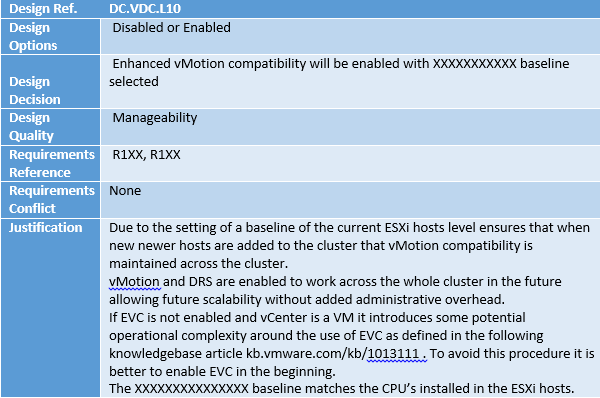
  3. The next change was one that took quite a while due to me having to retrofit it into my design but I implemented and applied the requirements matrix mapping Rene mentions in his posting to ensure I had clear mapping between my conceptual,logical and physical design sections. A large portion of this was implementing all of the design decision tables into my design for all my design decisions. This method was/is brilliant and really makes you think about every possible option and why not only did you choose one of them but why you didn’t choose the others. This also helps you remember in the defence why you made these decisions and why the others weren’t the most optimal. An example of one of the logical design tables that I had for VDC is below:Design Decision – DRS Enhanced vMotion Compatibilityimage
  4. I  read through my whole design whilst doing the requirements matrix mapping and with now more experience as an architect behind me made improvements to my design and simplified wherever possible so that the solution not only met the customers requirements but was also operationally easier to manage once I walked out the door. This also applied to my operations guide where I made improvements.
  5. I ensured all my physical design decisions mapped to validation/tests within my validation guide thereby proving I had validated them and the test we ran to prove this. As stated before my design was a real world design so these tests were actual ones I had done before and actually had in my original submission but the mapping of these ensured there was a clear link from conceptual all the way to validation.
  6. I standardised and simplified all my diagrams. For my diagrams I had a few that I had used varying colours for when I first built the design to make it look flash but all it made them look like were that they came from different sources. For my design I tried to standardise all the colouring and not make the colours neon colours and also simplified them where applicable so they made more sense.

If you want to read about my utter joy about passing the VCDX then have a look at my VCDX #205 posting and also my VCDX Spotlight.

Gregg


1 Comment

vRealize Production Test Tool Configuration

The vRealize Production Test Tool was released in April this year to allow people to do health checks on their vRealize Automation, vRealize Business and vRealize Operations solutions to ensure your environments are running as planned and the most important part to me, being able to quickly prove the environment is working to your customer/consumers.

The tool is free and has been updated to version 1.2 at the time of this posting. Once once you have downloaded the tool you need to browse to the location where you saved the tool via command prompt and run the config command on the tool like the example below.

image

You accept the EULA after of course reading every single word and promising your first-born child and then get to the configuration UI.

image

image

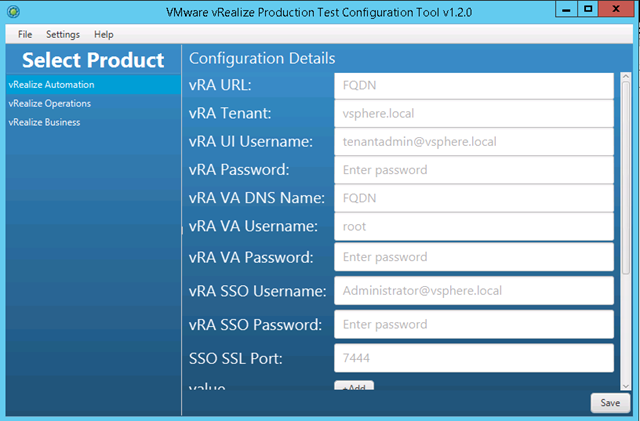
Click on either vRealize Automation, Operations or Business on the left hand side and start filling in all your information.

vRealize Automation

If you have selected the vRealize Automation option and have your vRA portal load balanced then ensure the vRA URL is the VIP URL of your load balancers. The rest of the information is fairly straight forward.

image

For the endpoints I clicked the add button a few times to add additional fields so that I could enter not just my vCenter endpoints but also my vRO and NSX endpoints.

image

For the vRA Tenant name above go to https://your-vra-instance.com/vcac and check the name under your tenants tab and put in the exact name including the case.

image

Now save the configuration and close the UI. Now you can run the tool via command prompt by running the java -jar vrealize-productiontest-1.2.0.jar run –oobList VRA command like the example below.

image

vRealize Business

Open up the configuration UI again by running the config command as shown below

image

For vRealize Business click the option on the left and fill in the required information. The vRA tenant name can be retrieved via the method mentioned above in the vRA section ensuring the case sensitivity is maintained.

image

Once complete save the configuration and close the UI

Now you can run the test via command including the VRB acronym at the end to run the vRB test.

image

Once it completes running it will give you the number of tests runs and most importantly how many failures you may have.

image

You can then see the output of the report under the folder you ran the tool from /report/VRPTReport.html and it gives you a brilliant break down of the tests and where you may have had failures. The remediation and cause fields are URLs to VMware KB articles to fix the issues. In my lab I have three failures as you can see in the screenshot below.

clip_image001[4]

I haven’t gone through the vROPs setup but it follows very much the same method as the vRA and vRB sections. I really like the tool although it isn’t perfect for enterprise distributed installations and I had quite a few hassles with the vRA tool working but it is good and coupled with the vRA management pack for vROPs it gives brilliant reporting  of your environment.

Gregg


Leave a comment

VCDX Troubleshooting Skills

55020378So this posting isn’t about my opinion of if the dropping of the scenario is good or bad as in all honesty more time in the design scenario sounds great to me. This posting is actually about the resources I used to prepare for my VCDX troubleshooting scenario that I think an architect should know and thereby any good VCDX should also.

  • The first resources I used were actually the ones I used in my preparations for the VCAP5-DCA as this really makes you learn where all the logs are, what methods there are of troubleshooting issues and what you might be looking for. My study resources list for the VCAP5-DCA is a great start and if you are at the point of defending for VCDX you should have used some of these in your preparations but what I went over again were the troubleshooting videos by David Davis. Even though they are old the methods in them still apply especially ESXTOP etc.
  • The next resources were a mix between my two mentors for my recent VCDX attempt aka Larus Hjartarson and Rene van den Bedem. Both of them did brilliant breakdowns of how to prepare and think during the scenario and the methodology you need to keep to. These methods give you a great plan of attack even if it is a real world customer you are trying to help. Larus’ methodology is mention in his VCDX: Troubleshooting Scenario posting and Rene’s VCDX – Troubleshooting Scenario Strategy posting.
  • One resource that I felt was the best real world applicable resource I used that didn’t map perfectly to the VCDX scenario methodology but was brilliant was one that was recommended to me by Frank Buechsel who used to work for VMware GSS until recently was a book called Debugging—The Nine Indispensable Rules for Finding Even the Most Elusive Software and Hardware Problems. It’s more based at software development but each of the steps applies perfectly to troubleshooting any issues in a technology environment and now that the scenario has been stopped I can put out the loose outline from the book and kinds of questions I wrote up for each of the headings plus what I wanted to say to explain why i was asking in red that I wanted to ask in the scenario and how I thought it might fit:
    • UNDERSTAND THE SYSTEM
      • When did the problem start exactly?
      • What is meant to happen? – Why I am asking is because……………and what I’m hoping to achieve…………
      • When did you see the problem start happening? Is it recurring after a certain task or event or has it only happened once? – Why I am asking is because……………and what I’m hoping to achieve…………
      • Have any changes been made recently and are they tracked in a change management system? – Why I am asking is because……………and what I’m hoping to achieve…………
      • Have we collected logs or alerts from the systems and are we using something like vCOps where we can drill down and see alarms or alerts? ? – Why I am asking is because these mechanisms can give us ideas of the failures and possibly where it is happening if not just one location and what I’m hoping to achieve is to find the specific places the errors are showing, what the errors have been in the past if possible but also prepare for the next step of making it fail again so we can possibly see the error again or collect it for the first time.
    • MAKE IT FAIL
      • If it happens around a certain event can we try replicate the error and make it happen as often as possible? – Why I am asking is because I want to confirm the error is in fact happening at the point you mention and I’m hoping to achieve the exact step where it is happening and confirm if indeed our assumptions of when it is happening are true or not so we don’t waste time troubleshooting an assumption.
      • When are we doing the replication of the error can we document each step? – Why I am asking is because I want to confirm it is not just the step where it fails but the steps leading up to it in case a step in the sequence is then causing the eventual failure and I’m hoping to achieve the possible conflict or incorrect setting/step being followed.
    • QUIT THINKING AND LOOK
      • Are there any alarms or alerts on the source or destination system/s ? – Why I am asking is because I want to confirm not just the outcome of the failure that you mention but hopefully what is causing the failure and what I’m hoping to achieve is the point/component where we should do the troubleshooting so that we don’t make any unnecessary changes.
      • For the errors can we search the VMware/Vendor KB/Forums and see if any matches come up for some/all of the errors? – Why I am asking is because some of the errors might be known or even just give us an idea for where to look and what I’m hoping to achieve is to isolate the problem even more and not waste time looking at other components when a kb article might give us a good lead and save us precious time getting the issue fixed
    • DIVIDE AND CONQUER
      • For the machines that are failing are they the same configuration/going to the same location/coming from the same location/going over the same path? – Why I am asking is because I want to isolate the good parts/side and the bad parts/side and what I’m hoping to achieve is to focus my attention on the side that is showing the error so we don’t waste time and have less things to cover in the hope we can isolate the problem.
      • Can we try reverse the step in the opposite direction? – Why I am asking is because……………and what I’m hoping to achieve…………
    • CHANGE ONE THING AT A TIME
      • Try a migration/alteration/fix and if it doesn’t work then change it back and try something new. “Please can we migrate the failing machines to another host? “it still fails” Ok please move it back “– Why I am asking is because I don’t want to receive additional/red herring errors due to the change we made and what I’m hoping to achieve is to keep the environment unchanged as much as possible so we don’t cause additional errors/lose methods to troubleshoot.
    • KEEP AN AUDIT TRAIL (these were more writing out my thoughts and what I felt I needed to remember)
      • Write down what you did and the outcome and also WRITE DOWN THEIR RESPONSES as these may have clues!! “there are no errors in vSphere” might mean the error is not reaching vSphere for it to log the error so go “upstream” to find the source.
      • The error doesn’t sound like it is in vSphere so can we please look at the HBA on the host and ensure it is connected correctly and receiving data via ESXTOP.
    • CHECK THE PLUG
      • You state that the network connections are correct but please can we get it checked again? – Why I am asking is because I want to confirm that what we state is correct is in fact correct right now and what I’m hoping to achieve is to clear up any assumptions and have clear and confirmed facts about necessary “upstream” components.
      • Are the steps you are following worked in the past? Are we following the exact steps that worked before? – Why I am asking is because I want to confirm if it has ever worked/if we are following different processes and what I’m hoping to achieve is to confirm if it has ever worked and if a new step if causing the error to happen so we can troubleshoot what the different steps is bringing up.
    • GET A FRESH VIEW
      • Not really applicable to VCDX troubleshooting but asking for someone who is an SME in the customer might shed some new light/clear up what the exact problem is.
    • IF YOU DIDN’T FIX IT, IT AIN’T FIXED
      • Not really applicable to VCDX troubleshooting.

If you want to read about my utter joy about passing the VCDX then have a look at my VCDX #205 posting and also my VCDX Spotlight.

Next I’m hoping to dive deeper into each of the points from my VCDX #205 posting starting with VCDX Resources – Did you use them all??

Gregg


Leave a comment

VCDX Spotlight – Sam McGeown

Name: Sam McGeown

Twitter Handle: @sammcgeown

Blog URL: www.definit.co.uk

Current Employer: Xtravirt

VCDX #: 204

How did you get into using VMware?

I used to manage the IT and web servers for a charity, so the budgets were extremely tight – I had one physical server for development to replicate the live IIS and MSSQL environment and I stumbled across VMware Server. It was like magic – two servers running on one! Later that became a stand-alone ESX server and I went on from there!

What made you decide to do the VCDX?

Well Gregg, can you think of anyone who twists people’s arms into going for VCDX?

I was never sure that I could defend VCDX! I did my first VCAP (the DCA) in August 2013 which is the first real step of the path to VCDX, and I did the DCD a few months later at VMworld. Once I had those under my belt I started felt a bit more confident and that maybe it wasn’t unobtainable!

How long did it take you to complete the whole VCDX journey?

Somewhat foolishly, I swapped track from datacenter to cloud at the beginning of 2015. I had been working on a DCV design, but it wasn’t great and would’ve required a lot of fictitious components. A huge vCloud Director project landed and it was perfect for VCDX so I started study for the cloud VCAP exams. Then the CIA and CID were retired with no replacement and I was left hanging for a few days before VMware announced they would waive the VCAP requirements for anyone submitting for the CMA.

The project I used started in January 2015 and ran for about eight weeks, it was finished with two weeks to the submission deadline for the June defence that year – I managed to submit it but it was a rush! I failed that first defence and spent a bit more time preparing for the second attempt this October, which I then passed – so on the face of it 10 months.

What advice would you give to people thinking of pursuing the VCDX accreditation?

· Just do it! Don’t put VCDX on a pedestal – it is achievable!

· Read the blueprint…repeatedly – it tells you everything you need to cover

· Build a small study group of people who you can meet with regularly – online is fine – and review, practice and study together.

· Get regular input from a VCDX mentor – they’ll help keep you on track and discover strengths and weaknesses.

· Don’t wait to find out if you are invited to defend – start working towards it as soon as you’ve submitted.

· If you get invited to defend don’t just practice your presentation – practice the design and troubleshooting scenarios too.

· Talk to your partner/wife/husband/family and make sure they are with you – you will need their support and their patience!

If you could do the whole VCDX journey again what would you do differently?

That’s a tough one – as you say, it’s a journey, so the whole experience builds toward the end goal. I think I needed the experience of the first defence to be able to pass the second. I did rush my first submission, but I don’t think it would’ve made any difference if I had waited and taken my time.

I think I should’ve engaged earlier with a study group on my first attempt, but I honestly don’t know if that would’ve helped me pass first time.

Life after the VCDX?  How did your company respond?  Was it worth it?

Ask me in 6 months? It’s a bit too new to really say, it hasn’t really sunk in for me yet!

The journey has been hugely rewarding – I am a *far* better architect now than I was at the start of the journey. On a personal level, setting huge targets and then achieving them is a massively rewarding process – I think it gives you a huge amount of confidence to do so. Dealing with the failure of the first defence was tough, really tough, but moving past it, trying again, and succeeding – well that was flipping awesome!


6 Comments

VCDX Spotlight – It’s Me =0)

So I promised Mark Brookfield that if I managed to get an illustrious VCDX number I would let him do a VCDX Spotlight on me. So he formulated the following questions and I answered them as below:

1. Wow… what a journey. You’ve come a long way, but you’ve finally made it. You are VCDX # 205, congratulations! How do you feel?

I’m in utter disbelief at the moment and keep looking at the email to ensure I haven’t misread it somehow. I think it will sink in over the next few days but when you’ve been aiming for something for so long and sometimes wonder if you’ll ever be good enough to obtain it, it’s crazy to get the number.

2. You’ve made no secret of the fact that you didn’t make the grade the first time around. What would you say you did differently for your second attempt?

Quite a few things. I’ve mentioned some of them in my blog posting about my second attempt but the main ones were:

· To start earlier so I didn’t burn out and could also find time to spend with my young family.

· Not stop preparing even after submitting.

· Leaving nothing in the tank.

· Taking a week’s annual leave before the defence (last time I worked the day before and day after my defence).

· More experience in front of demanding customers. My current project certainly gave me confidence that I belonged in that defence room and my panelists were my peers.

3. After you initial rejection, did you feel like quitting? If so, what motivated you to try again?

Oh absolutely and as I told to Josh Odgers after one of our mock sessions I actually thought about giving up on virtualisation totally and doing a new job. The failure is really really hard to take and I agree somewhat when people say it isn’t life or death but after putting in so much time and sacrificing so much it’s hard to then not make the grade and know you may have to do as much if not more than you did last time.

I think I had a few motivations, my wife was very supportive and is a massive blessing in my life with her belief in me and looking after our daughter when I’m locked away in my study. The motivation to not know myself as the person who failed the VCDX and gave up, how can I tell me daughter to not give up trying if I don’t live like that myself? Also wanting to better myself and complete what I had started.

4. In some circles, certification is regarded as a waste of time. What makes the VCDX so special?

Believe it or not I somewhat agree it is a waste of time if you don’t do it for the right reasons. One of the questions I ask in my VCDX spotlights is about what has changed and more often than not people lives haven’t changed dramatically and some haven’t changed at all. I use all my certifications to force myself to learn new things as I’m actually naturally quite a lazy person who needs to be pushed. Like I said in my VCDX blog posting I know there’s people who spent 40 hours on their designs, submitted and passed first time and credit to those people but I wanted to learn as much as possible along the way so that I could truly say and agree it was about the journey.

The VCDX is special as it isn’t about regurgitating information or sadly in some circles is open to people using cheat sheets. The VCDX is about building a design that is worthy of the defence but the true test is explain that design to a panel who know when you are faking it and who also want to know why you didn’t choose other options and if you did what would be the impacts of that. Real world customers change their minds all the time and sometimes architects just accept what is told or given to them by customers rather than challenging them and trying to work out what is best for them. The VCDX teaches you this. Also with just over 200 people with it globally it shows you that it takes a lot of effort to be at that level to achieve it.

5. The road to even submitting a defence is long and arduous; I myself recently failed the VCAP5-DCD. What advice would you give to others who may be struggling?

So I failed the VCAP-DCD the first time as well and failed my VCAP4-DCA twice so don’t feel bad about failing. Learn where you were weak and try again. It’s a cliché but it’s true that it is about the journey and you have to take failures as a lesson, regroup and go at it again. One of the first things I mention in my VCDX posting is about starting early and setting a timeline of when you want to defend. Also for those who fail the VCDX the first time I know it’s painful but there are some big names who failed first time (I’m not meaning me here) and are now double VCDX’s.

6. Where to now? Kick back with a beer or onto something else?

So a bit of a break but I did make a loose plan than when I passed this defence I would maybe look at going for double VCDX and submitting a version of my current vRA design. This won’t be until next year and I might do a joint submission with a friend but at present I actually need to learn some vSphere 6 and vRA 7 as I have to pay the bills and new technology is what allows me to do that. I’m also starting a VCP6-CMA series on the vBrownbag so will be spending some of my now freed up time there and I have a second clone on the way in April next year so I’m certain that will keep me busy.


17 Comments

#VCDX #205

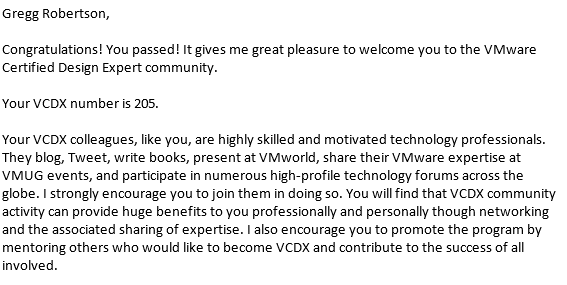
vcdxFirst and foremost I’d like to give all glory to GOD for giving me the opportunities,family, vfriends , #LonVMUG crew, colleagues, mentors, fellow defenders and the abilities to be able to attempt (twice) and now achieve this. I’m still in utter shock and have read the email almost fifty times already to make sure I haven’t misread it somehow. I received the email at 7:50 GMT and with my heart in my throat opened it and saw the words congratulations and 205 and shouted out until my throat was coarse.

vcdx


I promised Mark Brookfield I would allow him to do a VCDX Spotlight on me so below is more a thanks and also an encouragement for those who think it’s impossible to achieve.

A lot of people have given amazing advice on the VCDX and I have no plans of rehashing any of that but some quick advice which I might break down into separate posts over the next few weeks are which I would have given to myself at the start of the process are:

  • It’s never too early to start aiming and preparing for the VCDX. My design was an enhanced (learnt how to make it better) real world design I did at my first gig as a technical consultant almost four years ago.
  • Make plans for when you want to submit and keep to it. I’ve been part of a number of really great study groups which then whittled down to a core few just before defences and the benefit from them is amazing. Both Ray Heffer and Hugo Phan have done brilliant postings around making a plan and also not using excuses of why you cant do it.
  • Make sure you also learn T skills. This is one of the major reasons I failed my first attempt as I just didn’t have the t skills around the supporting technologies and was more a VMware SME than an Architect who does VMware designs. Rene van den Bedem has a brilliant list   (the study plan ones in particular I am referring to here) which I used to learn everything as well as my own VCDX Round 2 list. I’ve got a lot of feedback where people say I went overboard in my preparations and people have passed after doing a design in forty hours. If you are like that and can do it in forty hours then hats off to you but I wanted to use the process to force myself to learn new things and so for my second attempt left nothing in the tank.
  • Don’t leave it too late. I did this with my first submission where I left too much to do near the end and even though I managed to submit and get a defence invite I was so burnt out that I didn’t keep the momentum going after submitting and then just couldn’t find enough time to join my study group before the defence. If you have a good plan and schedule you can find time to relax with the family and learn, you just need to work out realistic times to do it. Like Ray says in his posting I too have been on a project away from home (in Rotterdam) and even though it was painful to force myself to do it I would read and study on the plane and train and airport back and forth each week. I know one of my mentors Larus Hjartarson took the bus each day to work so he could read and go over his quizlet questions.
  • Do you want it more than X? This was a massive one that stayed in my head for my whole second attempt and links back to the past two points as well. Each day when I remembered I would watch the following two videos and really listen to the words https://youtu.be/scr2PrcDxEo and  https://youtu.be/mgmVOuLgFB0. Each time I wanted to go for a drink with friends or when I wanted to go watch a tv program I would ask myself how bad do I want to be a VCDX and become better? Now not eating or drinking is a level too far and not advisable but being willing to sacrifice to attain what you want is very applicable. The second video was more about getting myself out of my pity party around my first failure and getting back into the ring. I do think you need to take a break right after as you don’t want to burn out but as they say in the video “Pain is temporary……it will subside, if you quit however the pain will last forever”. I didn’t want to be a person who failed once and never tried again, now I know some people have done this for the VCDX and everyone has their own reasons and I certainly don’t mean my situation applies to everyone but I knew I needed to go again.
  • Learn on the job. Ray mentions this partly in his posting but as obvious as it sounds I didn’t utilise my time in my day job surrounded by smart people to learn off them and try apply that to the VCDX. I’m very fortunate to have been on projects with some extremely clever people but I never tried to absorb their knowledge like I have in the past year. I was weak in storage and networking after my last defence and so i spent loads of time with those SME’s on my current project learning and asking them questions. Also learning soft skills like customer presentations from colleagues has had a massive impact on my confidence.
  • You belong in there. Last time I defended I walked into the defence like I was an unworthy worm in front of super stars. Now don’t get me wrong the guys on your panel are smart guys but they are also your peers and going in there with the mindset that it is a number of your peers who are interested in your design and want to learn how you did certain things and why made me much more confident and calm when I was grilled by the panel. This partly comes down also to my previous point about working with super smart people who are your peers. If you feel you don’t have these kinds of peers around you then maybe it’s time for a new job or role or more responsibility?
  • Never stop learning. It’s amazing to me how much I learnt about my vSphere 5.0 design from my vRA 6.1 design that I’ve been doing for my current customer. Very much like the point about learning on the job, I asked VCDX like questions to my customer and from seeing how certain thing worked I knew how to not only better my old design but also the reasons not only why I chose something but why I didnt choose the others.
  • Choose people you trust and know. I was very fortunate to have some amazingly clever guys as part of both of my preparations who were my mentors and study partners. If you want the VCDX then surround yourself with people who want it as badly as you do and are willing to make the same sacrifices to obtain it. Larus wasn’t even my official mentor but was amazing at doing mocks with my core study group and answering questions wherever he could. My official mentor and fellow defender in my first attempt Rene van den Bedem is as I’m sure you are aware very motivated and has some insane methods to better yourself. I followed all of Rene’s advice and spent most of my time related to my design for my second attempt revamping it to follow his requirements matrix idea and not only did it help me really learn why I did things but also to make sure I did meet all the requirements the customer had

Now it’s time for me to have a bit of a break. I am contemplating submitting for my double in the future especially seeing as I’ve been doing cloud work as VMware PSO for the last few years.

Lastly there are just too many people to thank for their advice, help, brutal honesty and support. Also I would like to thank the panelists who don’t get much thanks for the work they do in their own time to keep the program going. I promised myself I would be a mentor when I passed and I am going to keep to that (not that I’ve bene asked to be a panelists tbh) .

Gregg

PS: Someone on twitter asked how do I feel now that I have passed. The best way to describe it is 18:00 onwards into this video


Leave a comment

VCDX Spotlight: Jens Hennig

Name: Jens Hennig

Twitter Handle: @hennig_jens

Blog URL: comdivision youtube channel

Current Employer: comdivision consulting GmbH

VCDX #: 196

How did you get into using VMware?

I started in 2004 with ESX 2.0 at a German manufacturing company. The design evolved and we added more and more advanced components with the new versions. We progressed from a test/development phase to full production VMs. When the first VDI product went beta (it was called VMware VDM back then), I liked the idea of having a virtual desktop and from that point in time I was also a fan of EUC. Working for comdivision consulting as an VMware Instructor made me go through all the advanced topics of the VMware SDDC.

What made you decide to do the VCDX?

I was an early adopter of the VMware certification program, starting with VCP-2. I kept my certifications current up till now and also did many of the VCAP exams, because I felt like this was the natural next step. In my career and especially as part of the comdivision team, I do not only create designs for new infrastructures, but also review designs from my colleagues.

How long did it take you to complete the whole VCDX journey?

The VCDX journey started last year in Summer, when we attended the one-time 5 day preparation offering at the VMware headquarters in Palo Alto, California. Back then we had a lot of ideas and a few concepts, but no real strategy. We aimed for a February defence, but realistically we moved the defence to June where I passed in the first attempt.

What advice would you give to people thinking of pursuing the VCDX accreditation?

I found it very useful to work on a joined design together with my colleague Yves Sandfort. While Yves wrote the parts of the design that dealt with the Cloud environment, I could focus on the desktop side. This way we could also discuss and debate a lot of items that needed to be clarified before we even went into the phase of mock defences and final preparation. During this time I easily spent more time with Yves than with my wife or anyone else. You need to be good friends to go through all the ups and downs of a VCDX design preparation.

Start building the defence presentation from the first minute. Building it after the design and before the defence made it cumbersome in some areas.

Start early and create a timeline/project plan. Stick with it, no excuse, don’t delay until last minute and do not wait for the dates of next year to show up. You can always start and finish it.

If you could do the whole VCDX journey again what would you do differently?

I would probably have a better time / project management in order to have a better overview of what is done or missing and I would start building my slide deck earlier. Apart from that I am pretty happy the way it went.

Life after the VCDX?  How did your company respond?  Was it worth it?

Life did not change so much. I still design architectures, but the way I create them has changed. With all the reviews and mock-defences I did, I think I have a better eye for erroneous designs right now. I don’t believe a certification has to be reflected directly in salary – it will pay off in a different way.


1 Comment

VCP6-CMA track on the EMEA #vBrownbag

Now that my VCDX defence is over and hopefully I’ve done enough to be awarded an illustrious number I can pick up my old responsibilities for the EMEA vBrownbag of which I am one of the hosts and decided that the VCP6-CMA track would be a great one to do.

african children dancing - Lets learn Some vRA goodness

We are going to be going through the blueprint in order so that it is easy to follow and watch as well if you are subscribed to the iTunes feed. So starting next week Tuesday at 7pm GMT (Clocks have changed in Europe so this is GMT not BST) we will be doing objective 1 and it is being covered by one of the co-hosts of the vBrownbag, Frank Buechsel. You can register for the series and future vBrownbag EMEA sessions via the following link https://attendee.gotowebinar.com/register/8540909933274906113 and can also subscribe to the vBrownbag YouTube channel.


If you are interested in covering an objective on the vBrownbag then please get touch as we are always looking for presenters.


Gregg


Leave a comment

VCDX Spotlight: Yves Sandfort

Name: Yves Sandfort

Twitter Handle: @yvessandfort

Blog URL: Not really blog… comdivision youtube channel

Current Employer: comdivision consulting GmbH

VCDX #: 203


How did you get into using VMware?

I started with VMware workstation and my company back then also operated a datacentre for hosting where we adopted ESXi with Version 2. While I did my VCP on V3 I was asked to become a VMware Instructor by VMware on V4, back then the classes were far more tech than today. I immediately went from standard to all the advanced topics. Then I evolved and was one of the first evangelists around first vCloud Director, then worked a lot on what is now called vRealize Suite (vR Ops, vRealize Automation etc.). My team has been embedded in parts of the vRealize BU within VMware and we do PSO and Training still for VMware but also direct.

What made you decide to do the VCDX?

To be honest VCP and VCAP was a great experience but even in my early days I always wanted to go one way up. But you know it’s something which you keep saying and never really do. Then a while back we had a team meeting at a customer site and three of us decided we go for it. Currently we help others who are looking into it to stay focussed.

How long did it take you to complete the whole VCDX journey?

We really started last year in Summer with preparation and then attended the one time 5 day prep offering at VMware HQ in Palo Alto last year. That really helped us get things straight. Then we aimed for the February date, but couldn’t make that so we moved the defense to June. Jens Hennig passed, I had to redo now in October.

What advice would you give to people thinking of pursuing the VCDX accreditation?

Set clear target dates and stick to them, no excuse. And don’t set your targets purely based on defense dates. Most people expand their VCDX design of a customer story, which you should. You can always add fictitious parts, but do not go 100% fictitious! Treat it like a real customer project, a customer does not accept being pushed out again and again. Find people to work in teams. We had such a good experience working on the design and so many long and good discussions during the design creation process. You need to be friends or you need to become close friends, as there will be times you would like to kill each other. And every level of honesty must be allowed, it doesn’t help if someone tells you: “Ah that’s great” and thinks “Oh that is useless”.

Think graphical, a lot of people tend to create text graves in both the design and even more the presentation. Have workflows and pictures allow a more fluent explanation.

If you could do the whole VCDX journey again what would you do differently?

Actually not that much, I would pursue it again as a team, two people were ideal in our scenario. The only thing: Work on the presentation while you write your design! By your submission ideally your deck is ready. Many people had the same experience that they found areas they would like to edit when they did the presentation afterwards.

Life after the VCDX?  How did your company respond?  Was it worth it?

It’s all still new, as I own most of the comdivision group there is not much change directly, however I think I will change my way how I do work. I would encourage people not to go for VCDX for a raise, it’s personal development and it will pay off on maybe different levels.