TheSaffaGeek

My ramblings about all things technical


Leave a comment

VCDX-Cloud and DT VCAP Requirements Waiver Extended

A quick posting for those who may have missed it that the waiver of the VCAP requirements to submit for VCDX-Cloud or VCDX-DT has been extended to the October defences. This means if you are thinking of defending VCDX in either of these paths you have until August 25th to build a design and submit it as long as you have the VCP in the track.

waived


I know a number of people who were working tirelessly to get their submissions created before the April 1st submission delaine for June defences and this will certainly relieve some pressure there and will also mean a second shot opportunity for those who submit in either of the tracks for June using the waiver and don’t achieve the certification.


Good luck to all of those looking to submit for June and those now thinking of submitting for October.


Leave a comment

VCDX Spotlight: Chris McCain

Name: Chris McCain

Twitter Handle: hcmccain

Current Employer: VMware

VCDX #: 79

How did you get into using VMware?

I was an independent contract trainer/consultant/author. I wanted to stay on the forefront of technology. I was impressed with my first experiences with VMware Workstation so after digging deeper into the GSX and ESX products I decided to engage VMware on the idea of providing training services. This led to wanting to publish a book, Mastering VMware Infrastructure 3, and thus began a career in virtualization.

What made you decide to do the VCDX?

I decided to do my VCDX to become the first US-based VMware Certified Instructor to also hold a VCDX as well as to jumpstart my consulting opportunities.

How long did it take you to complete the whole VCDX journey?

My VCDX project was in place for almost 2 years before I came to idea of submitting for the certification. After deciding on VCDX, I spent approximately 3 months finalizing the application and supporting documentation. In the month prior to my defense session I performed two mock defences with colleagues in order to ensure my presentation and my timing were sufficient.

What advice would you give to people thinking of pursuing the VCDX accreditation?

The VCDX certification is not something you study for. It is not a set of skills that you learn in one week and then feel prepared. Your abilities as a design expert are crafted over your experiences in the field, in the classroom, in meeting rooms, or at conferences. There will be no question in your mind when you know you are ready to take that step to VCDX. There are many folks with technical expertise, those who know the products inside and out. But you have to be able to articulate that knowledge in an ad-hoc, shoot from the hip manner. Anyone pursuing the VCDX should practice delivering that information. Its easy to find opportunities to hone these skills. Leverage your existing job role to set appointments with customers to white board a solution architecture or teach your co-workers about a certain feature of a product.

If you could do the whole VCDX journey again what would you do differently?

Nothing. In my opinion, the two keys to a VCDX are; 1) technical knowledge and 2) presentation and delivery skills. My experience as a consultant and author prepared me from a technical perspective while my experience as a trainer prepared me from a delivery perspective.

I did do it again. I earned VCDX-NV in 2013.

I will do it again.

Life after the VCDX?  How did your company respond?  Was it worth it?

After my VCDX I found more opportunities for bigger projects where I played lead roles. My only regret on the VCDX is that I did not do it sooner. I could have been VCDX 007. 🙂


Leave a comment

VCDX Spotlight: Ray Heffer

Name: Ray Heffer

Twitter Handle: @rayheffer

Blog URL: www.rayheffer.com

Current Employer: VMware

VCDX #: 122


How did you get into using VMware?

I was working for an ISP at the time and was fortunate enough to be responsible for customer hosted services. This was 2004, way before private cloud and back then it was all about managed services. I first got my hands on VMware GSX, then soon after started tinkering with ESX. By 2007 I had my first VCP and was piloting VDM 2.0 beta (now Horizon / View).

What made you decide to do the VCDX?

When I first joined VMware in 2011 there were already a few VCDXs working in the professional services team. For me it was a goal to becoming a consulting architect, but also a personal endeavour to prove my abilities to myself. Without drawing comparisons to post-grad education (because it’s not) it did present a challenge over the longer term, rather than study then take an exam.  

How long did it take you to complete the whole VCDX journey?

I took my time. Although I already had a few designs under my belt, I wanted to approach a customer design engagement with VCDX in mind from the start. That particular customer project lasted 12 months so I was able to go through all of the design phases (discovery, assessment, plan & design, build & test, etc.) and put emphasis on each phase.

What advice would you give to people thinking of pursuing the VCDX accreditation?

Firstly don’t try and rush it. Really. Spend as much time as you need on the design, and make sure you read the blueprint! It may seem obvious, but I have seen designs that completely miss some parts of the blueprint out. Also you may need to dust off an old design. This is ok, but try and update it even if you have to introduce some fictitious elements.

The next biggest tip is to avoid just filling in a design template. VMware partners and professional services have access to delivery kits and design templates. Feel free to use them but remove all of the sample content and use your own material. The secret formula? Set yourself a high standard of documentation and clearly articulate the design, mapping the customer requirements to each design decision you make.

If you could do the whole VCDX journey again what would you do differently?

I wouldn’t change anything. After all I managed to pass first time so I must have done something right. However, looking back on my design now is eye opening. The journey doesn’t end once you achieve VCDX. I can pick so many flaws with my original design now I look back at it. That said, the VCDX process doesn’t look for the ‘perfect’ design and I remember putting in over 100% so that is what matters.

Life after the VCDX?  How did your company respond?  Was it worth it?

Yes it was worth it. In fact I had just transitioned to a new role within VMware while waiting for the results. Everyone in my new team knew I had just finished the defence panel so there was a lot of pressure to succeed. Until someone goes through the process themselves I don’t think many people realize how difficult it can be.

Since getting my second VCDX (Desktop), customers often ask for me by name which does wonders for my reputation within VMware. It also allows me to work on some very exciting projects which means I get to work with some big names in the industry.

Life now? It has simply made me realize that there is so much more to learn. It never stops 🙂


Leave a comment

VMware Knowledge Nuggets – Percentage of Host Resources Admission Control

As started and introduced in my introductory posting around the VMware Knowledge Nuggets I am posting compact VMware knowledge nuggets which I hope will show people some unknown features or things they need to think about around choosing features and maybe even get some good discussions going via the comments section.


Using Percentage Based Admission Control and the usage of das.vmMemoryMinMB and das.vmCpuMinMHz.

This discussion stemmed  from the twitter discussion I had with Ed Grigson a few weeks back as mentioned in my first posting (albeit a tangent off of it) . I commented that even if you use percentage based admission control it is still a good idea to configure the das.vmMemoryMinMB and das.vmCpuMinMHz advanced settings to provide a better idea when HA is doing the math for admission control and prevent overcommitment with a specified minimal amount of resources for each virtual machine.


Rather than re-cover what has been done and explained so well,  the following two postings from Duncan Epping and Josh Odgers respectively cover it perfectly


Using das.vmmemoryminmb with Percentage Based admission control

Example Architectural Decision – VMware HA – Percentage of Cluster resources reserved for HA


Certainly something to keep in mind when doing designs and even something that you may determine is good to add to your existing environment. Although remember that admission control is not about resource management as described really well by Duncan Epping in his article here. Funnily enough I think a discussion I had with Duncan at the 2011 Europe VMworld around a customer using reservations with percentage based admission control for resource management caused him to create the posting.


1 Comment

VMware Knowledge Nuggets

Over the past few weeks I have had several discussions around VMware features and technologies via twitter where someone asked a question or made statement around a VMware vSphere feature and the subsequent discussions seemed to shed some light on things people either didn’t know or had forgotten.


So my idea is to create a series of blog postings trying to cover compact VMware knowledge nuggets which I hope will show people some unknown features or things they need to think about around choosing features and maybe even get some good discussions going via the comments section.

nuggets

Does excluding VMs from HA exclude them from admission control calculations?

This question was posted by fellow London VMUG attendee Ed Grigson a few weeks back via twitter as shown below


image


Due to my aiming to reattempt my VCDX defence soon I have been reading and learning as much as is possible and had come across the answer to this during my reading of Duncan Epping and Frank Denneman’s vSphere 5.1 Clustering Deepdive book and responded to Ed with the answer which is No. Even if it is disabled within HA, it is still included in admission control calculations. So be mindful of leaving machines lying around in your cluster as depending of your admission control policy this could have varying impacts on your ability to power on machines.


Leave a comment

Requesting Certificates for vRealize Automation Components


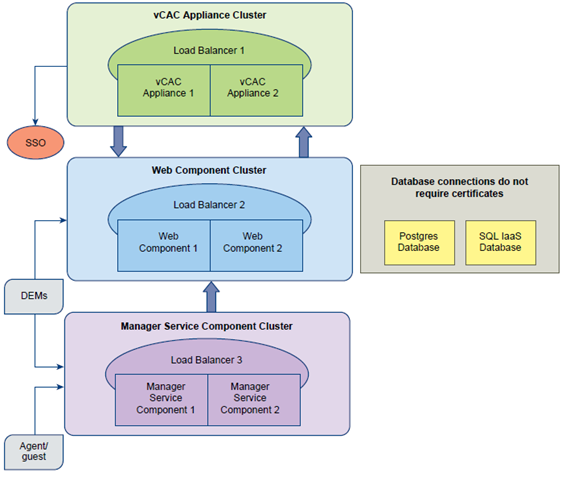
For the project I am currently working on we are doing a distributed installation of vRealize Automation with load balancers and therefore internally signed as a minimum is required. the trust requirements of these are shown below from the diagram in the vcloud-automation-center-61-installation-and-configuration document.


image


Now the point of this posting is that I personally found it fairly confusing what is required in the cfg files and why it is required as my customer challenged all of the portions of the cfg files we were supplying them to ascertain if they were in fact a hard requirement and what the impacts would be to their security if they signed our certificate requests. Also due to them using UniCERT-PKI-software ,the creation of the template to sign the requests was not as simple as it would be via a Microsoft CA.

Requesting the certificates

For the certificate requests Eiad Al-Aqqad has done two really great postings (part 1 and part 2 ) around the formats required and using openssl to create the certificate requests. For me the certificate requests via openssl wasn’t an option due to the PKI being used so I needed to supply the requests in cfg format as per the example below (sanitised of course) with the portions I needed to change in blue.


[ req ]
default_bits = 2048
default_keyfile = rui.key
distinguished_name = req_distinguished_name
encrypt_key = no
prompt = no
string_mask = nombstr
req_extensions = v3_req
[ v3_req ]
basicConstraints = CA:FALSE
keyUsage = digitalSignature, keyEncipherment, dataEncipherment, nonRepudiation
extendedKeyUsage = serverAuth, clientAuth
subjectAltName = DNS:vRAApp1, DNS: vRAApp1.TheSaffaGeek.co.uk, IP:192.168.1.1, DNS:vRAApp2, DNS: vRAApp2.TheSaffaGeek.co.uk, IP:192.168.1.2, DNS: DNS:TheSaffaGeekvRA, IP:192.168.2.1, DNS:TheSaffaGeekvRA.TheSaffaGeek.co.uk

[ req_distinguished_name ]
countryName = UK
stateOrProvinceName = South England
localityName = London

0.organizationName = TheSaffaGeek
organizationalUnitName = TheSaffaGeekLab

commonName = TheSaffaGeekvRA


For the SubjectAltName section I was challenged around the requirement I had submitted with the IP:192.168.1.1 included ,which is actually just a VMware recommendation so this could be dropped from my request. Another section that had conflicting information was for the organizationalUnitName where it was stated that this needed to be unique for each vRA component. This is only applicable if all the vRA components (this also applies to vSphere components btw) are installed on the same server as stated in this vCenter certificates kb and quoted below:


Each SSL Certificate needs a unique Distinguished Name (DN). The examples in this article use the OrganizationalUnitName (OU) field to achieve this uniqueness, based on a configuration where all components are installed on the same server. If the services are all on separate servers, they have a unique DN by default.


Due to us deploying a distributed installation this was not applicable and so the customers standard could be applied for this section.


Hopefully this is beneficial to people coming across the UniCERT-PKI-software and having to motivate why certain entries are required and others are just nice to have. If it isn’t then it’s just here for my future reference 😀


Gregg


Leave a comment

#vBrownbag #VCDX Series Follow Up

As people may or may not be aware the EMEA vBrownbag of which I am a co-host have been doing a VCDX series covering a number of topics around the VCDX and preparations for attempting it. We have done three sessions and all three recordings are below:

Next week we will have John Arrasjid and Mark Gabryjelski continuing the delivery of additional infrastructure architecture design advice and recommendations from a recent presentation John delivered at the Singapore vForum where he stated all three sessions of the presentation were full.

Also a special shout out and thanks to Rene van Den Bedem aka VCDX133 for co-hosting with me and supplying so many questions as well as answers on the VCDX Panel session. Go check out his VCDX series of postings if you want some of the best VCDX material available.

Koala can't believe it - Over VCDX 50 postings Still maintains a day job and wife?

Gregg


8 Comments

#VCDX Mentor Rallying Call

First off let me give you a bit of background as it does apply to this posting and my reason as to me posting this.

As you may or may not be aware the VCDX certification team decided to remind people of the current policy (even though it seems some people only have heard about it recently) that VCDX panellists are not allowed to help potential candidates with reviews, mocks or mentoring. For this I have had numerous heated discussions with Chris Colotti who I must apologise to as my frustration at some of it he received and he is honestly trying to make it better and in actual fact my frustration is grossly misdirected.

rage

It is in fact directed at the lack of mentors who are willing to help grow the VCDX community and help out people who are at varying stages of the process. Now I do want to say there are  VCDX who are amazing at giving back ( good friend VCDX133 is one of these but there are MANY like him who have also been doing it for years) but like I know this community has proven so many times before I am asking current VCDX to give back even if you didn’t have it during your preparations and am sending out a rallying call to all VCDX to become a mentor.

mentoring

There are currently 186 VCDX holders with some even being double VCDX, but at my last count there are only 32 people listed on the VCDX directory who are open to being a mentor for those looking to obtain this illustrious  certification. Yet there are at my last count 53 people listed as panellists and this is where I am asking current VCDX to think about becoming a mentor. Disclaimer I am fully aware VCDX holders also have full time jobs, family and it is something you have to realistically be honest if you have the time to help that person you are mentoring to help them think about their design and open their mind to see their design in a whole new holistic way /Disclaimer

matrix

I was asked by Chris that when I get my VCDX will I try help build the VCDX community and I certainly will by not becoming a panellist (if I was asked, although at present they are trying to keep it to VMware employees) and becoming a mentor to help people looking to obtain the accreditation. Now there have been a few blog postings about the fact that just because you got the VCDX it doesn’t mean you’ll get that promotion or mean you’ll instantly get an architect role which I think is really valid but the amount I have learnt and continue to learn in my second attempt at the VCDX is certainly preparing me in my role as a senior consultant and on other projects as an architect (Ray come join Xtravirt and I’m sure we have architect roles for a double VCDX Smile ). Also from the number of people i have spoken to who have been mentors or helped people with reviews that have said it has helped them become a better architect it really can be a win win situation.
So if there are any VCDX reading this or you know of a VCDX who isn’t listed as a mentor nor a panellist then please think about becoming a mentor/get them to think about being a mentor and let us disprove those who say the VCDX can’t have a large community structure around it like Matt Cowger rightly feels it should.

vcdx mentor

Lastly Chris is talking about a “cool off” period for those who don’t want to be a panellist anymore and would rather give back to the community and be a mentor to keep the community strong. So keep an eye/ear out for that if you do want to answer my battle cry and be a mentor.

Gregg


Leave a comment

Win 3 vSphere Home Labs from VMTurbo

5.1(250x250)As part of the release of VMTurbo’s Operations Manager v5.1 product they are giving away not one not two but three home labs to winners (one each) who sign up for their 5.1 release in-depth webinar on the 19th of February! I was fortunate enough to join a bloggers webinar about the announcement which I will be posting a blog posting about soon. But I bet if you are like me you want to know the specs of the home labs! Well here it is:

  • Intel NUC with Intel Core i5-4250U
  • G.SKILL Ripjaws Series 16GB (2x8G) 204-Pin DDR3 Memory
  • SAMSUNG 840 EVO 250GB SATA III TLC Internal Solid State Drive
  • Synology DS415+ Diskless System DiskStation 4-Bay NAS
  • 2x Dell 1TB 7200 RPM SATA 3.0Gb/s 3.5″ Hard Drive
  • Cisco SG300-10 10-port Gigabit Managed Switch
  • Rosewill 7ft. Cat 6 Network Cable

I could certainly do with that in my home lab  and if you aren’t a customer of VMTurbo and you want a free 30-day trial then sign up here.

Gregg


Leave a comment

vExpert 2015 – Honoured

Late yesterday (well in the UK it was late) the 2015 vExpert list was released. I am truly honoured to have obtained it for the fifth year running (2011-2015).

For those who don’t know what this means and think it is just another certification I have done (I admit I do sit a large amount of exams) below is a brief description of the award and what it is for:

The VMware vExpert Award is given to individuals who have significantly contributed to the community of VMware users over the past year. vExperts are book authors, bloggers, VMUG leaders, tool builders, and other IT professionals who share their knowledge and passion with others. These vExperts have gone above and beyond their day jobs to share their technical expertise and communicate the value of VMware and virtualization to their colleagues and community.

What did you do last year to get it?

As the vExpert designation is given for the work you did in the previous year, when people ask how they can become one or what did I do to be selected it is always around half a year behind what people should have been trying do to be in contention to be selected. For me I did some of the following:

–  VMware Communities Moderator

–  Co-hosts of the EMEA vBrownbag podcast

–  Co-host of the vBrownbag VMworld TechTalks and the Opening Acts.

–  Blog often from this blog on VMware matters and announcements. Specifically around VMware exams and study resources for the exams and my attempt at VCDX.

–  Beta tester of numerous VMware products

–  Active member of the VMware Communities

–  Active member of the London VMUG

I did all these things I love doing them and I’m passionate about the technology not because I wanted to become a vExpert though and I would recommend doing it for the right reasons and not because you want to get something out of it.

Massive Thanks

A massive amount of thanks to Corey Romero and his team who run the vExpert program and for feeling I was worthy of the designation. Also congratulations to all the other  vExperts!! There are a number of newcomers and as many returning vExperts so it is great to share this designation with so many passionate and amazingly friendly people.

 Xtravirt Taking the Lions Share

Lastly I would like to congratulate all my Xtravirt colleagues who obtained the vExpert designation this year for a total of twelve of us namely:

  • Curtis Brown
  • Jason Meers
  • Jim Griffiths
  • Jonathan Medd
  • Michael Poore
  • Michael Rudloff
  • Paul Davey
  • Sam McGeown
  • Sean Duffy
  • Simon Eady
  • Steve Dunne
  • Me Smile

Even though we sadly had Darren Woollard, Seb Hakiel and Ather Beg all decide to try something new we still kept out high numbers and for a company of under 50 people with under thirty being consultants this is certainly something i’m impressed with and proud to be a part of and should earn us the highest percentage per number of employees accolade again. If you want to join Xtravirt and work with 12 vExperts doing cutting edge virtualisation work then drop me a dm on twitter on @greggrobertson5 and I can put you in contact with the right people.

Gregg