TheSaffaGeek

My ramblings about all things technical


Leave a comment

VCDX Spotlight: Kalen Arndt

Name: Kalen Arndt

Twitter Handle: @KalenArndt

Blog URL: www.vmrage.com

Current Employer: World Wide Technology

VCDX #: 132


How did you get into using VMware?

When I was working as a customer I had to do a rip and replace of ESX 3.5 to ESXi 4.1 with new hardware. I learned a ton about virtualization and when I first vMotioned a VM I said “Wow this is awesome and I have to work there.” I moved across the country to work for VMware where I worked commercially in networking/storage/fault support for about a year. After that I moved onto the Federal team at VMware where I was a TSE , Research Engineer, and then Escalation Engineer. I finally decided that I wanted to architect environments and I left for WWT where I implement large scale environments that leverage VMware.

What made you decide to do the VCDX?

It was a challenge! I did the same thing with my VCP and then my VCAPs for DCV and View and finally hit the point where I felt I would be comfortable defending.

How long did it take you to complete the whole VCDX journey?

I initially planned for defending for 4.1 and then 5.0 came out and I switched teams. I would say the initial 4 submission was about 6 months. After I left VMware I spent about 8 months working on getting my VCAPs and submitting my defence for 5.5

What advice would you give to people thinking of pursuing the VCDX accreditation?

Be honest and know your defence. I wrote an entire article about helpful things for future candidates can do here : http://www.vmrage.com/vcdx-dcv-overview/

If you could do the whole VCDX journey again what would you do differently?

I would have tried doing more mocks and additional proof reading of my design prior to my submission. I do plan on submitting for VCDX-DT with a totally new design from a previous implementation. So I guess you could say that I get to do over half of it over again Smile

Life after the VCDX?  How did your company respond?  Was it worth it?

A lot of people followed me on Twitter now which is pretty awesome. I am currently making a huge effort to mentor future VCDXs throughout the process. We had a few mentors and it was a HUGE help to the group.

My company was extremely excited that I had obtained it.

It was worth it to me because it was goal that I set and I finally did it. I loved the product enough to uproot my life to work on it and I am glad that I mastered one of their certification tracks. I plan on advocating it even further in the future


2 Comments

VCDX Spotlight: Josh Coen

Name: Josh Coen

Twitter Handle: @joshcoen

Blog URL: valcolabs.com

VCDX #: 129

How did you get into using VMware?

In 2006, when I was active duty in the U.S. Air Force, we had a project to stand up a lab for testing patches and other projects. A server was bought and VMware Infrastructure 3 was purchased, but no one had training. I was brought into the project and sent to San Diego to take the VMware Infrastructure 3: Install and Configure course (coincidentally, Rawlinson Rivera was my instructor). I was immediately hooked and knew that my professional future had to include virtualization.

What made you decide to do the VCDX?

After I started doing the VCAP5-DCA I decided I wanted to go for VCDX. The two biggest drivers for me was the challenge it presented and the doors it might open; professionally and monetarily

How long did it take you to complete the whole VCDX journey?

It took me roughly 12 months from the time I completed the last of the VCDX prerequisites (VCAP5-DCD) to the time I defended

What advice would you give to people thinking of pursuing the VCDX accreditation?

Don’t give up. There were plenty of times during the process that I questioned “why am I doing this” and even contemplated quitting. These questions came when I got stuck on a particular part or section in the process and was unsure how to move forward. If that sounds familiar, take a break, clear your head and keep at it. Eventually something will click and you will break through

If you could do the whole VCDX journey again what would you do differently?

I would have tried to complete it sooner. I had the potential to defend sooner than I did had I got off my butt and completed the required documentation. Don’t procrastinate.

Life after the VCDX?  How did your company respond?  Was it worth it?

I’m not sure what’s next professionally, but I’m keeping an open mind. Personally, I’m going to focus on continuing to learn Spanish as well as Python. My company didn’t support what I was doing. All time and money associated with VCDX were my own. It was definitely worth it. A very rewarding experience and I’m glad to have went through it.


Leave a comment

VCAP-CID Objective 2.1 – Determine Catalog Requirements for a Logical Design

Knowledge

Identify what can be included in a published catalog.

  • A published catalog is one that is created in the administrative organisation with all the required components and  vApp templates published to all other organisations in the vCloud environment. Good design practice to only allow the administrative organisation to publish its catalog and deny this ability for all the standard organisations.
  • The components that can be included in a published catalog are:
    • Standardised gold master vApp that can consist of a single virtual machine all the way to 3 tiered offerings like a web service with a web front end, an application server and a database server. These are verified templates that meet regulatory and security standards which ensures consistency across the environment and provides the consumers with verified offerings that can be deployed with ease.Guest customisation changes the identity of the vApp and can be used for post-deployment steps, such as the joining of vApps to domains.
    • vApp Templates which can cannot be deployed but can be deployed (instantiated), creating a vApp that can be deployed and powered on.
    • Media like ISO files for software and applications. These are also verified and commonly customised to ensure standardisation and to provide specific capabilities.

Identify what can be included in a private catalog.

  • A private catalog can have the exact same components but it is controlled by the user/group assigned the Catalog Author vCloud role. This catalog is limited to a specific organisation and good design practice states you should limit the ability to publish this catalog thereby making it a private catalog.
  • This can still contain standardised vApp’s and ISO’s and if you are a service provider this is where the cloud consumer will place their standardised vApp’s and ISO’s so that the organisation can use them but other organisations cannot.

Identify permission controls for catalogs.

  • There are three Predefined roles in vCloud that have varying permissions and rights to make changes and create components in catalogs. A breakdown of the predefined roles and their rights are contained in this documentation centre link

Explain the functionality of a catalog.

    • This should be straight forward as this is VCP-IaaS level and I think all the previous sections define it pretty well also. But just in case i have pasted the VMware definition below:
      • VMware vCloud Director uses the concept of a catalog for storing content. Organizations have their own catalog that they can populate and and share the contents with other organizations and users.

All entities in the catalog are stored in a content repository system. The content repository, a component in the vCloud Director storage subsystem, provides an abstraction to the underlying datastores while offering features to store, search, retrieve, and remove both structured and unstructured data.

Skills and Abilities

Based on application requirements, determine appropriate vApp configuration.

  • As I mentioned for the published catalog and private catalog sections above you can configure vApp’s with multiple tiers to allow the organisations to provision these offerings in their vCloud organisation and maintain standardisation. If a customer asks for a web service offerings then you can provide them with a three tiered vApp with a web front end, an application server and a database server. There may even be a requirement for availability of the offering so you will created multiple front end, application servers and a clustered database back end.
  • Using the web service example this will also require different networking to ensure the security of the offering which will mean different servers connecting to different networks and vCNS endpoint devices being configured as part of the vApp. I am planning on creating a few of these as practice in visio so that I can visualise them and make sure I know what they should look like in case a visio style question comes up or i just need a good mental picture to make decisions for questions.

Determine appropriate storage configuration for a given vApp.

  • This follows closely to what I covered above but now you need to think of the storage offering the vApp components are going to be kept on and what storage you are going to allow the vApp to be deployed onto. Using my trusty web service example you wouldn’t want the database sitting on low end storage as this would severely impact the service.
  • This is what I think they are asking for so if you think i’m wrong then please do tell me as I’m also learning and sometimes it’s difficult to gleam what they mean as this could also relate to fast provisioning.

Given customer requirements, determine appropriate catalog design.

  • I think for this if you have created catalogs countless times and know what you can put in there and that they can be published to specific organisations from other organisations or published to all from the administrative organisation then designing it should be simple enough.

Determine the impact of given security requirements, on a catalog structure.

  • This may be numerous things but there are times when an organisation wants only certain vApp’s and ISO’s in a catalog to be available to certain people and so you can configure the catalog to have certain portions only available to certain people.
  • There are also many organisations who have very customised and important virtual machines which they have converted to vApp templates and they want these secured so that only a certain person can access them and only that person can provision them for people.

If you think I have totally missed something then please do tell me as I’m only learning and I’m certainly not perfect.

Gregg


Leave a comment

VCAP-CID Objective 1.3 – Determine Capacity Requirements for a Conceptual Design


Skills and Abilities

Determine how storage and network topologies affect capacity requirements for a vCloud conceptual design.

  • This in my opinion can be taken in a few ways so I welcome any feedback on if you think I have looked at this the wrong way but the way I am looking at this is the way it is all connected to differing portions of the environment obviously impacts the speeds that can be achieved and thereby the capacity of virtual machines that can be run over a certain link for networking or even over a specific NIC/Switch/HBA/Cable. So to use the networking topology as the example:
    • Network: For networking there are a number of constraints that can affect the capacity requirements for a vCloud conceptual design. To give an example I will use one that I am seeing a lot recently which is a 10Gb NIC connection from each blade/rack server in your proposed vCloud environment. For this 10Gb link you need to carve it up (either via native hardware methods or via NIOC) for all the varying types of traffic that needs to go over the link for your vCloud environment. Now if your network topology is inside an existing datacentre then you may have to connect to an existing top of rack switch which may only have the capability to provide two 10Gb connections per switch and the price for 2 new 10Gb switches (to obviously provide resiliency) won’t fit in the budget. So for the conceptual design if you need 10Gb of network traffic leaving each host to supply network requirements of the virtual machines on the host then you will need to either:
      • Change the hosts to have a sufficient number of NICs to provide this or
      • Go down an infiniband route or
      • Explain to the customer due to the constraint of having to use existing switches it is not possible to provide the required network bandwidth for each host so they will need to buy more hosts so that the virtual machines on each host get their required bandwidth.
    • This way of thinking applies exactly the same for storage and if you are running converged networking then it can be almost exactly the same.

Describe VMware vCloud Director and VMware vSphere functionality and limitations related to capacity.

  • This in my opinion is all about vSphere and vCloud maximums which is always something you have to keep in mind when doing a conceptual design as for example the linked clone chain length limit is 30 and then after this a new shadow copy is created which then utilises more space on a new datastore and affects storage capacity. Actually knowing these functionality metrics and limitations is something I have been learning from going through the vCAT documentation. I did think about listing all of them but there are so many and what they could impact is so vast I think this is something where you need to know the limitations and functional capabilities of the two products and then think of it in the holistic manner of the whole design and how it impacts the conceptual design. Now remember the conceptual design is the “napkin” style design and so product names do not feature but you need to understand at a certain level what is and is not possible from the products.
  • As I mentioned in my previous point if you feel I am totally wrong then please do tell me in a friendly manner as I am certainly not perfect and am doing this to learn.

Given current and future customer capacity requirements, determine impact to the conceptual design.

  • During your design workshops you will work out and record what the customer’s current and future capacity requirements are and then will need to plan for that 20% year on year growth they require to give an example. So if their current requirements can be met with eight hosts to be very simplistic then you will need to ensure you have sufficient capacity not just in compute but also storage, networking, cooling, power and switching.

Given a customer datacenter topology, determine impact to the conceptual design.

  • For this I think I covered it in the first section but you now need to look at the whole topology with storage, networking, power, rack space, distances between components, distances between datacentres, cooling and weight limitations to name a few off my head that may impact your conceptual design. So say for cooling you can only put in a certain amount of hardware into each rack which then impacts your conceptual design of how many blades can fit into the datacentre/server room.

Given cloud capacity needs, constraints, and future growth potential, create an appropriate high-level topology.

  • This is the point where you have done your design workshop and are now looking to do a high-level design of the environment that meets all the customers’ needs and shows to them you understand what they require and have planned for the future. The below diagram is a very basic version of what you would provide based on networking to show you understand their needs :

    image


    Leave a comment

    VCDX Spotlight: Jonathan Kohler

    Name: Jon Kohler

    Twitter Handle:  @JonKohler

    Blog URL: vdoogle.wordpress.com

    Current Employer : MSN Communications

    VCDX #: 116

    How did you get into using VMware?

    I started using VMware ESX 3.x and Workstation in late 2008. The more I started to use VMware’s products, both personally and professionally, the more impressed I was with their functionality and direction. I worked at a VMware partner at the time vSphere 4.0 came out and deployed it internally for their production environment and externally for customers as part of PS engagements. I decided then that VMware virtualization is where I wanted to maintain my professional focus and haven’t let up since.

    What made you decide to do the VCDX?

    I decided to go after the VCDX after I changed jobs a few years ago. I moved from Vermont to Colorado after finding a VMware Infrastructure engineering job at a large national health system on Twitter. The person who got me in the door was Nate Raper, VCDX 85, though not a VCDX at the time. I had both of my VCAP4’s at the time, and hadn’t really given much thought to the VCDX. That changed when I saw what Nate brought me in to work on. The environment at this company was massive in both complexity and size. To give you an idea of the level of VMware engineering at this particular establishment, the enterprise both Nate and I worked in has produced 3 VCDX’s (Tom Ralph, Nate, and Myself). That scale, as well as Nate’s encouragement, is what got me hooked and on the right path.

    How long did it take you to complete the whole VCDX journey?

    I started with the VCP4 in January 2009 and finished up with the VCDX5-DCV in August 2013, so holistically the better part of five years. In terms of hours, I probably spent over 600 hours over the last year working on everything associated with the VCDX deliverables. This was over the course of three application attempts and one defense attempt.

    What advice would you give to people thinking of pursuing the VCDX accreditation?

    Approach all of your work like it was going to be compared against the VCDX blueprint, this will get you in the right mind set to succeed on whatever design you choose. I know the blueprint can be kind of vague, but try to use it as a checklist when you think you are done with a project, and literally go down the list and point out where you have those items in your design. Also, get and read the VCDX boot camp book.

    Have confidence in yourself and give yourself a LOT of time. No matter how good of an engineer or architect you are, trying to rush to put together a world class deliverable simply doesn’t work, which I learned the hard way when I didn’t allow myself enough time for proper decompression, peer review, etc and failed the application stage twice.

    If you get invited to defend, no matter how confident you feel, get SEVERAL different peer reviews on your presentation, practice frequently, and KNOW YOUR DESIGN INSIDE AND OUT. This means know why you made choices (very specifically), what you didn’t choose to implement (alternative design choices), and why you did what you did.

    Past that, keep your hands in the dirt, as you will need to be sharp for the troubleshooting and design sections. I got lucky on my troubleshooting piece, as it was a problem I had actually dealt with in the real world before, which made me much more confident when engaging the panellists.

    If you could do the whole VCDX journey again what would you do differently?

    I would have given myself much more time the first go around, so that I didn’t have to stress over this for the past year. Smile

    Life after the VCDX?  How did your company respond?  Was it worth it

    Life has been much less stressful for sure. My employer MSN Communications and manager Colin were supportive throughout the entire journey, and have responded well. No change in positions or anything, but as fate would have it, Nate and I left our healthcare IT jobs last year when we got outsourced, and both went to MSN. He just left MSN to go to VMware’s Global CoE, so I am going to step up and fill some of that gap with our customers, which I don’t think I could have done without going through the VCDX process. Lastly, I do think this journey was worth it and I would do it again in a heartbeat.


    Leave a comment

    VCDX Spotlight: Brian Suhr

    Name: Brian Suhr

    Twitter Handle: bsuhr

    Blog URL: www.virtualizetips.com

    Current : Ahead

    VCDX #: 118

    How did you get into using VMware?

    I was working for a large enterprise at the time and they had already begun to deploy some workloads into VMware 2.5. I was looking for more ways to expand my skills and learn new things. So I kept asking my manager to let me start working with this new virtualization stuff. This got me hooked on VMware early and fast, soon came amazing things like vMotion that blew my mind.

    This was really a pivotal point in my technology career that set me on a course that led me to the point I’m at today. Without getting that early opportunity I would have not likely been introduced to VMware for several years.

    What made you decide to do the VCDX?

    I remember back about three years ago, thinking that I was pretty bored at the time. I was looking for a new challenge and I would need to make a career move. So I took my time and looked for a company that would provide me with the support and environment that would allow me to earn the skills necessary for me to make a VCDX attempt. This was the early days of VCDX and I was impressed with the level of people that were already certified then.

    How long did it take you to complete the whole VCDX journey?

    If you count the point from which I made the job change about 2.5 years. But for me it was about 18 months ago. That was when I began taking my VCAP5 exams and selected which one of my projects I would use for the submission. Anything before that point was preparation that I needed to hone my consulting and architecture skills.

    What advice would you give to people thinking of pursuing the VCDX accreditation?

    I would say that while its possible to pursue VCDX by yourself it’s much easier if you have a support system. This could be co-workers or other technology people. You can then use these people for technical reviews and practice answering their questions. Even if you are a consultant and work with customers daily and are good at presenting, the VCDX defense session is at another level and you will want to be ready for it.

    If you could do the whole VCDX journey again what would you do differently?

    I am pretty proud of my VCDX journey, don’t think that there is anything that I would change about it. Well I would have loved to pass on my first attempt. I should have taken a few more vacation days before each defense attempt to feel more prepared.

    Life after the VCDX?  How did your company respond?  Was it worth it

    It’s only been a short time since I was notified of my success. But my company values the VCDX program very highly and offers unprecedented support to those who wish to pursue.

    For me it was absolutely worth it. To make the VCDX attempt it required me to push my technical and soft skills to a much higher level. So whether I was successful or not that was worth it for me. Granted being awarded the certification brings with it a lot of recognition both from the community and customers. But it was really about challenging myself and that was accomplished.


    Leave a comment

    VCDX Spotlight: Tim Antonowicz

    Name: Tim Antonowicz

    Twitter Handle: @timantz

    Blog URL: whiteboardninja.wordpress.com

    Current Employer: Mosaic Technology

    VCDX #: 112


    How did you get into using VMware? In early 2004, I was a SysAdmin at Bowdoin College in Maine.  Running out of datacenter footprint, we consolidated our servers with ESX 2.01 retiring 50 physical servers and leaving us 80% virtualized.  After Katrina in 2005, we worked with LMU in Los Angeles to co-host each other’s VMs for DR purposes. This project was one of the inspirations behind the development of VMware’s SRM solution.


    What made you decide to do the VCDX? After moving into the Partner space, I began seeing and designing for several different customer environments. The VCDX program not only recognized those at the pinnacle of our profession but also advocated those skills and abilities needed to become the best at what we do. If I wanted to become a successful Architect, I should aspire to be a VCDX.


    How long did it take you to complete the whole VCDX journey? Overall, the process was almost 3 years in length. I spent over a year getting my VCAPs and had a few attempts as a design, but nothing serious until about a year ago. My first design attempt didn’t make the deadline for submission, and I had to wait for PEX13 for my first official submission and defense invitation. While unsuccessful at PEX, I learned from my mistakes there and applied my experiences to my successful defense at VMworld13.


    What advice would you give to people thinking of pursuing the VCDX accreditation? Don’t attempt this unless you really want it. The VCDX process is not something you can go into half-committed. It will tax and test you all along the way, both technically and mentally. It is not for the faint hearted. With that in mind, if the VCDX is something that you want to do, and you are committed to becoming the very best you can be in your field, go for it. It is a journey that pays back 1000 fold what you put into it. By going through the VCDX, I am a better Architect than I was before. I’ve changed the way I approach each project, and my company, my customers, and I are better off as a result of my work and dedication. Aside from the actual certification, I am better at my job today for just going through the process. Holding the VCDX after it all is just the validation that I was on the right track all along.

    If you could do the whole VCDX journey again what would you do differently? Looking back, I wouldn’t have waited so long between getting my VCAPs and actually working on a design for submission. I should have started the process a year earlier than I did. Also, I only did one ‘Mock Defense’ for my first attempt. To all prospective VCDX applicants: “Mock, Mock, Mock!” Realtime, live interaction can do nothing but help you with your preparation for your defense.


    Life after the VCDX?  How did your company respond?  Was it worth it? Since it has only been a few days since I received “my number”, nothing has changed for me professionally at this time. Personally… For the first time in over a year, I haven’t woken to thoughts of my design, potential flaws, and defense preparation scenarios running through my mind. It’s nice to hear the birds outside my window.


    Leave a comment

    VCDX Spotlight: Kenny Garreau

    Name: Kenny Garreau

    Twitter Handle: @kennega

    Blog URL: http://dudewheresmycloud.com

    Current Employer : Lumenate

    VCDX #: 115

    How did you get into using VMware?

    My first exposure to VMware came when I was starting as a System Admin for a financial services company. I invested a lot of personal time learning the technology, and was eventually given the task of re-architecting our virtual infrastructure. This was a formative time for learning and putting into practice VMware, networking and storage design skills before I dove into the consulting arena.

    What made you decide to do the VCDX?

    I spent a couple of years consulting before I felt I had enough customer presentation and design experience to suitably defend a design. The design I submitted for my VCDX application was my first design at my second consulting job, and I remember thinking “Wow, this would be a great candidate for a VCDX defense.” It turns out that VMware and the panellists agreed.

    How long did it take you to complete the whole VCDX journey?

    I began by completing my VCAP-DCD and VCAP-DCA at the end of October 2012. I submitted my initial design in early December of 2012 to defend at PEX. I didn’t pass, so I took a couple of months off to recharge. I went back at it for VMworld 2013, and passed. So about 10 months.

    What advice would you give to people thinking of pursuing the VCDX accreditation?

    Understand it’s not about the size or the complexity of the design you’re submitting to defend. It’s about your skills in designing around customer requirements and constraints, and mitigating risk to the customer and the project. Know your design, and recognize that if you include something in your design, justify it and know it. Finally, make sure your significant other knows and understands the journey you’re about to undertake. You’ll need their support, but it’s equally important to make time for them as well.

    If you could do the whole VCDX journey again what would you do differently?

    I would engage my fellow applicants earlier – they will be much more critical of your design going through the process than someone outside of the VCDX program. I’d try to complete my design a couple of weeks ahead of the deadline and run through a mock defense. It will help you identify weak points in your presentation, both technically and grammatically. You can then improve your design for its final submission and review by the panel.

    Life after the VCDX?  How did your company respond?  Was it worth it?

    Spend some time decompressing; you are going to need it! I had an overwhelming response from my co-workers, but the community response was what inspired me. Those who have been through the program realize the time and effort that goes into the entire process. To be counted among many of the very best names in datacenter and virtualization design is a humbling honour.


    Leave a comment

    VCDX Spotlight: Travis Wood

    Name: Travis Wood

    Twitter Handle: vTravWood

    Current Employer: VMware

    VCDX #: 97


    How did you get into using VMware?
    I’d seen a demo of VMware and like many people I was blown away by the concept of VMotion. The company I was working for won a deal to build a VMware environment and P2V about 100 servers into it, so I positioned myself to get selected for the project. It was intense working with such a new technology, stuff broke and we had to work through a lot of problems. P2V’s were far more complex then as Converter didn’t exist yet so we spent many late nights swapping NICs and disk controllers around trying to get the right combinations of hardware that’d work with P2V Assistant or using Ghost. But the experience was invaluable, at the time P2V skills were rare so this opened up many opportunities for me.


    What made you decide to do the VCDX?

    I remember where I was when I first heard of VCDX. It was described as the pinnacle of VMware certification and extremely difficult to obtain. The concept of defending before a panel sounded intimating but challenging at the same time, I knew immediately this was something I’d have to do! At the time I was working in a projects team, building VMware environments with little design experience so I knew I’d have to start working my way towards a design role.


    How long did it take you to complete the whole VCDX journey?
    It depends when you measure it from. When I received my VCDX certification in 2012 I’d been working in IT for about 10 years, and each step along the whole process eventually got me here. I first heard about the certification in 2008 and decided I would go for it but the journey really started when I joined VMware in 2009, so it took about 3 years.


    What advice would you give to people thinking of pursuing the VCDX accreditation?

    Start with your end goal, VCDX and then figure out where on the scale you are now. Then create a plan to get there through a series of small, iterative but measurable steps. Figure out what you need to do and how you will do it. Secondly when it comes to submitting your design, read the blueprint. It is quite specific one what you need to cover.


    If you could do the whole VCDX journey again what would you do differently?

    I was quite happy with my journey, really the only thing I would’ve changed is tried to get more of the documentation done during the actual project that I used in my submission. When I decided to submit I reviewed my design against the blueprint and noticed there were areas I needed to cover but weren’t a part of this design, so that meant a bit of extra work ensuring I’d covered off everything.

    Life after the VCDX?  How did your company respond?  Was it worth it

    Before VCDX I was in the VMware Professional Services team for Australia & New Zealand which gave me the necessary experience to get the certification. My VCDX certification got me noticed by the right people in the company to get tapped on the shoulder to join the Global Professional Services Engineering team as a Solution Architect. Now I am responsible for creating the services that VMware Professional Services offer as well as being an escalation point for the field and interacting with our product teams. I am also now a VCDX panellist which I find very interesting seeing how people approach design problems.


    Leave a comment

    VMworld US Day 1

    Now that the dust has started to settle on day 1 of VMworld US 2013 let’s have a look at what was announced, what seems to have been missed from the keynote that I felt are a few major improvements/fixes in vSphere/vCloud 5.5 and all the other important releases coming from the conference. *disclaimer* I am not at VMworld US so this is my take from across the Atlantic.

    The day started with the keynote form VMware CEO Pat Gelsinger. I’m not going to detail a minute by minute commentary on it as I think the blog postings I will be mentioning below cover everything you need to know and you can watch the keynote for yourself clip_image001 Also Scott Lowe has done a brilliant live blogging of the keynote here.

    I was fortunate enough to again be invited to an early access blogger program by VMware almost two months ago around all the announcements that were due to come out at VMworld. It has been really hard as a consultant to not mention it to customers especially the changes/rebuild of SSO. I did have a few blog postings in the works on the announcements but felt I could not do them justice so left it for better people and I was right in doing this I think as Chris Wahl has done an amazing nine part series on all the announcements which I think are a great overview of all the new features and changes and would have destroyed mine:

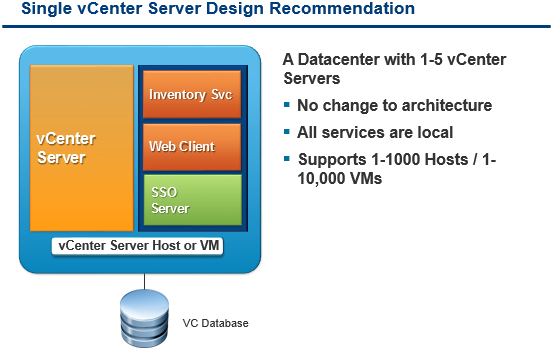
    As I mentioned one of the big changes in vSphere 5.5 that I felt should have been mentioned in the keynote and would have probably got a loud cheer from the crowd was the massive changes to SSO. The SSO service has been almost totally rebuilt and when I was on the early access blogger webinars everyone breathed a sigh of relief as the SSO in vSphere 5.1 was not a simple thing to install especially seeing as it was recommended to break up all the individual components. This has now changed and it is recommended that they are all kept on one machine. Below is the recommended layout now for the vCenter Server design.

    image

    Kendrick Coleman also gave a great overview of it from 30k feet here . For me the real improvement is the simple steps to setup SSO now which are:

    1. Accept License agreement (EULA)

    2. Prerequisite check summary

    3. Edit default port number 7444 (if necessary)

    4. Select Deployment placement

    5. Provide Administrator@vSphere.local password

    6. Provide a site name or select a previous site name

    7. Edit destination directory (if necessary)

    8. Summary

    9. Installation Complete

    I’m one of the hosts of the EMEA vBrownbag and all of the US Brownbag and a few of the APAC vBrownbag team are out at VMworld US doing the very popular Tech Talks. The Tech Talks are 10 to 15 minute presentations by members of the VMware community on topics of their choice, almost like a mini #vBrownBag. They are being streamed live by the vBrownbag guys and are being recorded for people like me to watch them when you can. The schedule for the Tech Talks can be found here. Make sure you watch the stream live and give the guys the support they deserve as all of these presentations are from the community.

    Talking about the vBrownbag crew one of the main culprits Nick Marshall has released alongside Scott Lowe, Forbes Guthrie, Matt Liebowitz and Josh Atwell (another vBrownbag host) the next instalment of the Mastering VMware vSphere book for vSphere 5.5. A massive congratulations to Nick on this project and for being asked and doing such an awesome job whilst still helping out on the vBrownbag. Nick has detailed the announcement on here blog here.

    One of the biggest announcements from the keynote was the release of VMware NSX, as Forbes Guthrie said I’m waiting for NSXi clip_image003 but until that day the below are some of the highlights of the new feature and I would highly encourage you to read Chris Wahl’s detailing of the feature from above.

    NSX Highlights:

    • VMware NSX is a next-generation network virtualization solution
    • Provide the key functions of network virtualization: decouple, reproduce, and automate
    • NSX will support any hypervisor, any CMP, any network hardware
      • vSphere, KVM, and Xen are currently supported
      • CMPs currently supported are OpenStack, CloudStack, and vCAC/VCD
    • NSX optimized for vSphere leverages the platform’s enhanced functionality

    High-level View of VMware NSX Architecture:

    clip_image004

    VMware NSX Controllers:

    • Designed with a distributed, scale-out architecture.
      • Minimum of 3 controllers for an NSX controller cluster.
      • NSX optimized for vSphere scales to 5 controllers.
    • NSX controllers run a common code base in different form factors.
      • Controllers run as infrastructure/service VMs in NSX optimized for vSphere.
      • Controllers run as physical appliances in multi-hypervisor environments.
    • Controller functions optimized in each delivery option.

    VMware NSX Virtual Switches:

    • NSX uses programmable virtual switches on the hypervisors
    • In NSX optimized for vSphere, NSX leverages:
      • the vSphere Distributed Switch (VDS)
      • the UW (Userworld) Agent for communications with NSX controllers
    • In multi-hypervisor environments, NSX uses:
      • Open vSwitch for KVM and Xen
      • NSX vSwitch (an in-kernel virtual switch) for ESXi

    VMware NSX Gateways:

    • The gateways are the “on ramp/off ramp” into or out of logical networks
    • Both L2 (bridging) and L3 (routing) gateway functionality available
    • Basic functionality the same regardless of delivery option
      • NSX optimized for vSphere leverages NSX Edge (derived from vCNS Edge)
      • In multi-hypervisor environments, gateways are physical appliances leveraging a scale-out architecture

    VMware have also posted the What’s New pdf for vSphere 5.5 which gives you a very good overview of all the new features and services here

    VMware have released a new VMware certification called the VMware Certified Associate for those people looking to get into the IT industry. Unlike the VCP there is no required training but there are free eLearning courses available for people to skill up for the exam. These do look like a good starter for people thinking of learning the basics of virtualization and in my opinion would be great for high school students thinking of going into IT and virtualization after high school.

    Well that is what caught my attention from day 1 of VMworld US. I’m looking forward to more information coming out and to getting my hands on all the new vSphere 5.5 tools.

    Gregg