TheSaffaGeek

My ramblings about all things technical


Leave a comment

vCloud endpoint wont delete from vCAC 5.2

I am currently working on a project that is using vCAC 5.2 ,vFabric Application Director 5.2 and vCloud 5.1 to provide automated self service provisioning of resources for customers (super learning experience).

Whilst going through the manual steps of removing a test customer from the solution before automating the steps through VCO, I hit a very strange problem where at the point of deleting the endpoint to the vCloud Organisation that was assigned for the test customer I got an error stating “ Error has been caught,see event logs located on the vCAC server for detail” and as shown below.

clip_image001

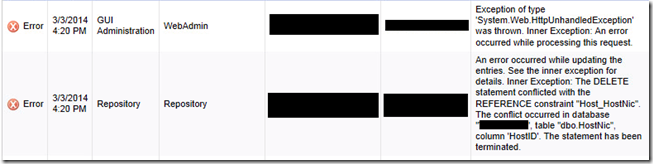
If I went to the the logs within vCAC there were two errors linked to the problem. the main one stating “….  Inner Exception: the DELETE statement conflicted with the REFERENCE constraint “HostNic….”
clip_image002

The error is showing that a computer resource is still attached to the endpoint even though I had removed the computer resource from the vCloud Enterprise Group computer resources selection, removed the Org VDC from vCloud and run a manual data collection. It seems that there is a bug at present that doesn’t allow the removal via the UI (bug report already opened before someone asks) so what you need to do is (I make no promises or guarantees around this script so use at own discretion and backup your DB before running this):

  1. Go to the SQL server that hosts the vCAC database.
  2. Open SQL Management Studio as a user with sufficient permissions.
  3. Select the vCAC database and click the New Query button at the top left.
  4. Ensure the vCAC database is selected.
  5. Paste the following SQL script in the query box and change the ‘ORG VDC NAME’ to the name of the Organisation VDC that the endpoint was connected to and execute the query.

DECLARE @HostId uniqueidentifier

SET @HostId= (SELECT HostId FROM Host WHERE HostName = ‘ORG VDC NAME’)

DELETE FROM VirtualMachine WHERE HostID = @HostId

DELETE FROM HostNicToReservation WHERE HostNicID IN (SELECT HostNicID FROM HostNic WHERE HostID = @HostId)

DELETE FROM HostReservation WHERE HostID = @HostId

DELETE FROM HostNic WHERE HostID = @HostId

DELETE FROM HostToStorage WHERE HostID = @HostId

DELETE FROM AdminGroupToHost WHERE HostID = @HostId

DELETE FROM ResourcePool WHERE HostID = @HostId

DELETE FROM Host WHERE HostUniqueID = (SELECT HostUniqueID FROM Host WHERE HostID = @HostId) AND ClusterHostID = @HostId

DELETE FROM Host WHERE HostID = @HostId

  1. The results should show that some values have been changed.
  2. Now you can remove the endpoint from vCAC and the computer resource won’t show up for selection under the vCloud Enterprise Group either.

I hope this saves someone the time I spent trying to fix the problem.

Gregg


    Leave a comment

    VCDX Spotlight: Hersey Cartwright

    Name: Hersey Cartwright

    Twitter Handle: @herseyc

    Blog URL: http://www.vhersey.com/

    Current Employer: ABS Technology Architects

    VCDX #: 128

    How did you get into using VMware?

    I started using VMware back in late 2006/early 2007 when I was working for a community Credit Union. I was really impressed with HA. Prior to VMware getting the same level of availability was costly and complex, HA greatly simplified this. By the time I left the Credit Union about 85% of the environment was virtualized on VMware.

    What made you decide to do the VCDX?

    I saw it as a learning experience. I learned a tremendous amount about myself and my abilities through the process of designing the solution, preparing the documentation, and participating in the defense.

    How long did it take you to complete the whole VCDX journey?

    I completed the VCAP-DCD in December 2012. I made the commitment to pursuing my VCDX in February 2013 and set a goal for defending at PEX 2014. So a little less than a year of actually preparing.

    I started the design I submitted in October 2013 and it was implemented in November. I had somewhere between 120 and 180 hours of preparation for the VCDX defense outside of the work that was done directly for the customer. This included preparing the design documentation, studying, and participating in mocks.

    What advice would you give to people thinking of pursuing the VCDX accreditation?

    Set a goal and work towards it. I think that setting the goal on defending at PEX 2014 helped me keep focus. Attend the VCDX boot camp if you can, or at least watch the ProfessionalVMware.com vBrownBags on it. This will give you a lot of insight into the defense. Sign up for one of the study groups and participate in as many mocks as possible.

    During mocks don’t forget about the Design and Troubleshooting scenarios. Be sure to practice these also!

    Another piece of advice I would give is to choose a design you find interesting. The design I submitted and defended was for a 911 call center. It was a small environment but I found the availability requirements for the solution interesting. I also really enjoyed working with the customer to meet their requirements. I was very involved through the entire project, from design to implementation, and that definitely helped me defend the design.

    If you could do the whole VCDX journey again what would you do differently?

    More mocks!

    I did a bunch of them but they were all with the people I worked with. The “unfriendly” mock defense I participated in the day before my actual defense, with people that I did not know (other than the occasional tweet), was extremely beneficial. During the “unfriendly” mocks the participants dug much deeper into my design decisions than the folks that I worked with on a regular basis did.

    There was a lot of benefit in both the “friendly” and “unfriendly” mocks, but the “unfriendly” mock really helped to prepare me for the defense panel.

    Life after the VCDX?  How did your company respond?  Was it worth it?

    Preparing for and successfully defending the VCDX was definitely worth it, especially for the learning experience. In a short period of time it has benefited both me and my company.

    If I had to do it all over again, I definitely would!

    A little more on my VCDX experience can be found here: http://www.vhersey.com/2014/02/vcdx-cxxviii-128/


    Leave a comment

    VCDX Spotlight: Garrette Grouwstra

    Name: Garrette Grouwstra

    Twitter Handle: @VirtualCanadian

    Blog URL: vCanadian.ca

    Current Employer: Long View Systems

    VCDX #: 127

    How did you get into using VMware?

    I was working for a small ISP in 2009, and began a consolidation project to go hand-in-hand with their upcoming infrastructure refresh. As soon as I started using ESXi 3.5, I thought that the whole idea of virtualization was something I needed to focus on professionally.

    What made you decide to do the VCDX?

    For the past 2.5 years, I have had the privilege of building and architecting a public cloud offering to help diversify the services that the company I work for offers to clients. VCDX-DCV had been on my mind at the time as I watched others in the organization (@vcloudmatt and @DavesRant) go through the process. Once the Cloud track was announced, I knew that would be my next goal.

    How long did it take you to complete the whole VCDX journey?

    That is a tough question, as the VCDX-Cloud certification is still brand spanking new. I had to complete all of the prerequisites first, I received the VCP-Cloud in August of 2012, followed by the Beta’s of the VCAP-CID, and VCAP-CIA, which I received in February 2013.

    I started writing my design documentation in March of 2013, putting it aside while I planned a wedding and went on a honeymoon, and picked back up in August 2013. With the help of my design Co-author, Matt Vandenbeld (@vcloudmatt), I was able to complete the application by the end of December, and was fortunately invited to defend in February 2014.

    What advice would you give to people thinking of pursuing the VCDX accreditation?

    1. Get support from your family, and work. I was lucky that both my husband and Long View Systems gave me time, and supported me on this journey. I could not have remained sane without them.

    2. Set milestones to complete sections of your design doc, and within all supporting material. Keep to the deadlines.

    3. Don’t work in a vacuum. There are many great resources out there, both blogs and people (Inside and outside of your organization). Use them

    4. Know your design inside and out. Really, I mean it.

    5. Accept that you may have submitted a design with mistakes. Own those mistakes and call them

    6. Practice, practice, practice! Find others in the community that are able to assist you, and do mock defences, design and troubleshooting scenarios. Brad Christian (@BChristian21) organized mock defences between most of the candidates defending at PEX. The group ripped my design apart more so than they did in the room, and were amazing help preparing.

    7. Breathe. Take a time out before the actual defence to compose yourself.

    If you could do the whole VCDX journey again what would you do differently?

    The only thing I would do differently is more mocks. I saw myself grow so much as a consultant and VCDX candidate during the weeks leading up to the defence, and the mocks were a LARGE part of that. I wish I would have done more troubleshooting and design mocks.

    Life after the VCDX?  How did your company respond?  Was it worth it?

    The VCDX is a certification I achieved for myself, not for my company. They have been supportive along the way, and all congratulated me, however I did not, and do not expect much to change from a company perspective.

    The biggest change personally, is that I have free time again. I’m still trying to come to terms with that and debating how to fill the void that VCDX prep has left.


    Leave a comment

    VCDX Spotlight: Derek Seaman

    Name: Derek Seaman

    Twitter Handle: @vDerekS

    Blog URL: www.derekseaman.com

    Current Employer: Nutanix

    VCDX #: 125


    How did you get into using VMware?

    In 2006 I was a Sr. Unified Communications Consultant and used VMware Workstation on my home computer to try out various software products. By 2008 I had some customers wanting to virtualize Exchange and other services, but my exposure to the ESX platform was still limited. In 2009 I started a new job as a Lead Systems Engineer for a U.S. Government project and took my first vSphere 4.0 install/configure course. After that course I was truly fascinated with the technology, breadth of skills needed, and the wicked cool features like vMotion. Ever since then I’ve focused on virtualizing enterprise services and VDI.


    What made you decide to do the VCDX?

    Through my blog came to know several well-known bloggers and virtualization geeks. By 2013 nearly all of them were VCDXs and I told myself that I could do it. VMworld 2013 in San Francisco was a turning point and lit a fire to knock out my VCDX. I also figured it would professionally open up doors that might not otherwise be as open.


    How long did it take you to complete the whole VCDX journey?

    I took my first ever VCAP exam (VCAP5-DCD) the day before VMworld 2013 San Francisco, and passed. A few weeks later I took the VCAP5-DCA exam, and was also successful. All told it was a six month effort from starting the VCAP pre-reqs and getting my VCDX congratulations letter.


    What advice would you give to people thinking of pursuing the VCDX accreditation?

    The certification takes a lot of time. How much time depends on the complexity of your design, and how much may already exist in terms of documentation that you can use. Not much existed for the project I chose, so I spent literally hundreds of hours writing everything to make sure it met the VCDX blueprint requirements. Also, get involved in a study group early on, so you can do peer reviews and support each other throughout the process.


    If you could do the whole VCDX journey again what would you do differently?

    Overall I wouldn’t change anything, except getting connected with more candidates prior to the initial application submission. I had connected with two others, but didn’t know there were a dozen more on the same track. Definitely get on Twitter and find your peers.

    Life after the VCDX?  How did your company respond?  Was it worth it?


    Social media blew up (in a good way) after getting my certification. After being accepted to defend for the VCDX but prior to my passing I had accepted an offer from Nutanix as a Sr. Solutions and Performance engineer. That team already has two VCDXs, and I couldn’t be more excited to join them and other VCDXs within the company.

    The entire process was totally worth it. I feel that I’m a better architect, and made great professional connections with both existing VCDXs and those that went through the PEX 2014 process.


    2 Comments

    VCDX Spotlight: Josh Coen

    Name: Josh Coen

    Twitter Handle: @joshcoen

    Blog URL: valcolabs.com

    VCDX #: 129

    How did you get into using VMware?

    In 2006, when I was active duty in the U.S. Air Force, we had a project to stand up a lab for testing patches and other projects. A server was bought and VMware Infrastructure 3 was purchased, but no one had training. I was brought into the project and sent to San Diego to take the VMware Infrastructure 3: Install and Configure course (coincidentally, Rawlinson Rivera was my instructor). I was immediately hooked and knew that my professional future had to include virtualization.

    What made you decide to do the VCDX?

    After I started doing the VCAP5-DCA I decided I wanted to go for VCDX. The two biggest drivers for me was the challenge it presented and the doors it might open; professionally and monetarily

    How long did it take you to complete the whole VCDX journey?

    It took me roughly 12 months from the time I completed the last of the VCDX prerequisites (VCAP5-DCD) to the time I defended

    What advice would you give to people thinking of pursuing the VCDX accreditation?

    Don’t give up. There were plenty of times during the process that I questioned “why am I doing this” and even contemplated quitting. These questions came when I got stuck on a particular part or section in the process and was unsure how to move forward. If that sounds familiar, take a break, clear your head and keep at it. Eventually something will click and you will break through

    If you could do the whole VCDX journey again what would you do differently?

    I would have tried to complete it sooner. I had the potential to defend sooner than I did had I got off my butt and completed the required documentation. Don’t procrastinate.

    Life after the VCDX?  How did your company respond?  Was it worth it?

    I’m not sure what’s next professionally, but I’m keeping an open mind. Personally, I’m going to focus on continuing to learn Spanish as well as Python. My company didn’t support what I was doing. All time and money associated with VCDX were my own. It was definitely worth it. A very rewarding experience and I’m glad to have went through it.


    Leave a comment

    VCAP-CID Objective 2.1 – Determine Catalog Requirements for a Logical Design

    Knowledge

    Identify what can be included in a published catalog.

    • A published catalog is one that is created in the administrative organisation with all the required components and  vApp templates published to all other organisations in the vCloud environment. Good design practice to only allow the administrative organisation to publish its catalog and deny this ability for all the standard organisations.
    • The components that can be included in a published catalog are:
      • Standardised gold master vApp that can consist of a single virtual machine all the way to 3 tiered offerings like a web service with a web front end, an application server and a database server. These are verified templates that meet regulatory and security standards which ensures consistency across the environment and provides the consumers with verified offerings that can be deployed with ease.Guest customisation changes the identity of the vApp and can be used for post-deployment steps, such as the joining of vApps to domains.
      • vApp Templates which can cannot be deployed but can be deployed (instantiated), creating a vApp that can be deployed and powered on.
      • Media like ISO files for software and applications. These are also verified and commonly customised to ensure standardisation and to provide specific capabilities.

    Identify what can be included in a private catalog.

    • A private catalog can have the exact same components but it is controlled by the user/group assigned the Catalog Author vCloud role. This catalog is limited to a specific organisation and good design practice states you should limit the ability to publish this catalog thereby making it a private catalog.
    • This can still contain standardised vApp’s and ISO’s and if you are a service provider this is where the cloud consumer will place their standardised vApp’s and ISO’s so that the organisation can use them but other organisations cannot.

    Identify permission controls for catalogs.

    • There are three Predefined roles in vCloud that have varying permissions and rights to make changes and create components in catalogs. A breakdown of the predefined roles and their rights are contained in this documentation centre link

    Explain the functionality of a catalog.

      • This should be straight forward as this is VCP-IaaS level and I think all the previous sections define it pretty well also. But just in case i have pasted the VMware definition below:
        • VMware vCloud Director uses the concept of a catalog for storing content. Organizations have their own catalog that they can populate and and share the contents with other organizations and users.

    All entities in the catalog are stored in a content repository system. The content repository, a component in the vCloud Director storage subsystem, provides an abstraction to the underlying datastores while offering features to store, search, retrieve, and remove both structured and unstructured data.

    Skills and Abilities

    Based on application requirements, determine appropriate vApp configuration.

    • As I mentioned for the published catalog and private catalog sections above you can configure vApp’s with multiple tiers to allow the organisations to provision these offerings in their vCloud organisation and maintain standardisation. If a customer asks for a web service offerings then you can provide them with a three tiered vApp with a web front end, an application server and a database server. There may even be a requirement for availability of the offering so you will created multiple front end, application servers and a clustered database back end.
    • Using the web service example this will also require different networking to ensure the security of the offering which will mean different servers connecting to different networks and vCNS endpoint devices being configured as part of the vApp. I am planning on creating a few of these as practice in visio so that I can visualise them and make sure I know what they should look like in case a visio style question comes up or i just need a good mental picture to make decisions for questions.

    Determine appropriate storage configuration for a given vApp.

    • This follows closely to what I covered above but now you need to think of the storage offering the vApp components are going to be kept on and what storage you are going to allow the vApp to be deployed onto. Using my trusty web service example you wouldn’t want the database sitting on low end storage as this would severely impact the service.
    • This is what I think they are asking for so if you think i’m wrong then please do tell me as I’m also learning and sometimes it’s difficult to gleam what they mean as this could also relate to fast provisioning.

    Given customer requirements, determine appropriate catalog design.

    • I think for this if you have created catalogs countless times and know what you can put in there and that they can be published to specific organisations from other organisations or published to all from the administrative organisation then designing it should be simple enough.

    Determine the impact of given security requirements, on a catalog structure.

    • This may be numerous things but there are times when an organisation wants only certain vApp’s and ISO’s in a catalog to be available to certain people and so you can configure the catalog to have certain portions only available to certain people.
    • There are also many organisations who have very customised and important virtual machines which they have converted to vApp templates and they want these secured so that only a certain person can access them and only that person can provision them for people.

    If you think I have totally missed something then please do tell me as I’m only learning and I’m certainly not perfect.

    Gregg


    Leave a comment

    VCDX Defences Dates For 2014 Announced


    Spongebob-Happy-spongebob-squarepants-154897_338_432As some people who know me may be aware I pushed for a UK VCDX defence this year as I along with numerous other people were looking to submit for the VCDX but couldn’t motivate and/or afford the costs to fly to the other defences released. Mark Brunstad was very helpful and put out a feedback form for people to submit their interest in a UK defence and sadly we fell a few people short of making it worth the expense and time for VMware. In all honesty it wasn’t a bad thing for me as with a very busy (but super exciting) work schedule and getting used to trying to study with a child under one in my house I wouldn’t have made a defence anyways.

    But at VMworld Europe this year I rekindled the idea and Mark and John Arrasjid really liked it and again voting was opened. I knew for a fact there were at least 5-6 people who were interested to submit for it from the UK and numerous more in western Europe. Now I’m certainly not saying I had anything to do with it but it seems there were so many people interested that there are not one but TWO defences going to happen in Frimley UK next year. I’m hoping I wont need a second defence date but it is really great to have the option. The other dates are below which were released by Mark on the VMware Communities here.

    February 10-14 2014: VMware Partner Exchange (PEX) – San Francisco CA US

    VCDX Candidates wishing to defend at PEX 2014 may register by following this link:

    http://mylearn.vmware.com/mgrSurvey/feedback.cfm?survey=49517

    Applications for the PEX San Francisco 2014 VCDX Design Defense will be due on or before Midnight PST (UTC -8:00)  Friday December 20,  2013

    April 2014:

    April 7-9 2014 Frimley UK

    April 7-9 2014 Sydney AU

    Applications for April 2014 Frimley and Sydney VCDX Design Defense will be due on or before Midnight PDT (UTC -8:00) Friday 02 February 2014

    July 2014:

    July 7-9 2014 Cambridge MA US

    July 7-9 2014 Frankfurt DE

    July 7-9 2014 Singapore SG

    Applications for July 2014 Cambridge, Frankfurt, and Singapore VCDX Design Defense will be due on or before Midnight PDT (UTC -8:00) Friday 09 May 2014

    October 2014:

    October 6-8 2014 Palo Alto CA USA                                   

    October 6-8 2014 Frimley UK

    October 6-8 2014 Kuala Lumpur MY

    Applications for October 2014 Palo Alto, Frimley, and Kuala Lumpur VCDX Design Defense will be due on or before Midnight PDT (UTC -8:00) Friday 08 August 2014.

    Good luck to all of those looking to submit next year and hopefully I’ll be posting this post next year this time as a VCDX Open-mouthed smile

    Gregg


    Leave a comment

    VCAP-CID Objective 1.3 – Determine Capacity Requirements for a Conceptual Design


    Skills and Abilities

    Determine how storage and network topologies affect capacity requirements for a vCloud conceptual design.

    • This in my opinion can be taken in a few ways so I welcome any feedback on if you think I have looked at this the wrong way but the way I am looking at this is the way it is all connected to differing portions of the environment obviously impacts the speeds that can be achieved and thereby the capacity of virtual machines that can be run over a certain link for networking or even over a specific NIC/Switch/HBA/Cable. So to use the networking topology as the example:
      • Network: For networking there are a number of constraints that can affect the capacity requirements for a vCloud conceptual design. To give an example I will use one that I am seeing a lot recently which is a 10Gb NIC connection from each blade/rack server in your proposed vCloud environment. For this 10Gb link you need to carve it up (either via native hardware methods or via NIOC) for all the varying types of traffic that needs to go over the link for your vCloud environment. Now if your network topology is inside an existing datacentre then you may have to connect to an existing top of rack switch which may only have the capability to provide two 10Gb connections per switch and the price for 2 new 10Gb switches (to obviously provide resiliency) won’t fit in the budget. So for the conceptual design if you need 10Gb of network traffic leaving each host to supply network requirements of the virtual machines on the host then you will need to either:
        • Change the hosts to have a sufficient number of NICs to provide this or
        • Go down an infiniband route or
        • Explain to the customer due to the constraint of having to use existing switches it is not possible to provide the required network bandwidth for each host so they will need to buy more hosts so that the virtual machines on each host get their required bandwidth.
      • This way of thinking applies exactly the same for storage and if you are running converged networking then it can be almost exactly the same.

    Describe VMware vCloud Director and VMware vSphere functionality and limitations related to capacity.

    • This in my opinion is all about vSphere and vCloud maximums which is always something you have to keep in mind when doing a conceptual design as for example the linked clone chain length limit is 30 and then after this a new shadow copy is created which then utilises more space on a new datastore and affects storage capacity. Actually knowing these functionality metrics and limitations is something I have been learning from going through the vCAT documentation. I did think about listing all of them but there are so many and what they could impact is so vast I think this is something where you need to know the limitations and functional capabilities of the two products and then think of it in the holistic manner of the whole design and how it impacts the conceptual design. Now remember the conceptual design is the “napkin” style design and so product names do not feature but you need to understand at a certain level what is and is not possible from the products.
    • As I mentioned in my previous point if you feel I am totally wrong then please do tell me in a friendly manner as I am certainly not perfect and am doing this to learn.

    Given current and future customer capacity requirements, determine impact to the conceptual design.

    • During your design workshops you will work out and record what the customer’s current and future capacity requirements are and then will need to plan for that 20% year on year growth they require to give an example. So if their current requirements can be met with eight hosts to be very simplistic then you will need to ensure you have sufficient capacity not just in compute but also storage, networking, cooling, power and switching.

    Given a customer datacenter topology, determine impact to the conceptual design.

    • For this I think I covered it in the first section but you now need to look at the whole topology with storage, networking, power, rack space, distances between components, distances between datacentres, cooling and weight limitations to name a few off my head that may impact your conceptual design. So say for cooling you can only put in a certain amount of hardware into each rack which then impacts your conceptual design of how many blades can fit into the datacentre/server room.

    Given cloud capacity needs, constraints, and future growth potential, create an appropriate high-level topology.

    • This is the point where you have done your design workshop and are now looking to do a high-level design of the environment that meets all the customers’ needs and shows to them you understand what they require and have planned for the future. The below diagram is a very basic version of what you would provide based on networking to show you understand their needs :

      image


      Leave a comment

      VCDX Spotlight: Jonathan Kohler

      Name: Jon Kohler

      Twitter Handle:  @JonKohler

      Blog URL: vdoogle.wordpress.com

      Current Employer : MSN Communications

      VCDX #: 116

      How did you get into using VMware?

      I started using VMware ESX 3.x and Workstation in late 2008. The more I started to use VMware’s products, both personally and professionally, the more impressed I was with their functionality and direction. I worked at a VMware partner at the time vSphere 4.0 came out and deployed it internally for their production environment and externally for customers as part of PS engagements. I decided then that VMware virtualization is where I wanted to maintain my professional focus and haven’t let up since.

      What made you decide to do the VCDX?

      I decided to go after the VCDX after I changed jobs a few years ago. I moved from Vermont to Colorado after finding a VMware Infrastructure engineering job at a large national health system on Twitter. The person who got me in the door was Nate Raper, VCDX 85, though not a VCDX at the time. I had both of my VCAP4’s at the time, and hadn’t really given much thought to the VCDX. That changed when I saw what Nate brought me in to work on. The environment at this company was massive in both complexity and size. To give you an idea of the level of VMware engineering at this particular establishment, the enterprise both Nate and I worked in has produced 3 VCDX’s (Tom Ralph, Nate, and Myself). That scale, as well as Nate’s encouragement, is what got me hooked and on the right path.

      How long did it take you to complete the whole VCDX journey?

      I started with the VCP4 in January 2009 and finished up with the VCDX5-DCV in August 2013, so holistically the better part of five years. In terms of hours, I probably spent over 600 hours over the last year working on everything associated with the VCDX deliverables. This was over the course of three application attempts and one defense attempt.

      What advice would you give to people thinking of pursuing the VCDX accreditation?

      Approach all of your work like it was going to be compared against the VCDX blueprint, this will get you in the right mind set to succeed on whatever design you choose. I know the blueprint can be kind of vague, but try to use it as a checklist when you think you are done with a project, and literally go down the list and point out where you have those items in your design. Also, get and read the VCDX boot camp book.

      Have confidence in yourself and give yourself a LOT of time. No matter how good of an engineer or architect you are, trying to rush to put together a world class deliverable simply doesn’t work, which I learned the hard way when I didn’t allow myself enough time for proper decompression, peer review, etc and failed the application stage twice.

      If you get invited to defend, no matter how confident you feel, get SEVERAL different peer reviews on your presentation, practice frequently, and KNOW YOUR DESIGN INSIDE AND OUT. This means know why you made choices (very specifically), what you didn’t choose to implement (alternative design choices), and why you did what you did.

      Past that, keep your hands in the dirt, as you will need to be sharp for the troubleshooting and design sections. I got lucky on my troubleshooting piece, as it was a problem I had actually dealt with in the real world before, which made me much more confident when engaging the panellists.

      If you could do the whole VCDX journey again what would you do differently?

      I would have given myself much more time the first go around, so that I didn’t have to stress over this for the past year. Smile

      Life after the VCDX?  How did your company respond?  Was it worth it

      Life has been much less stressful for sure. My employer MSN Communications and manager Colin were supportive throughout the entire journey, and have responded well. No change in positions or anything, but as fate would have it, Nate and I left our healthcare IT jobs last year when we got outsourced, and both went to MSN. He just left MSN to go to VMware’s Global CoE, so I am going to step up and fill some of that gap with our customers, which I don’t think I could have done without going through the VCDX process. Lastly, I do think this journey was worth it and I would do it again in a heartbeat.


      Leave a comment

      VCDX Spotlight: Tim Antonowicz

      Name: Tim Antonowicz

      Twitter Handle: @timantz

      Blog URL: whiteboardninja.wordpress.com

      Current Employer: Mosaic Technology

      VCDX #: 112


      How did you get into using VMware? In early 2004, I was a SysAdmin at Bowdoin College in Maine.  Running out of datacenter footprint, we consolidated our servers with ESX 2.01 retiring 50 physical servers and leaving us 80% virtualized.  After Katrina in 2005, we worked with LMU in Los Angeles to co-host each other’s VMs for DR purposes. This project was one of the inspirations behind the development of VMware’s SRM solution.


      What made you decide to do the VCDX? After moving into the Partner space, I began seeing and designing for several different customer environments. The VCDX program not only recognized those at the pinnacle of our profession but also advocated those skills and abilities needed to become the best at what we do. If I wanted to become a successful Architect, I should aspire to be a VCDX.


      How long did it take you to complete the whole VCDX journey? Overall, the process was almost 3 years in length. I spent over a year getting my VCAPs and had a few attempts as a design, but nothing serious until about a year ago. My first design attempt didn’t make the deadline for submission, and I had to wait for PEX13 for my first official submission and defense invitation. While unsuccessful at PEX, I learned from my mistakes there and applied my experiences to my successful defense at VMworld13.


      What advice would you give to people thinking of pursuing the VCDX accreditation? Don’t attempt this unless you really want it. The VCDX process is not something you can go into half-committed. It will tax and test you all along the way, both technically and mentally. It is not for the faint hearted. With that in mind, if the VCDX is something that you want to do, and you are committed to becoming the very best you can be in your field, go for it. It is a journey that pays back 1000 fold what you put into it. By going through the VCDX, I am a better Architect than I was before. I’ve changed the way I approach each project, and my company, my customers, and I are better off as a result of my work and dedication. Aside from the actual certification, I am better at my job today for just going through the process. Holding the VCDX after it all is just the validation that I was on the right track all along.

      If you could do the whole VCDX journey again what would you do differently? Looking back, I wouldn’t have waited so long between getting my VCAPs and actually working on a design for submission. I should have started the process a year earlier than I did. Also, I only did one ‘Mock Defense’ for my first attempt. To all prospective VCDX applicants: “Mock, Mock, Mock!” Realtime, live interaction can do nothing but help you with your preparation for your defense.


      Life after the VCDX?  How did your company respond?  Was it worth it? Since it has only been a few days since I received “my number”, nothing has changed for me professionally at this time. Personally… For the first time in over a year, I haven’t woken to thoughts of my design, potential flaws, and defense preparation scenarios running through my mind. It’s nice to hear the birds outside my window.