TheSaffaGeek

My ramblings about all things technical


Leave a comment

VCDX Troubleshooting Skills

55020378So this posting isn’t about my opinion of if the dropping of the scenario is good or bad as in all honesty more time in the design scenario sounds great to me. This posting is actually about the resources I used to prepare for my VCDX troubleshooting scenario that I think an architect should know and thereby any good VCDX should also.

  • The first resources I used were actually the ones I used in my preparations for the VCAP5-DCA as this really makes you learn where all the logs are, what methods there are of troubleshooting issues and what you might be looking for. My study resources list for the VCAP5-DCA is a great start and if you are at the point of defending for VCDX you should have used some of these in your preparations but what I went over again were the troubleshooting videos by David Davis. Even though they are old the methods in them still apply especially ESXTOP etc.
  • The next resources were a mix between my two mentors for my recent VCDX attempt aka Larus Hjartarson and Rene van den Bedem. Both of them did brilliant breakdowns of how to prepare and think during the scenario and the methodology you need to keep to. These methods give you a great plan of attack even if it is a real world customer you are trying to help. Larus’ methodology is mention in his VCDX: Troubleshooting Scenario posting and Rene’s VCDX – Troubleshooting Scenario Strategy posting.
  • One resource that I felt was the best real world applicable resource I used that didn’t map perfectly to the VCDX scenario methodology but was brilliant was one that was recommended to me by Frank Buechsel who used to work for VMware GSS until recently was a book called Debugging—The Nine Indispensable Rules for Finding Even the Most Elusive Software and Hardware Problems. It’s more based at software development but each of the steps applies perfectly to troubleshooting any issues in a technology environment and now that the scenario has been stopped I can put out the loose outline from the book and kinds of questions I wrote up for each of the headings plus what I wanted to say to explain why i was asking in red that I wanted to ask in the scenario and how I thought it might fit:
    • UNDERSTAND THE SYSTEM
      • When did the problem start exactly?
      • What is meant to happen? – Why I am asking is because……………and what I’m hoping to achieve…………
      • When did you see the problem start happening? Is it recurring after a certain task or event or has it only happened once? – Why I am asking is because……………and what I’m hoping to achieve…………
      • Have any changes been made recently and are they tracked in a change management system? – Why I am asking is because……………and what I’m hoping to achieve…………
      • Have we collected logs or alerts from the systems and are we using something like vCOps where we can drill down and see alarms or alerts? ? – Why I am asking is because these mechanisms can give us ideas of the failures and possibly where it is happening if not just one location and what I’m hoping to achieve is to find the specific places the errors are showing, what the errors have been in the past if possible but also prepare for the next step of making it fail again so we can possibly see the error again or collect it for the first time.
    • MAKE IT FAIL
      • If it happens around a certain event can we try replicate the error and make it happen as often as possible? – Why I am asking is because I want to confirm the error is in fact happening at the point you mention and I’m hoping to achieve the exact step where it is happening and confirm if indeed our assumptions of when it is happening are true or not so we don’t waste time troubleshooting an assumption.
      • When are we doing the replication of the error can we document each step? – Why I am asking is because I want to confirm it is not just the step where it fails but the steps leading up to it in case a step in the sequence is then causing the eventual failure and I’m hoping to achieve the possible conflict or incorrect setting/step being followed.
    • QUIT THINKING AND LOOK
      • Are there any alarms or alerts on the source or destination system/s ? – Why I am asking is because I want to confirm not just the outcome of the failure that you mention but hopefully what is causing the failure and what I’m hoping to achieve is the point/component where we should do the troubleshooting so that we don’t make any unnecessary changes.
      • For the errors can we search the VMware/Vendor KB/Forums and see if any matches come up for some/all of the errors? – Why I am asking is because some of the errors might be known or even just give us an idea for where to look and what I’m hoping to achieve is to isolate the problem even more and not waste time looking at other components when a kb article might give us a good lead and save us precious time getting the issue fixed
    • DIVIDE AND CONQUER
      • For the machines that are failing are they the same configuration/going to the same location/coming from the same location/going over the same path? – Why I am asking is because I want to isolate the good parts/side and the bad parts/side and what I’m hoping to achieve is to focus my attention on the side that is showing the error so we don’t waste time and have less things to cover in the hope we can isolate the problem.
      • Can we try reverse the step in the opposite direction? – Why I am asking is because……………and what I’m hoping to achieve…………
    • CHANGE ONE THING AT A TIME
      • Try a migration/alteration/fix and if it doesn’t work then change it back and try something new. “Please can we migrate the failing machines to another host? “it still fails” Ok please move it back “– Why I am asking is because I don’t want to receive additional/red herring errors due to the change we made and what I’m hoping to achieve is to keep the environment unchanged as much as possible so we don’t cause additional errors/lose methods to troubleshoot.
    • KEEP AN AUDIT TRAIL (these were more writing out my thoughts and what I felt I needed to remember)
      • Write down what you did and the outcome and also WRITE DOWN THEIR RESPONSES as these may have clues!! “there are no errors in vSphere” might mean the error is not reaching vSphere for it to log the error so go “upstream” to find the source.
      • The error doesn’t sound like it is in vSphere so can we please look at the HBA on the host and ensure it is connected correctly and receiving data via ESXTOP.
    • CHECK THE PLUG
      • You state that the network connections are correct but please can we get it checked again? – Why I am asking is because I want to confirm that what we state is correct is in fact correct right now and what I’m hoping to achieve is to clear up any assumptions and have clear and confirmed facts about necessary “upstream” components.
      • Are the steps you are following worked in the past? Are we following the exact steps that worked before? – Why I am asking is because I want to confirm if it has ever worked/if we are following different processes and what I’m hoping to achieve is to confirm if it has ever worked and if a new step if causing the error to happen so we can troubleshoot what the different steps is bringing up.
    • GET A FRESH VIEW
      • Not really applicable to VCDX troubleshooting but asking for someone who is an SME in the customer might shed some new light/clear up what the exact problem is.
    • IF YOU DIDN’T FIX IT, IT AIN’T FIXED
      • Not really applicable to VCDX troubleshooting.

If you want to read about my utter joy about passing the VCDX then have a look at my VCDX #205 posting and also my VCDX Spotlight.

Next I’m hoping to dive deeper into each of the points from my VCDX #205 posting starting with VCDX Resources – Did you use them all??

Gregg


Leave a comment

VCDX Spotlight – Sam McGeown

Name: Sam McGeown

Twitter Handle: @sammcgeown

Blog URL: www.definit.co.uk

Current Employer: Xtravirt

VCDX #: 204

How did you get into using VMware?

I used to manage the IT and web servers for a charity, so the budgets were extremely tight – I had one physical server for development to replicate the live IIS and MSSQL environment and I stumbled across VMware Server. It was like magic – two servers running on one! Later that became a stand-alone ESX server and I went on from there!

What made you decide to do the VCDX?

Well Gregg, can you think of anyone who twists people’s arms into going for VCDX?

I was never sure that I could defend VCDX! I did my first VCAP (the DCA) in August 2013 which is the first real step of the path to VCDX, and I did the DCD a few months later at VMworld. Once I had those under my belt I started felt a bit more confident and that maybe it wasn’t unobtainable!

How long did it take you to complete the whole VCDX journey?

Somewhat foolishly, I swapped track from datacenter to cloud at the beginning of 2015. I had been working on a DCV design, but it wasn’t great and would’ve required a lot of fictitious components. A huge vCloud Director project landed and it was perfect for VCDX so I started study for the cloud VCAP exams. Then the CIA and CID were retired with no replacement and I was left hanging for a few days before VMware announced they would waive the VCAP requirements for anyone submitting for the CMA.

The project I used started in January 2015 and ran for about eight weeks, it was finished with two weeks to the submission deadline for the June defence that year – I managed to submit it but it was a rush! I failed that first defence and spent a bit more time preparing for the second attempt this October, which I then passed – so on the face of it 10 months.

What advice would you give to people thinking of pursuing the VCDX accreditation?

· Just do it! Don’t put VCDX on a pedestal – it is achievable!

· Read the blueprint…repeatedly – it tells you everything you need to cover

· Build a small study group of people who you can meet with regularly – online is fine – and review, practice and study together.

· Get regular input from a VCDX mentor – they’ll help keep you on track and discover strengths and weaknesses.

· Don’t wait to find out if you are invited to defend – start working towards it as soon as you’ve submitted.

· If you get invited to defend don’t just practice your presentation – practice the design and troubleshooting scenarios too.

· Talk to your partner/wife/husband/family and make sure they are with you – you will need their support and their patience!

If you could do the whole VCDX journey again what would you do differently?

That’s a tough one – as you say, it’s a journey, so the whole experience builds toward the end goal. I think I needed the experience of the first defence to be able to pass the second. I did rush my first submission, but I don’t think it would’ve made any difference if I had waited and taken my time.

I think I should’ve engaged earlier with a study group on my first attempt, but I honestly don’t know if that would’ve helped me pass first time.

Life after the VCDX?  How did your company respond?  Was it worth it?

Ask me in 6 months? It’s a bit too new to really say, it hasn’t really sunk in for me yet!

The journey has been hugely rewarding – I am a *far* better architect now than I was at the start of the journey. On a personal level, setting huge targets and then achieving them is a massively rewarding process – I think it gives you a huge amount of confidence to do so. Dealing with the failure of the first defence was tough, really tough, but moving past it, trying again, and succeeding – well that was flipping awesome!


6 Comments

VCDX Spotlight – It’s Me =0)

So I promised Mark Brookfield that if I managed to get an illustrious VCDX number I would let him do a VCDX Spotlight on me. So he formulated the following questions and I answered them as below:

1. Wow… what a journey. You’ve come a long way, but you’ve finally made it. You are VCDX # 205, congratulations! How do you feel?

I’m in utter disbelief at the moment and keep looking at the email to ensure I haven’t misread it somehow. I think it will sink in over the next few days but when you’ve been aiming for something for so long and sometimes wonder if you’ll ever be good enough to obtain it, it’s crazy to get the number.

2. You’ve made no secret of the fact that you didn’t make the grade the first time around. What would you say you did differently for your second attempt?

Quite a few things. I’ve mentioned some of them in my blog posting about my second attempt but the main ones were:

· To start earlier so I didn’t burn out and could also find time to spend with my young family.

· Not stop preparing even after submitting.

· Leaving nothing in the tank.

· Taking a week’s annual leave before the defence (last time I worked the day before and day after my defence).

· More experience in front of demanding customers. My current project certainly gave me confidence that I belonged in that defence room and my panelists were my peers.

3. After you initial rejection, did you feel like quitting? If so, what motivated you to try again?

Oh absolutely and as I told to Josh Odgers after one of our mock sessions I actually thought about giving up on virtualisation totally and doing a new job. The failure is really really hard to take and I agree somewhat when people say it isn’t life or death but after putting in so much time and sacrificing so much it’s hard to then not make the grade and know you may have to do as much if not more than you did last time.

I think I had a few motivations, my wife was very supportive and is a massive blessing in my life with her belief in me and looking after our daughter when I’m locked away in my study. The motivation to not know myself as the person who failed the VCDX and gave up, how can I tell me daughter to not give up trying if I don’t live like that myself? Also wanting to better myself and complete what I had started.

4. In some circles, certification is regarded as a waste of time. What makes the VCDX so special?

Believe it or not I somewhat agree it is a waste of time if you don’t do it for the right reasons. One of the questions I ask in my VCDX spotlights is about what has changed and more often than not people lives haven’t changed dramatically and some haven’t changed at all. I use all my certifications to force myself to learn new things as I’m actually naturally quite a lazy person who needs to be pushed. Like I said in my VCDX blog posting I know there’s people who spent 40 hours on their designs, submitted and passed first time and credit to those people but I wanted to learn as much as possible along the way so that I could truly say and agree it was about the journey.

The VCDX is special as it isn’t about regurgitating information or sadly in some circles is open to people using cheat sheets. The VCDX is about building a design that is worthy of the defence but the true test is explain that design to a panel who know when you are faking it and who also want to know why you didn’t choose other options and if you did what would be the impacts of that. Real world customers change their minds all the time and sometimes architects just accept what is told or given to them by customers rather than challenging them and trying to work out what is best for them. The VCDX teaches you this. Also with just over 200 people with it globally it shows you that it takes a lot of effort to be at that level to achieve it.

5. The road to even submitting a defence is long and arduous; I myself recently failed the VCAP5-DCD. What advice would you give to others who may be struggling?

So I failed the VCAP-DCD the first time as well and failed my VCAP4-DCA twice so don’t feel bad about failing. Learn where you were weak and try again. It’s a cliché but it’s true that it is about the journey and you have to take failures as a lesson, regroup and go at it again. One of the first things I mention in my VCDX posting is about starting early and setting a timeline of when you want to defend. Also for those who fail the VCDX the first time I know it’s painful but there are some big names who failed first time (I’m not meaning me here) and are now double VCDX’s.

6. Where to now? Kick back with a beer or onto something else?

So a bit of a break but I did make a loose plan than when I passed this defence I would maybe look at going for double VCDX and submitting a version of my current vRA design. This won’t be until next year and I might do a joint submission with a friend but at present I actually need to learn some vSphere 6 and vRA 7 as I have to pay the bills and new technology is what allows me to do that. I’m also starting a VCP6-CMA series on the vBrownbag so will be spending some of my now freed up time there and I have a second clone on the way in April next year so I’m certain that will keep me busy.


Leave a comment

VCDX Spotlight: Eric Shanks

Name: Eric Shanks

Twitter Handle: @eric_shanks

Blog URL: theITHollow.com

Current Employer: Ahead

VCDX #: 195

How did you get into using VMware?

I was at a Chicago Microsoft Users Group and a company called Altiris was speaking about virtualizing applications with their solution. The whole idea was pretty eye opening to me so when my boss suggested some enhancements to our infrastructure the virtualization concept was brought up again. After some testing we decided that VMware was the clear leader in the space so we virtualized our infrastructure on 4.0.

What made you decide to do the VCDX?

The VCDX certification was a challenge I wasn’t convinced that I could achieve, but I had to know for sure. A few other co-workers already had the credentials and I decided it was the time to find out what I was capable of doing.

How long did it take you to complete the whole VCDX journey?

The whole process took me about six months to complete. I already had my VCAP-DCA and VCAP-DCD before I decided to try the VCDX so that helped, but I left myself plenty of time to work out my design before submitting it.

What advice would you give to people thinking of pursuing the VCDX accreditation?

Talk with your family first about the endeavour. The VCDX is challenging, but more than that time consuming. Expect to spend nights and weekends working on it. The VCDX journey is personal achievement but can’t be done without some support from family, friends and co-workers.

Aside from talking with your family first, the second piece of advice I’d give is don’t be afraid to fail. This isn’t an easy challenge and many really qualified people have stumbled on it. It doesn’t mean you’re not awesome, it just means you need to tweak your design or presentation skills a bit.

If you could do the whole VCDX journey again what would you do differently?

I would have made sure to understand the defense blueprint better from the start. I felt that there were specific sections of the blueprint where I didn’t have enough things in my design to present. Specifically my design didn’t have a lot of “Security” related items so I wasn’t able to talk in depth about it in my defense. If I could have done it over I would have added an additional security requirement and supported it with my design so that I could talk about it in the defense.

Life after the VCDX?  How did your company respond?  Was it worth it?

After the process was over I was recognized at our company’s Tech Summit and given a bonus for the achievement. The feeling of a sense of accomplishment from meeting a personal goal made the process worth it.


Leave a comment

VCDX Spotlight: Scott Norris

Name: Scott Norris

Twitter Handle: @auscottnorris

Blog URL: www.virtualiseme.net.au

Current Employer: VMware

VCDX #: 201

How did you get into using VMware?

After finally scoring a server role back in 2005 I was introduced to ESX 2.5 and GSX, right then while like some kind of black magic I saw the potential and tried to be actively involved when it came to installing, configuring and supporting the platform. Later in 2009 I was leading a team 100% dedicated to VMware technologies that supported local and global accounts right up until 12 months ago when I made the jump to work for VMware.

What made you decide to do the VCDX?

The VCDX for me was my own personal challenge which I set some time ago.

How long did it take you to complete the whole VCDX journey?

This question is a difficult one to answer technically I attempted to start the journey in 2011 but unfortunately was diagnosed with Non-Hodgkin’s Lymphoma which put the brakes on for some time.

But after everything I finally found the time to complete it and restarted the journey late 2014. I was ready for PEX defence where I was accepted but was unable to get time off work. So defended in June instead, this gave me a little more time to polish off some rough bits in the design.

All up about 6 months of solid work it took to get across the line.

What advice would you give to people thinking of pursuing the VCDX accreditation?

My advice is:

· Keep the design simple, it doesn’t have to be complicated

· When it comes to the presentation take advice from people but do it your way, do what flows well to you. Just because X worked for me doesn’t mean it will for you.

· Don’t over prepare if you feel yourself losing interest or just want it to end have a couple days off kick back relax and get back into it.

If you could do the whole VCDX journey again what would you do differently?

I don’t think I would have done anything differently as far as the preparation I did, I think if anything I would have dialled back the amount I did, towards the end it was becoming a chore where its meant to be fun and something I want to do. Also I don’t advise writing a book at the same time that didn’t help at all.

Life after the VCDX?  How did your company respond?  Was it worth it?

The response from family, friends, the VMware community and work was fantastic. And for me personally was worth it. Having something to show for all the time and effort was fantastic.

As for life after, nothing has changed but I have noticed at the engagements I’m on my word has more sway than it did before, or I’m just imagining it. Either way I think VCDX will definitely open up doors which would have been shut previously but for now I’m just catching up on sleep.


Leave a comment

VCDX Spotlight: Nick Bowie

Name: Nick Bowie

Twitter Handle: @nickbowienz

Current Employer: ViFX Ltd.

VCDX #: 202

How did you get into using VMware?

I’d had exposure back in the earlier days with GSX and ESX Server through David Manconi (@dmanconi), when we worked together previously. I remember he was pretty excited about it, so I figured there must be something to it 😉 But I didn’t really have the opportunity to pursue it professionally until late 2009 when I became involved in a large data centre migration project which included establishing an SRM enabled ESXi 3.5 infrastructure.

What made you decide to do the VCDX?

I had heard about it through my go-to places like Yellow-Bricks, as I tried to soak up as much as I could about virtualisation. It wasn’t until I was fortunate enough to spend some time with Michael Webster (@vcdxnz001), who had just achieved his and, later in 2011, Travis Wood (@vTravWood) who was so excited to be pursuing it that I started to understand the level it represented. When I joined ViFX I realised the calibre of people I was fortunate enough to be working with and felt I really needed to lift my game.

How long did it take you to complete the whole VCDX journey?

It’s been such a gradual, incremental process it’s hard to pinpoint exactly when it started in earnest. If I measure from obtaining the VCP5-DCV in September 2012, it took almost three years. It became a realistic goal after joining ViFX in August 2013 though.

What advice would you give to people thinking of pursuing the VCDX accreditation?

It’s not a race 🙂 Each qualifying exam (VCP, VCAP DCA/DCD) are challenging in their own rights. Focus on the immediate, realistic goals and you’ll find your capabilities grow significantly through those achievements. When you’re at the point where you can submit the design: read the blueprint. Everyone says that, and I must admit I’d get a little frustrated at hearing it so often, but it’s true. Read it, understand it as best you can and make sure you touch on all the points.

If you could do the whole VCDX journey again what would you do differently?

I’m not sure I would do it too differently. The design I based it on was light on some components of the blueprint requirements, due to certain constraints and challenges, which meant some extra work was required on my own time. While working on that project I completed a few others in between that were more “blueprint-friendly”, in BC/DR and vBCA Oracle based engagements, but this was the one I had invested myself into with the goal in mind so I was determined to use it all the way through.

Life after the VCDX?  How did your company respond?  Was it worth it?

It’s only been a week, so it’s early days yet 😉 ViFX are extremely proud to have the 2nd VCDX in New Zealand, and the only one in the VMware partner space. We definitely have more VCDX’s in progress – watch this space!


Leave a comment

VCDX Spotlight : Joe Clarke

Name: Joe Clarke

Twitter Handle: @elgwhoppo

Blog URL: www.elgwhoppo.com

Current Employer: Rolta AdvizeX

VCDX #: 138

How did you get into using VMware?

Started leveraging it when the company I worked for started a P2V project in 3.X days.

What made you decide to do the VCDX?

The desire to become the first VCDX at my company, and a little bit of notoriety as well.

How long did it take you to complete the whole VCDX journey?

Start to finish, it probably took me 6 months. Writing that documentation definitely took several full Saturdays at the office.

What advice would you give to people thinking of pursuing the VCDX accreditation?

DO IT. You will learn more than you ever imagined, pass or fail. Get ready for a rough period of time however, you will be consuming a lot of personal time.

http://elgwhoppo.com/2014/07/13/how-the-path-to-vcdx-will-change-you/

If you could do the whole VCDX journey again what would you do differently?

Thinking back, I probably would have perhaps relaxed on my documentation a little, but that’s only because I think I perhaps did too much. For example, I literally spelled out every single design consideration and rationale that I encountered with a full pros and cons matrix. That may have been a little over the top, but hey, it sure helped me make sure I knew why I had decided something.

Life after the VCDX?  How did your company respond?  Was it worth it?

The VCDX was a definite “market value adjustment” talking point in my yearly review. It also started a domino effect, and we now have 2 other VCDXs at the company in total, with several more studying currently for 2015 defenses. Completely worth it, highly recommend.


Leave a comment

VCDX Spotlight: Samir Roshan

Name: Samir Roshan

Twitter Handle: @kooltechies

Blog URL: http://thinkingloudoncloud.com

Current Employer: Nutanix

VCDX #: 124

How did you get into using VMware?

It’s been more than a decade of my adventure and journey with VMware and Virtualization. I started using VMware workstation as a customer in 2004 when I was working for Safenet. One day I got a call from a recruiter hiring for EMC2 in their project team which was working on VMware products. At that time VMware was not an independent company in India and it was still under the banner of EMC2. I was so impressed by Workstation back then that I decided to go ahead and joined them in 2005 then I moved from New Delhi to Bangalore. I spent around 8 years working in 3 different teams of VMware in two stints. The most recent was as a Senior TAM where I was leading the TAM practice for India and SAARC before joining Nutanix.

What made you decide to do the VCDX?

For me it was about the next level and being a better technical person in the journey. When I look back at my journey I think it was all well worth the effort.

How long did it take you to complete the whole VCDX journey?

The roots of my journey dates back to 2009 when VMware launched the advanced exams for VCDX. I was working in VMware R&D back then as Lead in the CPD team. My curiosity in the exam was due to the fact that it was the next level in VMware cert having achieved VCP and VCI I thought to conquer this exam. So I decided to take the exam on 3rd October 2009 and I got my results 17 days later with a score that I passed.

clip_image002

I was very serious about getting VCDX that I decided to leave my excellent job in VMware R&D and moved to IBM Software Labs in a consulting role. I knew that I can’t do VCDX without having a consulting/design experience. However I couldn’t pursue other necessary certification for next 2 years. Then in 2011 an excellent opportunity again knocked on my doors, I got a call for a position of Senior Consultant in VMware PSO when VMware started their consulting business in India. I grabbed the opportunity and started as the first consultant in the VMware PSO India team.

This was an excellent platform for me to start the journey again but at this time the VCDX was at version 4. I needed to take the same journey again so I cleared VCP 4, VCAP DCA, and VCAP DCD. I couldn’t focus on creating a VCDX proof design in that time period.

Then VCDX5 was announced and I thought lets do it on version 5, same process again, I cleared all the prerequisites and then started working on my design. This time I got it through; I paired with one of my colleagues Shankar Garikapati for the design and then we both submitted our design. It took 5 months from completing all the prerequisites, working on the design and then clearing the Defense.

What advice would you give to people thinking of pursuing the VCDX accreditation?

Don’t loose the sight on the goal, even though it’s the toughest and will take a longer time. Remember there is no glory in achieving something simple and timid. When you feel like quitting remember why you started.

I like the below quote by Mario Andretti

“Desire is the key to motivation, but it’s the determination and commitment to unrelenting pursuit of your goal – a commitment to excellence – that will enable you to attain the success you seek.”

VCDX is such a goal and you need to be prepare well, you have to pace yourself through the journey. You have to make sure that you are not burning yourself through the process it’s all about learning at each and very step.

If you could do the whole VCDX journey again what would you do differently?

I would not change anything much. I did what I could do best by keeping my work life balance. I didn’t burn myself and was able to spend time with my family and my newborn Son.

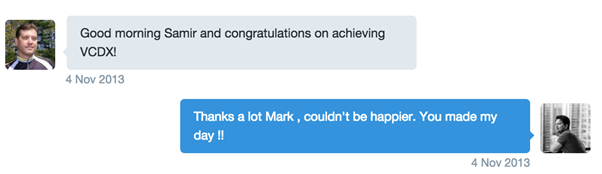
I was fortunate enough to pass in my first attempt and I am thankful to my family for that. Being the first VCDX in India was a special feeling for sure. I can’t forget the below message on 4th Nov 2013 by Mark Brunstad.

clip_image004

The first thing I did was to touch the feet of my Mother/Father for their blessings and thanked God (It’s an Indian thing you can say ;-)).

Life after the VCDX?  How did your company respond?  Was it worth it?

VCDX is worth every second, every minute every hour, every day that you spent on doing it. The VCDX process changed my perspective on many things, made me aware of my strengths and weaknesses. Made me a confident person, again it’s not the tag it’s the whole journey that’s matter.


Leave a comment

VCDX Spotlight: Magnus Edh

Name: Magnus Edh

Twitter Handle: @vTerahertz

Current Employer: VMware

VCDX #: 140

How did you get into using VMware?

I started working with VI3 back in 2008. We were looking for a new way of deploying servers for internal use but also for our customers as the number of physical servers was growing fast, but the rack space remained the same.

What made you decide to do the VCDX?

It was a personal challenge for me, to see if I had what it took to reach that kind of level. I also saw it also as a great learning experience as I knew that a lot of different areas needed to be covered in depth.

How long did it take you to complete the whole VCDX journey?

From start to finish it took around 10 months. And in parallel of doing the VCDX design I was also studying for both the VCAP-DCA and DCD exams, which in itself, was a challenging task. So in the end there was a lot for writing, a lot of reading, a lot of thinking, some sleeping, and a lot of preparation/mock defences for the main defence.

What advice would you give to people thinking of pursuing the VCDX accreditation?

Follow the blueprint, know all the “why” in your design, and say “Yes, I can!”

If you could do the whole VCDX journey again what would you do differently?

I would not do the VCAPs or the equivalent certifications at the same time when preparing a VCDX design that’s for sure.

Life after the VCDX?  How did your company respond?  Was it worth it?

A nice change after I got my number was that I didn’t need to set an early alarm clock on the weekends any more. And it was a very interesting feeling to know that I was the second VCDX in the Nordic. Was it worth it? Oh yes, it was absolutely worth it, every minute I spend doing it. You learn so much during the journey and quickly realize that it never stops.


Leave a comment

VCDX Spotlight – Alexander Thoma

Name: Alexander Thoma

Twitter Handle: @vcdx026

Current Employer: VMware

VCDX #: 26

How did you get into using VMware?

It was during my time @Novell, when we had to deal with a lot of complex customer scenarios in PSO. We were using Virtual PC from Connectix those days. When they were acquired by Microsoft®, Novell internally switched to VMware Workstation – that was 2003.

What made you decide to do the VCDX?

It was a logical step since it was a blueprint of what I was doing for my customers in PSO in those days. We were told to sit the beta version of the 2 required multiple choice tests with no notice during an offsite in southern France. Still remember Duncan sitting with me in the same room … and it was a real beta 😉

How long did it take you to complete the whole VCDX journey?

Originally I was planned to be in the first group of 10-15 people doing the defences, but due to my busy schedule I was not feeling comfortable to be able to prepare my design in 10 business days. So it took me about 3 months to prepare.

What advice would you give to people thinking of pursuing the VCDX accreditation?

The first and utmost important thing is to accept that this certification will require experience. It will be very hard to achieve with little or no experience in the field actually doing design work.

Secondly I strongly recommend taking your time to prepare, do not rush anything or spend all your spare time with the application. Better go for the next defence round then burning out on trying to meet unrealistic timelines.

If you could do the whole VCDX journey again what would you do differently?

I have been able to sit on more than 90 defence panels and the amount of knowledge that I have gained through this about different ways to design, think and communicate is endless. My new journey would be far better planned, organized and structured. And would take much more time.

Life after the VCDX?  How did your company respond?  Was it worth it?

I have not done a lot of things in my life that made such a difference for my career, but also for me as a person. In VMware PSO I was promoted to Consulting Architect (during that time it was a hard requirement to be VMware Certified Design Expert). In addition to that it has opened so many doors, enabled so many opportunities to influence the way the company would evolve that I can only strongly recommend anyone to pursue this certification.