TheSaffaGeek

My ramblings about all things technical


Leave a comment

VCDX Spotlight- Andrea Mauro

Name: Andrea Mauro

Twitter Handle: @Andrea_Mauro

Blog URL: http://vinfrastructure.it

Current Employer : Assyrus Srl (Italian company)

VCDX #: 35

How did you get into using VMware?

As most people I’ve started of course with VMware Workstation and honestly not with the ESX 1.0 (I remember that was not possible, at least in my Country) to have an evaluation or trial version.

My first virtualization project (for academic purposes) was building a virtual honeynet with Linux UML (it was the end of 2001). My first virtualization project based for a production system virtualization solution was instead with VMware ESX 2.5.

After that I’ve follow a lot of virtualization projects and I’ve started also to give some contribution to the VMTN Community (my nick is AndreTheGiant). This probably has open new perspectives, outside the limits of my Country and my native language (that isn’t English). For example, I’ve tried to applied with success to the VCDX3 path and also to vExpert 2010, 2011 and 2012.

What made you decide to do the VCDX?

The first time that I hear about VCDX was in the middle of 2008, and I filled the VCDX Qualification Review on August 21, 2008, just for curiosity and as a challenge.

I was thinking (wrong) that there were some intermediate certifications for each step (now there are the VCAP certification, but only for the VCDX4 path), and I was very interested to prove myself knowledge on the Admin exam.

I also was thinking that the VCDX certification was only of VMware gurus and only for big enterprise environments… But I’ve reconsidering that also in a medium project you may have several aspects and consideration that could be similar in a big project. You have only to design something that could scale.

How long did it take you to complete the whole VCDX journey?

I filled the VCDX Qualification Review on August 21, 2008. But the entire VCDX path was not available yet.

On September 8th 2008 I receive this mail with the blueprint of the Admin exam:

“Thank you for you interest in the VMware Certified Design Expert Program. We have received your pre-registration survey and are working to schedule more Enterprise Administration Exams. As soon as we have more dates and locations scheduled, we will send you the appropriate information.”

On February 12th 2009 I receive another e-mail with the great opportunity to take the Admin exam at VMworld Europe in Cannes. I schedule the exam at February 23rd 2009. On March 19 I receive the report with the result… PASS!!!

At this point was clear for me, that the intermediate steps are not useful… So I tried the full path and start studying for the Design exam. Unfortunately I lose the opportunity to take the beta exam of the Design exam… So I had to wait until the official exam was available. So I take the exam on October 23rd 2009, and I pass at the first attempt.

Then I scheduled the Defense step at the Partner Exchange 2010 at Feb 10th 2010.

So is more than one year… but with several dead-time due to the non-availability on the exams or the date (without them 3-6 months could be reasonable). A disadvantage to be in the early phase!

What advice would you give to people thinking of pursuing the VCDX accreditation?

VCDX is not a status… it is just a path where the journey is more important than the final result (and also if you fail it could be useful). And you have never finished… VCDX follows the vSphere products and you have to study and pass other exams to upgrade it.

It’s probably one of the hardest certifications, for the required time, for the type of steps (there are practical labs in the VCAP-DCA, questions and design in the VCAP-DCD, design project, presentation, discussions, … really a lot of capacities are tested in this certification), for the coverage of the arguments (not strictly only VMware related).

And it’s also a way to approach and think to your virtualization projects.

Maybe today you are not ready for this certification, but from VCDX4 there are intermediate certifications (the VCAP exams), so you can just start the journey and then reconsider your goals.

If you could do the whole VCDX journey again what would you do differently?

Good question! Probably the same.

But I have to admit that know is a “little” simpler (compared to the first years): lot of documentation, candidates experiences, hints, examples, workshops, … this could really help in the preparation. So you could be more focus on what you have to do, and not also on what you could expect.

Now there are also several other products that you can integrate in a VCDX design and discuss in the defense. Could be another interesting opportunity.

Life after the VCDX? How did your company respond? Was it worth it?

Basically my professional life has not changed at all, but this was my choice. After the certification I’ve received several interesting proposal, but I like my jobs and I’ve chosen (for this period) to remain in the “same boat”.

I work in a small company, but I’m the co-founder of this company so it is something that I feel is mine.

Leave a comment

VCDX Spotlight: Frank Denneman

Name: Frank Denneman

Twitter Handle: @frankdenneman

Blog URL: frankdenneman.com

Current Employer: VMware

VCDX #: 29

How did you get into using VMware?

During our VCDX sessions in Copenhagen we spoke about things in your life you would always remember. My reply was ; Seeing  Return of the Jedi in the cinema, the falling of the Berlin wall, 9/11 and witnessing vMotion in action for the first time.

I clearly remember my colleague screaming through the wall that separated our office. “Frank do you really want to see something cool?” As an MS exchange admin/architect responsible for a global spanning exchange infrastructure nothing really could impress me those days but  giving him the benefit of the doubt I walked over. Peter sitting there grinning like a madman, offered me a seat, because he thought it was better to sit down. He opened a dos prompt, triggered a continuous ping and showed the virtual infrastructure explaining the current location of the virtual machine. As he started to migrate the virtual machine he instructed me to keep tracking the continuous ping, after the one ping loss he explained the virtual machine was up and running on the other host and to prove me, he powered-down the ESX host. I just leaped out of my seat, said some words I cannot repeat online and was basically sold. I think we migrated the virtual machine all day long, inviting anyone who passed by our office to see the best show on earth. No explanation needed of course, but from that point I was hooked on virtualization and the rest is history.

What made you decide to do the VCDX?

The VCDX certification is the highest echelon of certification. That by itself fuelled my drive to get it. The way VCDX is structured by presenting to a panel and defending your decisions was very appealing to me, how crazy as it might sound. Being part of the first group of VCDX’es in the world outweighed the fact that I was going to be grilled by a panel containing Industry leading individuals.

How long did it take you to complete the whole VCDX journey?

It took me something like 6 months. I completed the VCDX enterprise and design exam in 2009 unfortunately I received the results of my VCDX design exam 2 days to late. That meant I couldn’t submit my session for the panels in Frankfurt in 2009 and defended my design 3 months later in Las Vegas in January 2010.

What advice would you give to people thinking of pursuing the VCDX accreditation?

The way I perceive VCDX is that it’s a validation of your skill-set as an architect. Through the years 2010 and 2011 I participated as a Panel member and seen many candidates. Usually the candidates that passed the exam were comfortable in having a dialog with the panel members. Being able to listen and respond to the question in such a way that the reply contained not only the answer but also explored the train of thought of the question itself. This usually is a product of having gone through multiple customer-facing projects as an architect. Helping the customer to understand how the product works and how certain features support with their business requirements or leverage or align with existing constraints. One often heard tip is to know your design. And this is really key! It doesn’t matter if your design you submitted is something you did 6 months ago, but you really need to know the details of the designs. The best advice I can give is know why you chosen for a specific setting but most of all understand why the other options of that particular setting did not align with your design. For example, understand why you selected port id load balancing on your vSwitch, but be ready to explain to the panel why IP-hash wasn’t a viable option for this particular design. Leaving out or disabling features to avoid discussing that technology does not work, for example if the requirements listed the customer was seeking for a high consolidation ratio \ high return of investment, then you better bring your A-game if your design list DRS as disabled. Another key is to know when you should leverage the whiteboard while explaining a certain configuration. Practice at home or at work drawing your diagrams such as storage layout or a vSwitch design, find a type of diagram that conveys the architecture and allows you to feel comfortable explaining it while drawing. I’ve seen many candidates trying to think about how to draw the architecture. This by itself should not decrease your score, but it cost a lot of time and believe me that is something you do not have when defending your design!

If you could do the whole VCDX journey again what would you do differently?

To be honest, no. I took a design I worked on for many years, I know my design choices inside out. The presentation deck I prepared had all the key diagrams in the main part and contained every possible diagram as a backup slides. I dressed the part, fully suited up just as I did with customers, giving me the correct frame of mind and just enjoyed the journey. One last piece of advice I can give. Enjoy it, enjoy being there in front of the panel. Before you know you are out the door again and if you prepared well you never have to do it again.

Life after the VCDX?  How did your company respond?  Was it worth it?

I’m currently not pursuing any level of certification as it is not a requirement of my current role. Earning VCDX opened many doors for me and I even prioritized it over finalizing my thesis for my bachelor’s degree. Though it’s not the primary basis of my the evolvement of my career it certainly contributed to it.


Leave a comment

VCDX Spotlight: Duncan Epping

Name: Duncan Epping

Twitter Handle: DuncanYB

Blog URL: http://www.yellow-bricks.com

Current Employer : VMware

VCDX #: 007


How did you get into using VMware?

I guess like many people… we were looking for a way to consolidate servers as we were growing out of our datacenter. Especially cooling was a huge problem for us so we needed to drastically lower the amount of iron in our datacenter. We explored several options but VMware was the only enterprise solution at that point. It proved to be the right decision, and that is also what was a huge change of direction in my career. Cause I changed from being a Windows admin to focusing purely on the virtual layer.


What made you decide to do the VCDX?

Well I worked for VMware already at that time. I was invited to take two early beta exams for VI3, which are now known as VCAP-DCA and DCD. Our group were literally the first group to take those exams. After about 6 months of waiting I finally found out that I passed those exams. When I was told I could do the VCDX Defense Panel I figured why not. Back then, and I was the first to actually take the exam (together with Richard Damoser who was in the room next to me), the process was slightly different though… You could say the early group did the beta defense.


How long did it take you to complete the whole VCDX journey?

From those beta exams to the defense itself probably 9 months in total. Funny thing is that in my case I heard 10 days before the defences were scheduled that I got a slot. Because I did not anticipated on it I didn’t have my docs ready. Although I heard it 10 days before, I only really had 4 days to complete the design as the panel of course needed to review and prep as well… on top of that I had a holiday with the family scheduled. So every night when my kids were in bed I was typing like a mad man. I guess I work best when under extreme pressure as the docs were accepted and the outcome of the defense was a pass 🙂


What advice would you give to people thinking of pursuing the VCDX accreditation?

Don’t just talk about it, DO IT! If you want to become a VCDX you better start prepping today. It takes a lot of time to produce a proper set of documents and those documents are the key to success. Before you go to the defense make sure you know your design. I know many will think “hey I do know my design”, but go over it with a colleague. Let him question you… You will notice that some decisions were made “just because it is a best practice”, well that is not the right answer I can tell you that. Know why it is a best practice, know why it met you customer’s requirements. Know your design inside out!


If you could do the whole VCDX journey again what would you do differently?

Not much to be honest. I used two existing designs and merged these. I made sure I had constraints, assumptions, risks etc. There were politics involved in those projects and I made sure I exactly knew what drove some of the crazy design decisions in there.

Life after the VCDX?  How did your company respond?  Was it worth it

When I took my defense we were at an “off-site” in San Francisco. The people who passed that week were all pulled up on stage during an “award dinner”. I can tell you that I felt really honoured receiving my VCDX plaque from the VP of Technical Service back then, Enis Konuk. Besides that, how cool is it to be up on stage with people like Mostafa Khalil, Kamau Wanguhu and John Arrasjid.

See pic in the below blog post, first 8 VCDX’s

http://www.yellow-bricks.com/2009/05/15/vcdx-award-dinner/


Leave a comment

VCDX Spotlight–Jason Boche

Name: Jason Boche

Twitter Handle: @jasonboche

Blog URL: http://boche.net/blog/

Current Employer : Dell Compellent

VCDX #: 34

How did you get into using VMware?

It was early in the year 2000 that my co-worker at the time, Paul Tisl (@PaulTisl), introduced me to VMware Workstation 2.x where we both worked for a large bank. I remember being paranoid at first that installing a Windows VM was going to hose the boot record of my physical workstation.

What made you decide to do the VCDX?

Sometime around 2008 I first started hearing rumours about an advanced VMware certification with a design focus. By this point I already had a few VCPs under my belt. Collectively I had built a handful of virtualized environments and I was spending a lot of time on the VMware forums covering as much as I could including expert level topics with knowledge I had picked up from others in the community including some key ones such as (in no particular order) Scott Herold, Mike Laverick, Ron Oglesby, Ken Cline, Steve Beaver, Thomas Bryant, Jason Mills, Joel Lockbaum, and Brian Gallob. I was already a proponent of technical certifications so combined with my VMware focus and enthusiasm, it seemed pretty clear that VCDX should be next on the list of goals. Admittedly, at the time with no program details, I didn’t realize how difficult it would actually be. I assumed it would just be a few more advanced exams at the local testing center. I was partially right.

How long did it take you to complete the whole VCDX journey?

That’s an interesting question and the answer really depends on what a person considers the starting point of the journey. If I focus only on the program questionnaire, the 3 written exams, the design submission, and the defense, then I’ll tell you it took a little less than a year. I went through the process fairly early so you have to factor in at the time the program moved somewhat slowly from step to step where candidates were invited to the next phase at some point after completing the previous phase and there were significant gaps of time between each phase before the next invitation would come from VMware. I began the written exams in July of 2009, submitted my design and defense application in December, and passed the defense in February 2010 at Partner Exchange in Las Vegas. However, I would argue “the journey” doesn’t start with written exams. Much of what’s tested on comes from experience in the datacenter and that doesn’t solely equate to VMware experience. The required skillset extends well beyond the boundaries of a hypervisor. Storage, networking, security, operations, documentation, presentation, design, troubleshooting, all of these skills are required at one point or another during the written exams and then finally are all tied together for the design submission and defense. To summarize, my certification track took roughly 9 months but the journey is measured in years.

What advice would you give to people thinking of pursuing the VCDX accreditation?

Understand that it takes commitment in terms of family/work/life balance so make sure the time is right for you and your family. The process takes time. There are no shortcuts. Take it slow and absorb what you pick up along the way because you’ll need to summon everything you’ve learned at the very end. Should the hard work pay off with a passing result, you’ll want to retain these skills anyway as you move forward with your career and give your best to each of your valued clients.

Also understand that VCDX certification is not meant for any stage of every person’s career path. There are many VCDX resources and accounts available for reading on blogs. Read through several of them to get a clear understanding of what’s required and then perform an honest assessment of yourself. Ask for an honest assessment from credible peers. Make sure you’re ready and you’re cut out for it. Merely having the financial backing to get through the process is not a substitute for the skillset required to achieve success and there is absolutely no shame in waiting. Rushing prematurely will more than likely yield frustration in the process.

If you could do the whole VCDX journey again what would you do differently?

Considering I was lucky enough to achieve a successful result on my first attempt, I’d be a fool to change anything. Ok, I would change one thing: I would have submitted a complete set of design documentation the first time around instead of forgetting one key document. Fortunately VMware allowed me a few extra days to come up with the missing document while still securing my defense slot.

Life after the VCDX?  How did your company respond?  Was it worth it?

When I went through the VCDX process, I was in a VMware customer role and had worked in a customer/end user roles in large enterprise environments for 13 years. I was not working as a consultant or architect for a partner or a vendor. Upon passing, I received a few personal congratulations but the VCDX goal was my own personal goal and not a goal established or valued greatly by my employer. I am grateful that my employer funded my expenses but if required I would have paid for them myself since I had the momentum and the desire. A year later, in order to put my skills to better use, I moved to a VMware partner. Was it worth it? Absolutely. No question about it.


Leave a comment

VCDX Spotlight–Nathan Raper

About two years ago I came up with the idea of the vExpert Spotlight to help people looking to get into IT,virtualisation and possibly gain the same kinds of roles a number of the vExperts are in. I’m pleased to say the idea gained loads of interest and is now being published three times a week on the VMTN blog. At present I’m looking to start my journey on becoming a VCDX5 and came up with the idea of using the same kind of format as the vExpert Spotlights but getting the current VCDX’s to answer a few questions so that VCDXWannabe’s like myself can find out more about each of them and why they decided to start the journey in becoming a VCDX. I asked a few of the VCDX’s I know who follow me on twitter if they would be willing to answer the questions and as is the case in the VMware community, everyone was more than happy to do it and liked the idea. So I would like to introduce the first in hopefully almost 100(the current number of VCDX’s worldwide) VCDX Spotlights and one from a good friend of mine who obtained his VCDX only a few months ago:

Name: Nathan Raper

Twitter Handle: @nateraper

Blog URL: nateraper.wordpress.com – I swear I’ll blog soon!

Current Employer: Catholic Health Initiatives

VCDX #: 85 – that’s “ochocinco” for the US folks 😉

How did you get into using VMware?

I worked for a small Citrix and Microsoft reseller in the late 1990s (Hensmann Technology in Castle Rock, CO for anyone who remembers them) that was focused on delivering solutions to small healthcare providers. The owner was a forward-thinker and saw VMware as a game changer. We started using ESX 1.5 internally and went to the 5-day certification class so that we could attain VCP certification and become an authorized reseller for VMware. I was hooked…

What made you decide to do the VCDX?

I love a challenge! VCDX was a motivation for me, a goal that would help me take my virtualization and datacenter skills deeper. I also saw it as career insurance – a way to differentiate myself in the job market.

How long did it take you to complete the whole VCDX journey?

I think it was some time in mid-2010 that I started exploring the idea of pursuing VCDX. In late 2010 I made up my mind and I started studying in earnest for the DCA exam and took that in early 2011. That’s probably the most difficult exam I’ve ever taken (although VCP2 was no walk in the park either). DCD came later that summer. I stalled a bit at that point because I knew that there was a lot of work that needed to go in to my design and there was uncertainty from VMware whether or not they would hold another VCDX 4 defense. I also had taken a lot of time off from pursuing my Master’s degree and needed to take some classes toward that. When VMware announced that Toronto would be the final shot at VCDX 4, I got busy! So I guess around 18 months, but I certainly didn’t hurry.

What advice would you give to people thinking of pursuing the VCDX accreditation?

Do it! I learned a tremendous amount through the process and took myself beyond limits that I thought that I had. Don’t look at the VCDX as a purely technical certification – it’s not. VCDX requires both technical and business skills, so seek peer review of both your submission and your presentation skills. Plan to do several mock defenses with both technical gurus and business leaders – the business leaders may ask more difficult questions and ones that you wouldn’t otherwise prepare for! Study the blueprint, VMware publishes it for a reason. And get support from your family and friends – find a cheerleader to keep you motivated when it’s late at night and you want to give up. VCDX is a long journey and I could not have achieved this without the support of my wife!

If you could do the whole VCDX journey again what would you do differently?

I would definitely work more on my soft skills and mentally preparing myself. I’m in a position right now that doesn’t require me to be in front of people very often, so my presentation skills had dried up a bit from my consulting days. Above all I would learn to control my nerves better and calm down – I was a nervous wreck during my defense!

Life after the VCDX? How did your company respond? Was it worth it?

Well it’s only been a couple of weeks since the results went out…not a lot of time for change, but it has certainly opened up some exciting doors for me. Several folks at my company congratulated me and my boss took me to dinner but I don’t think that many understand the significance of the certification. My reps and contacts at EMC and VMware were all excited and happy for me. Was it worth it? Absolutely!


3 Comments

Auto Deploy TFTP file won’t download

I’m currently doing a POC of vSphere 5’s Auto Deploy in an attempt to streamline/perfect my knowledge of all the PowerCLI commands and steps in preparation for a client delivery. I’ve built a whole test environment on my laptop in VMware Workstation following pretty much all the steps detailed in these three postings:

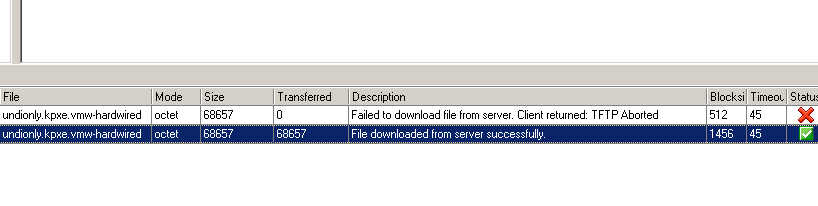
After setting everything up and adding my image profile to the deploy rule, I kept getting an error whenever my ESXi hosts tried to get the “undionly.kpxe.vmw-hardwired” file from my TFTP server as shown in the screenshot below

image

After trying everything from rebuilding Auto Deploy to re-creating the whole AD and the TFTP server I decided to try change my networking from Host Only to another setting in the hope this would do something and for reasons i’m actually unsure of at the moment it worked Open-mouthed smile .

Changing the setting from Host Only to a Custom VMnet2 on all my VM’s hosting my vCenter Server come Auto Deploy Server come TFTP server and all my ESXi hosts allowed the communication to let the ESXi servers get the “undionly.kpxe.vmw-hardwired” file and thereby allow all my stateless hosts to now boot perfectly. Now to finish off all my Auto Deploy Testing Smile

Gregg


Leave a comment

VCAP5-DCA: Objective 6

Objective 6 is what I believe is the core basis of the DCA exam as being able to effectively troubleshoot anything in your environment means you know all the varying methods to do things and how things are tied together and that is real administration. For this section I’ve been doing loads and loads of lab time from just building my lab and coming across certain problems or failures along the way which I’ve been trying to fix via the vMA, the command line and even the DCUI and purposely breaking things/causing problems just so I can practice fixing them . I think the best way of really learning these skills is putting in a solid amount of time in your lab as I believe the reason I failed my VCAP4-DCA the first time was down to not enough lab hours. When you’re under the time and nerve constraints that are part of the VCAP-DCA you make mistakes you wouldn’t normally do. I have also re-watched the Trainsignal VMware vSphere Troubleshooting Training videos as David does a brilliant job covering it all.

There aren’t many differences between the VCAP4-DCA Objective 6 and the VCAP5-DCA Objective six but the differences between the two (thanks to Ed Grigson’s breakdown) are:

  • Use esxcli system syslog to configure centralized logging on ESXi hosts

This is different as with the vMA 5 the syslog feature has been deprecated due to the new VMware Syslog Collector now being available. The steps to do it now via esxcli are covered perfectly on pg10&11 in this VMware PDF. http://pubs.vmware.com/vsphere-50/topic/com.vmware.ICbase/PDF/vsphere-esxi-vcenter-server-50-command-line-management-for-service-console-users.pdf

  • Install and configure VMware Syslog Collector and ESXi Dump Collector

This is really simple and is something you can learn to do very quickly in your lab. I tested this part during the building of my Auto Deploy testing. All the steps for the syslog collector are detailed here: http://blogs.vmware.com/esxi/2011/07/setting-up-the-esxi-syslog-collector.html and the steps for the dump collector are here: http://blogs.vmware.com/esxi/2011/07/setting-up-the-esxi-50-dump-collector.html

  • Configure and administer Port Mirroring

A new distributed vSwitch feature. Eric Sloof has done a brilliant video detailing how to do it here: http://www.ntpro.nl/blog/archives/1825-Video-How-to-setup-a-vSphere-5-Port-Mirror.html . Pretty simple to set up

  • Utilize Direct Console User Interface (DCUI) and ESXi Shell to troubleshoot, configure, and monitor ESXi networking

This is pretty straight forward I think as you need to know what kinds of things related to networking connectivity you can do via the DCUI (like restoring a standard switch) and how you can use the ESXi shell to change configurations/fix problems. I think this is all about lab playing and learning

  • Use esxcli to troubleshoot multipathing and PSA-related issues

The main difference here is now it is just esxcli so it’s all about being able to do things via esxcli. This part in particular was covered in objective 1.3

  • Use esxcli to troubleshoot VMkernel storage module configurations

Yet again this is down to your knowledge of how to troubleshoot the storage modules via esxcli. How to do this via esxcli is covered in the VMware documentation library here: http://pubs.vmware.com/vsphere-50/index.jsp?topic=/com.vmware.vcli.getstart.doc_50/cli_about.html

  • Use esxcli to troubleshoot iSCSI related issues

Another one where you will need to practice and learn how to do it via esxcli. All the commands and some great examples are all listed in the VMware documentation library here: http://pubs.vmware.com/vsphere-50/topic/com.vmware.vcli.examples.doc_50/cli_manage_iscsi_storage.7.5.html

  • Utilize Direct Console User Interface (DCUI) and ESXi Shell to troubleshoot, configure, and monitor an environment

This is down to playing around in your lab with it and knowing what kinds of troubleshooting you can do via the DCUI and the ESXi shell. This is VCP5 stuff so you should know this already

I’ve spent 70% of my lab time on this section as while building and trying out things in my lab I end up breaking things or things don’t work the first time and so I’ve been able to just mess around with all the tools and get it working again. As i said at the beginning, i think spending a large amount of time learning and trying out everything in this section is extremely important for the DCA exam.

Gregg


Leave a comment

VCAP5-DCA: Objective 5.2

Deploy and Manage Complex Update Manager Environments

This is another quick one and for most of it, I just did the Update Manager PowerCLI part as the rest is almost exactly the same as the VCAP4 objective. I think this is all about playing around in your lab again, breaking things, upgrading hosts, patching hosts and using the PowerCLI commands.

Knowledge

  • Identify firewall access rules for Update Manager

Skills and Abilities

  • Install and configure Update Manager Download Service
  • Configure a shared repository
  • Configure smart rebooting
  • Manually download updates to a repository
  • Perform orchestrated vSphere upgrades
  • Create and modify baseline groups
  • Troubleshoot Update Manager problem areas and issues
  • Generate database reports using MS Excel or MS SQL
  • Upgrade vApps using Update Manager
  • Utilize Update Manager PowerCLI to export baselines for testing <- Covered perfectly here: http://pubs.vmware.com/vsphere-50/topic/com.vmware.ICbase/PDF/vsphere-update-manager-powercli-50-inst-admg.pdf
  • Utilize the Update Manager Utility to reconfigure VUM settings

Now on to my favourite objective and the one I think is the number one thing the DCA is based on, Troubleshooting.

Gregg


Leave a comment

VCAP5-DCA: Objective 5.1

Objective 5.1 – Implement and Maintain Host Profiles

*NOTE: If this is the first time you have hit these objectives, I am only covering the new things in vSphere 5 and the VCAP5-DCA blueprint over and above what was already covered so well by Sean Cookston’s,Ed Grigson’s and Kendrick Coleman’s Blueprint Breaksdowns for the VCAP4.


Host profiles are extremely important in vSphere 5 environments and are a requirement for Auto Deploy. This is another objective I think you need to practice in your lab and do all the things listed below. If you don’t know about Host Profiles in vSphere 5 (which you should from your VCP5 studies) then there is a really good KB pdf by VMware that covers it all here. The guys from the vBrownbags have covered the whole of Objective 5 very recently here and Damian gives a great overview of it and some top tips.

Skills and Abilities

Loads of lab practice necessary for this objective which burnt a fair amount of my time. A fair amount of it is the same but due to it now being linked to Auto Deploy I wanted to really get my head around it all and how the answer files tie in.

Gregg


Leave a comment

VCAP5-DCA: Objective 4.2

Deploy and Test VMware FT


This is exactly the same as the VCAP4 Objective so this is all about reviewing and practice in the lab. I watched the Super High Availability with VMware Fault Tolerance (FT) topic in the the Trainsignal VMware vSphere 5 Training course, went through the stuff Ed listed .I have also watched the FT lesson from the Trainsignal VMware vSphere Pro Series Training Vol 2 as my refresher and enabled it, broke it and played around with it in my lab A very simple one once you have played around with it

Knowledge

  • Identify VMware FT hardware requirements
  • Identify VMware FT compatibility requirements

Skills and Abilities

  • Modify VM and ESXi host settings to allow for FT compatibility
  • Use VMware best practices to prepare a vSphere environment for FT
  • Configure FT logging
  • Prepare the infrastructure for FT compliance
  • Test FT failover, secondary restart, and application fault tolerance in a FT Virtual Machine

A very quick and easy one and seeing as Section 4.3 – Configure a vSphere environment to support MSCS Clustering and Section 4.4 – Deploy and maintain vCenter Heartbeat aren’t part of the VCAP5 blueprint so it means that’s Objective 4 completed Smile

Gregg